Sunday, 7 April 2013

The prizes are down the road

The patch had some competition today. Yesterday I had managed to become separated from my mobile phone, and then forgot to check it. Had I done so I would have learned that Mike had found a Black-tailed Godwit at Haselor scrape, ten minutes down the road from the patch.

This morning I discovered his message, but felt inspired to get to Morton Bagot in the hope that there was also something there. Dave joined me, but after about an hour we had found nothing better than three Green Sandpipers, two Chiffchaffs (one of which was singing), 23 Teal, a record count of 12 Coot, four Tufted Ducks, 23 Teal, two Little Ringed Plovers, and a Little Owl.

Little Owl
Oh and a first for Morton Bagot. Unfortunately just an escaped Snow Goose which flew in with some Greylags. There had been a white Greylag earlier this year so I initially ignored Dave's mutterings about an apparent Snow Goose which was flying in. I have never counted Midland Snow Geese as anything other than escapes, and this one won't be getting on my list either.

At this point my phone rang. It was Mike to say that the Black-tailed Godwit was still at Haselor. He then announced that Matt W had found a Water Pipit there last night and he was hoping to relocate it. We basically put on a bit of a spurt at this point with the vague intention of returning later.

We joined Mike at the scrape and ticked the Black-tailed Godwit. After about 30 minutes I spotted a Pipit crawling around a spit some distance from the road. The three of us then made a complete meal of trying to decide what we were looking at. We even rang Matt to ask him whether his bird had been in summer plumage. It had been, and so was clearly not the bird we were scoping. In the end the bird flew, possibly to a part of the scrape we couldn't see, and without calling. We hung around and eventually left with opinions divided.

The problems were distance from the bird, a surfeit of hope, and the fact that the bird was rather grey headed for a Meadow Pipit. The breast was streaked on a rather buffish background and contrasted with whitish, but streaked flanks. It had a hint of a pale super, but not enough of one.

Since getting home I have trawled through Internet images of both species and believe I have found an image of a Meadow Pipit, taken in March, which is a pretty close match. It is surprising how much Meadow Pipits vary between seasons and ages. All this deliberation took too big a chunk out of the morning and so the patch was left without being revisited.

On a brighter note I understand my camera has been fixed and it should be back with me this week.

Thursday, 4 April 2013

Snipe-fest

I have to admit that I have been using the continuing cold weather as an excuse to avoid a resumption of evening visits now that the clocks have gone forward.

In my absence, Matt W has been making hay, or rather counting Snipe. Loads of them. I got a text from him this afternoon saying that he, accompanied by the farmer, counted 126 Common Snipe on the main scrape today.

Now I am guessing he meant what I call the flashes and that the farmer was Steve Green who owns the land which the rest of us are not allowed to walk on. From the fence line you can often see bits of Snipe emerging and disappearing, and I often wonder how many there actually are. This count, whether it was made on the main pool or the flashes is a terrific effort and to put it into a regional context, it beats any count of Snipe reported in the West Midlands in 2010, the latest WMBC Bird Report to have been produced.

I suspect that by leaving the land largely undisturbed, we have all contributed to the success of the species here this winter , and I consider it a small price to pay for a more productive wildlife habitat.

Sunday, 31 March 2013

Sunday March 31

I met Dave at Netherstead Farm on another cold and frosty morning. The wind was quite light, but still from the east and bitterly cold. As Dave's summer migrant count was still on zero, an objective was set to at least get him off the mark.

This was achieved as we approached the main pool. A male Wheatear was perched on the top of a dead tree usually frequented by one of the local Kestrels. Soon afterwards we added a Chiffchaff which appeared in the scrubby western border of the pool field. The pool itself was frozen solid so the Tufted Duck had gone. The three Mute Swans were still present along with Canada and Greylag Geese, some Teal and about 40 Mallard. At the flashes we counted 27 Teal, 20 Common Snipe, a Green Sandpiper, and the pair of Little Ringed Plovers which had abandoned the frozen mud and were searching the pasture for food.

Little Ringed Plover
Behind us, the set aside field contained at least 50 Meadow Pipits, 30 Linnets, and about 10 Skylarks. We approached the shed silently, but there was no sign of the Barn Owl today.

Finally, we decided to check out the south end. At least 10 Buzzards circled, and a flock of eight Golden Plovers hurried south. We also saw a couple of Sparrowhawks thermalling, but on the whole it was pretty quiet. The last bird of the visit was a calling Chiffchaff near our cars, but a quick search for it was unsuccessful.

Friday, 29 March 2013

More migrants struggle in

Another cold week, but at least it wasn't snowing. It was actually a sunny morning when I set out to Morton Bagot and only slowly clouded over thereafter. I started at Netherstead Farm, and as was the case last weekend, soon started finding Meadow Pipits crawling around, this time in the rough pasture around the dragonfly ponds where about a dozen showed really well. I also noticed quite a few Black-headed Gulls flying north. Their destination was, rather unexpectedly, the main pool. I eventually counted 80 there and on a recently ploughed part of the field on the far side of the Shrike hedge. This hedge also contained my first Chiffchaff this year, which called briefly before disappearing. The pool itself was still playing host to a pair of Tufted Ducks and three Mute Swans as well as the usual Mallard and Coot.

At the Flashes I scanned through 52 Teal, 30 Lapwings, and a few Greylags before confirming that the two Little Ringed Plovers were still present, this time on the furthest flash. To their left, up popped a stunning male Wheatear. I felt I needed to mark the event with some sketches, and a cleaned up version of one of the originals is presented below.

The male Wheatear
The restricted area of orangey-yellow on the upper breast is an indication that this bird plans to go no further than northern Britain to breed and is quite different to the Greenland types I was blogging about last April. Unfortunately, the act of sketching made me miss the cause of a massive panic which emptied the flashes of almost everything and presented me with the spectacle of 700 Starlings swirling up from the pastures beyond. All the birds eventually returned except for the Wheatear, which I hope simply moved to another field.

Heading onwards, the back edge of the set-aside field contained about 50 finches and buntings, mainly Goldfinches and Linnets, with at least six Yellowhammers. Then I discovered that the shed contained a sleeping Barn Owl, which woke up and flew out shortly after I spotted it. It could have made a great photograph, but my camera is still away being mended. Barn Owls seem to be following me around this year!

Tuesday, 26 March 2013

Tuesday 26 March

I won't be able to get to the patch until the easter holiday begins, but I have still managed a good bird on my way home.

As I was stuck in traffic on the Alvechurch Highway just north of Bordesley at 5.30 pm a Barn Owl flew across the road in an easterly direction. This daylight record just goes to show that good birds can turn up anywhere.

Sunday, 24 March 2013

Migrants in the snow

It doesn't seem to have stopped snowing since Friday night and the potential for hazardous driving conditions was too much for Dave, so I was birding alone today. I parked at Oldberrow church as I wasn't sure how bad the small roads would be. Not too bad as it turned out.

I reached the gate overlooking the big pasture field just past Church Farm. The bedraggled sheep and lambs were baaing at me imploringly, and their hooves had churned up quite a muddy corner. Around them crawled lots of small birds taking advantage of the only part of the field which was snow-free and sheltered from the persistent north-easterly. I counted 30 Meadow Pipits, 40 Redwings, and smaller numbers of Fieldfares, Starlings, Robins, Blackbirds, and Song Thrushes, plus a solitary Skylark. The Meadow Pipits were particularly encouraging as I had only managed a single sighting throughout January and February. Clearly they were migrants.

The snow in the fields was about two inches deep, but I soon reached the main pool where, at long last, I claimed a year tick in the form of a pair of Tufted Ducks. Not too unexpected but they broke the log jam. Also on the pool were a pair of Gadwalls, several Teal, eight Coots, three Mute Swans including an immature, and plenty of Mallards, Canada Geese and Greylags. A dozen Common Snipe took off as I walked past. On Monday Mike Inskip had reported 60, presumably from the marsh, but I chose to leave them in peace today.

The Flashes contained another Gadwall and 54 Teal plus four Lapwings, six Snipe, six Meadow Pipits, and a pair of Little Ringed Plovers. These summer visitors were feeding in the marshy bit which the snow couldn't touch. Another year-tick, and although I generally find them in March, I wasn't at all optimistic today. Then, scanning the far flash I found more waders, two Green Sandpipers and a Dunlin. This winter plumaged individual was the bird of the day as I record the species annually but infrequently here.

Dunlin
I am still waiting for any other species of calidrid to get onto the Morton Bagot list, but the Dunlin was a very welcome find. I continued to Netherstead, but saw nothing better than three Herring Gulls going north, and a Goldcrest in the hedge by the road.

The walk back to the car into driving snow and the bitingly cold north-easterly wind was pretty tough.

Sunday, 17 March 2013

The drought continues

The title of this blog may be a bit misleading. The drought refers to the fact that I haven't managed a year-tick since Feb 24 and all our efforts today failed to produce even a single measly Chiffchaff. The water levels on the site are currently very high, and even the island in the main pool is close to being covered.

Dave and I gave it our best shot, and were rewarded with some quality at the flashes. A record count of Gadwall, two drakes and a duck, greeted us on arrival. This time I had my camera with me to record the event for posterity.


One of the drakes and the duck Gadwall
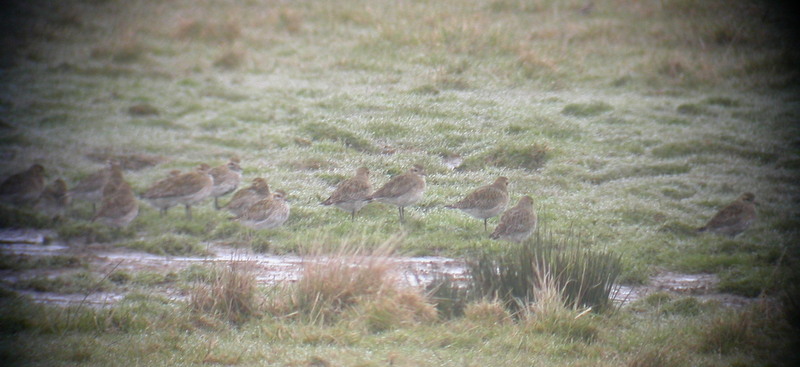
 I had barely had time to congratulate myself for this find, when Dave told me he was looking at a flock of Golden Plovers in the marshy bit between the two flashes. These were well worth seeing as nearly all the previous records had been extremely distant flyovers, and we had never recorded the species on the flash before.


The Golden Plovers
 Dave thought he had counted 17, but after repeated counting with the scope we could get no more than 16 birds, some of which were starting to moult into summer plumage.

A substantial flock of Gulls flew in, 60 Black-headed, four Lesser Black-backed, and two Common Gulls. They joined two Green Sandpipers on the furthest flash. A sudden disturbance resulted in the Gulls going, but the Teal numbers swelled to 62, while four Common Snipe remained visible.

It was at this point that disaster struck. My camera, which had been on the blink since I dropped it a fortnight ago, finally gave up the ghost. If I can't get it repaired somewhere this blog will start to feature field sketches and line drawings for the foreseeable.

Back at the south end we found a mixed flock of 200 Starlings, 100 Fieldfares and 20 Redwings. We also came across up to 20 Reed Buntings and a few Yellowhammers feeding in the stubble on the ridge field.

We spent 30 minutes trying to refind the Tree Sparrow I saw last month, but came up with nothing better than a pair of Marsh Tits. I just hope a pair of the former will find somewhere to breed in the area so that the species doesn't follow Curlew and Grey Partridge onto the formerly bred list.

PS We had been wondering where last month's Shelduck had gone. Lyn and I found the answer as the pair were swimming around on Haselor scrape this afternoon.