Monday, 18 August 2014

Monday August 18

Having been birding for almost my entire life, I do not expect to go to my local patch and come across a bird I cannot identify, but that's what happened this morning. It was actually a bird call, and those generally require some sort of previous experience, preferably recently.

This is what happened. I had nipped down to the flash to check it out, and found it was much as yesterday, 21 Teal, 11 Green Sandpipers, and two Snipe. So far, so boring. After a short trip down the hedgeline I was returning to the only bit where the trees thin out sufficiently to allow a view when I became vaguely aware of a disyllabic rather flutey call which was a bit like the begging call of a young Buzzard. Lazily I decided that must be what it was, and the noise seemed to fade away. Ten minutes later I heard it again, and I convinced myself this time it could be some kind of wader.

The calls got louder and louder, and I scanned the sky anxiously through my binoculars and by naked eye, but I just couldn't see anything. Its very difficult to describe calls. I wrote it down as " a liquid "kil - lee" with a slight upward inflection on the second syllable. It was vaguely like an Oystercatcher I suppose, but it wasn't that. Whatever it was flew quite rapidly south-west, and I could still hear it calling faintly in the distance for some time. I tried to drag some clue from my memory banks, but nothing came to mind. Perhaps it wasn't a wader, I can recall hearing an escaped Cockatiel once, and thinking that sounded wader-like. Maybe it was just a Parrot!

I hung around hoping for a second coming, but it was not to be. Instead I witnessed the surprising sight of a flock of 22 juvenile Lesser Black-backed Gulls heading west, and also two Sand Martins going south.

Back at the car I realised I hadn't photographed anything, and decided that a Collared Dove on wires above me would have to do.

Birding can be a frustrating business, but its kind of nice to be reminded that even after 50 years of birding, there is still plenty to learn.

Token bird !

Sunday, 17 August 2014

Sunday August 17

I arrived at Netherstead at about the same time as a weak weather front. So the first hour was spent sheltering from showers and a brisk westerly breeze. I spent the time beneath the copse opposite the entrance to Netherstead Hall, watching 60 or so hirundines, mostly House Martins catching insects on the sheltered side of the copse.

A few Tits were also feeding at the edge of the copse, and while looking at them I spotted a Spotted Flycatcher, the first this year.

92. Spotted Flycatcher
It seemed to be an adult, and was reasonably easy to photograph. Always a relief to get this species on the patch list each year.

I then went on my usual circuit. The weather improved, and eventually the sun came out. It remained annoyingly windy though. The hedge at the Netherstead end gave me a Lesser Whitethroat, and another hedge, this time at the far end of the pool produced a briefish view of an adult male Redstart. I can't help wondering if this is the same bird as the one in the same area in early July.

I reached the flash and was disappointed to find that there was no sign of the Ruff, nor any Snipe. The latter were probably just hiding in the grass somewhere, but it looks like the Ruff has gone. There were still at least 11 Green Sandpipers, 13 Teal, and 80 Lapwings present. Then a Kingfisher flew past, heading down the hedgeline. I relocated it by the pool, but just failed to get a shot. A family party of four Kestrels sailed overhead, and caused panic amongst the members of the Long-tailed Tit/Chiffchaff flock. It also contained a single Goldcrest.

The strong wind and lure of the test match had me abandoning the visit just before mid-day.

Wednesday, 13 August 2014

A decent wader at last

It's been a long wait. Since the Avocets in early April, the patch has failed to produce a single half-decent wader, until tonight.

Since Sunday's storm the weather has been a mixture of sunshine and heavy showers, and I certainly noticed that the water-level on the main pool had risen since Sunday. At the flashes the level seemed much the same, but almost the first bird I looked at was something different. A juvenile Ruff.

91. Ruff (with Snipe and Lapwing)
I struggled in relatively poor light to get any decent images, and these are the best of the bunch.


The interesting question to me is why tonight? It may just be luck (and to be fair it may not have arrived today), but I like to look for explanations. Perhaps the very bright moon has illuminated the water for a night flying migrant, perhaps it was the heavy showers, perhaps it came in with other birds. There were 87 Lapwings (a small increase), 10 Snipe (a large increase), 15 Teal, and 12 Green Sandpipers tonight. All of the latter were on the furthest flash, but fortunately the Ruff wasn't.

I wandered back feeling pretty pleased. A Sedge Warbler was present in the hedge bordering the pool, where there are now six adult and full-grown juvenile Tufted Ducks in addition to the six half grown ducklings. Back at Netherstead the hirundines were getting excited, and after a while a Hobby drifted through. Finally, the roosting corvids got themselves noticed as about 240 Jackdaws and a few Rooks launched themselves into the sky.

Sunday, 10 August 2014

Sunday August 10

I had intended to sit at home today. It chucked it down all morning, and we had our friend Mal coming for the afternoon. By 3.00pm  the rain had gone and had been replaced by a gale force westerly. Surely all this weather must have dropped something down, I thought.

I cracked, and blew oodles of brownie points promising I would be back in an hour. Another triumph of optimism over experience, the latter has taught me that the wild weather, which does indeed produce birds at Midland reservoirs, fails to have any effect at Morton Bagot. Perhaps its just too small.

Within minutes of arriving I found that once again the patch was untouched. The Green Sandpipers, Snipe, and Teal were all still present, and no other waders had joined them. I did get one slice of luck though. A rapidly moving bird caught my attention above the flash, not a wader, but a Hobby. It was far too quick for a photo though.

The main pool was also unaffected by the conditions, and I was left to wonder what would be worth photographing. The answer came when I remembered that yesterday I had noticed that there were actually two, not one, Little Grebe chicks. They were still present and a lot less wary than their pesky parents.


I suspect I will continue to visit the place after storms pass through. Perhaps one day my optimism may be vindicated.

Saturday, 9 August 2014

Saturday August 9

With ex-hurricane Bertha on the way it seemed sensible to switch my birding day to this morning. Sunny and only a light westerly breeze. Unlike last weekend, plenty of Warblers were zipping through the bushes. Seeing them properly was a bit of a problem though. While I was chasing after the first of several possible Lesser Whitethroats I came upon a more significant species in terms of the Morton Bagot year. A Willow Warbler.

When I first started birding in the Midlands 30 + years ago, this species was everywhere and easy to see. Over the years they have definitely got scarcer and whilst I would admit that Morton Bagot doesn't contain classic Willow Warbler habitat, I suspect it used to be commoner here too. This year has been particularly bad. I recorded just a single bird singing on one April date in spring, and didn't even see it. So today's migrant was the second of the year, and the first I have actually seen.

All this explains why I considered it to be sufficiently scarce to require a photo for the year list...no matter how bad it was.

90. Willow Warbler
 All I can say in my defence is that it looked better in the scope. I managed two shots, and unfortunately it was preening when my finger hit the shutter for the better of the two. (Its head was behind a leaf for the first). Check out the primary projection, about the only ID feature showing.

The rest of the walk round produced just the usual stuff. At least five young Whitethroats showed well, with a family party of Yellowhammers in the same bushes.

Whitethroat
The Flashes contained 13 Green Sandpipers, two Snipe, 11 Teal, 70 Lapwings and over 100 Greylag Geese. There was no sign of the Shoveler though.

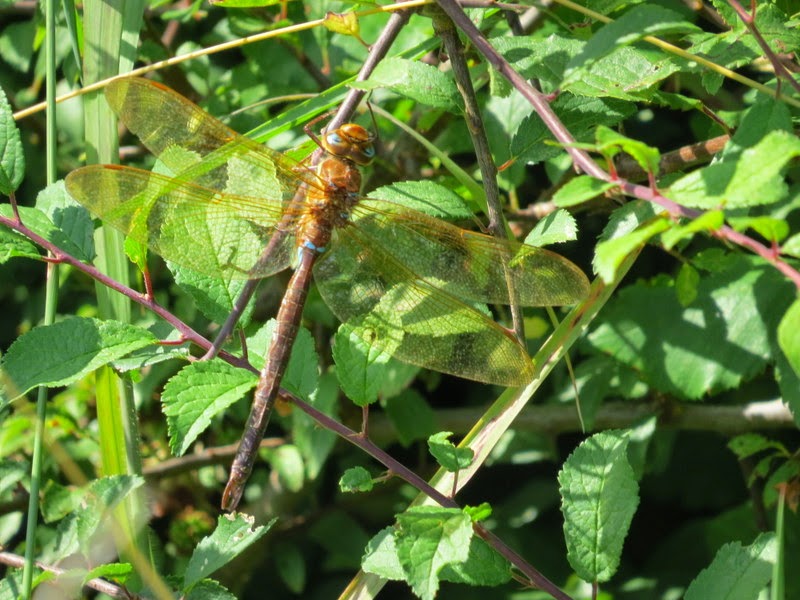
On the way back I finally got a shot of one of several Brown Hawkers. They seem to be having a good year.


The only other things worth mentioning are that there were a few Black-headed Gulls heading south, about 10 in all, and a second female Tufted Duck now has a brood (of one duckling) this time on the pool west of the flash.

Wednesday, 6 August 2014

Wednesday August 6

This evening was still and sunny at first. Gradually this gave way to almost complete cloud cover. Birding a small patch is all about dreaming of the big one, impossible dreams, and the occasional little victory.

This evening's bonus bird came as I was gazing at the flotilla of newly released Mallard on the main pool wondering if they would ever pull in something different. Scarcely had this thought floated away when something new did indeed drop in. A Shoveler, the first since March, and only the second in the last two years.

Shoveler
The remainder of the pool was filled with the usual stuff, although I did notice that the single female Tufted Duck with its brood of six had been joined by two more females.

At the Flashes I immediately regretted not packing my scope. At least 12 Green Sandpipers were split between the two flashes, and four Common Snipe were newly arrived on the nearest. Six Teal there were forced to swim nervously into the water as a Fox skirted the back of the pool.

Passerines this evening consisted of a Whitethroat, two Chiffchaffs, two Reed Warblers (one of which was singing despite a beak full of insects), 50 Goldfinches, 40 Swallows, 20 House Martins, and two Swifts.

The forecast for the weekend is for a return to wind and rain. I hope they have got it wrong.

Sunday, 3 August 2014

Sunday August 3

Sunny, breezy, fluffy clouds. Oh dear, a fluffy cloud day. Over the years I have nurtured a growing dislike of this type of weather. Blue sky and fluffy cumulus clouds scudding across from the south-west = no birds.

This is doubtless a drastic over simplification, but today was pretty typical. The breeze strengthened to the point where it was difficult to see passerines. The ones which did pop out were almost exclusively Chiffchaffs.

Chiffchaff
I reached the flash where I was pleased to count 13 Green Sandpipers and the Common Sandpiper plus  110 Greylag Geese and the juvenile Shelduck. Perhaps it wouldn't be such a bad morning after all. For a change I decided to enter Stapenhill Wood. This tiny wood has been left to its own devices for many years and consists of many rotting stumps, tall Ash trees, and a jungle of hawthorn and blackthorn. I was soon fighting my way through shoulder high nettles and brambles remembering why I so rarely go into it. The rotting wood is no doubt great for beetles etc, and also for fungi.


Unfortunately, despite buying a book on the subject, I remain entirely ignorant on the subject. This is some kind of bracket fungus.

Returning to my car I decided to try the flash again. En route I spotted the Little Grebe on the pool, and also proof that the pair had bred successfully.

Little Grebe chick
At the flash the cows had decided to visit the near flash en masse, and this had one beneficial effect. The Green Sandpipers were no longer spread out, but were (apart from one party pooper) all lined up for a group photo.

12 Green Sandpipers
All dots of course, but the cows were not content to leave it at that. They edged forward and flushed most of the waders to the near edge where I could get a better photograph to give you some idea of what a Green Sandpiper actually looks like.

A Green Sandpiper
This is about as close as I can get unless the waterlevel starts to drop on the main pool. That was about it. I recorded a single Swift and three Teal, two Whitethroats, and three Reed Warblers. The autumn migration will have to wait for another weekend.