Sunday, 7 April 2019

Sunday April 7

Mostly cloudy with a very light easterly. Chilly.

I had a good tramp around this morning, the emphasis remaining on birds because of the lack of sunshine and warmth. I didn't see a single butterfly.

However, spring did manage a bit of a look in. The usual Chiffchaffs and Blackcaps sang, and on reaching the end of the access road I was scanning towards Clowse Wood when my first two Swallows of the year flew through my field of view. there was no chance of a photograph as they hurried north.

A little later I noticed that the tree adopted by the local Cormorants supported six birds, a total of seven later flew off.

Cormorants
There was no sign of the Dunlin, or anything else, on the former pool. But the flash field was reasonable. It contained 31 Teal, 12 Coots, three Black-headed Gulls, four Lesser Black-backed Gulls, 12 Lapwings, a Green Sandpiper, three Snipe, a Redshank, and three Little Ringed Plovers.

When I reached the raptor viewpoint my scanning revealed four small hirundines distantly jinking around above the flash field. I concluded that they were Sand Martins. They soon disappeared so I guess they were, like the Swallows, heading north, but with less of a sense of urgency.

A big circuit around the south end was pretty disappointing, the only thing worth noting being a flock in 110 Linnets in the usual place.

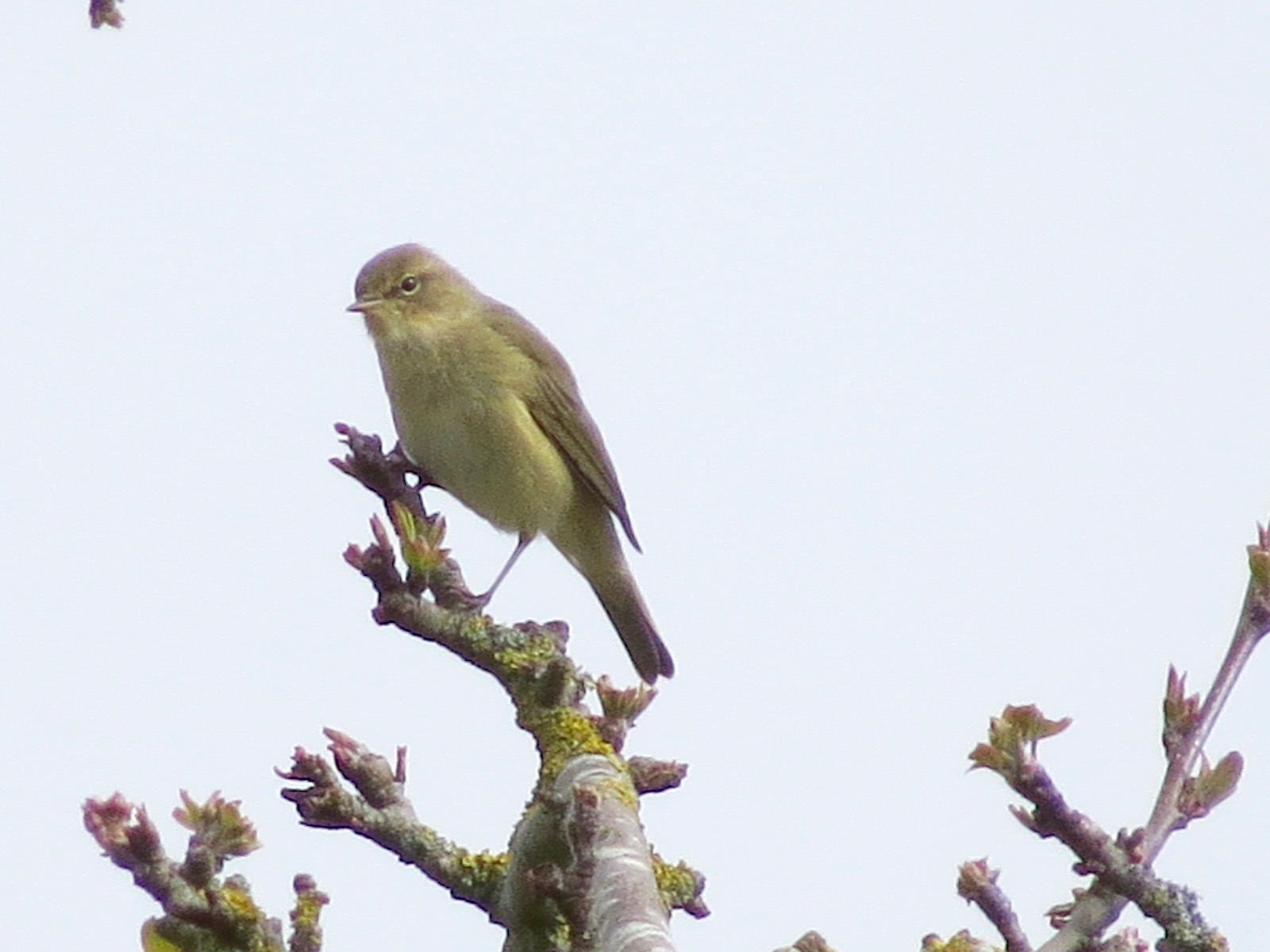
Finally, I decided to park at Bannam's Wood in the hope of photographing a Nuthatch. There was certainly at least one calling, but I only managed one view and it was well back in the wood. So I settled for a much more obliging singing Chiffchaff to conclude the morning's effort.

Chiffchaff


Thursday, 4 April 2019

Thursday April 4

A thoroughly unpleasant morning of driving sleet and rain put paid to Plan A (looking for Willow Tits in the Lenches), the cold night having scuppered Plan B (moth trapping in the garden). By mid afternoon there were signs that the rain might be easing, and so Plan C was put into action. A quick look at Morton Bagot.

These conditions should be grounds for optimism, but too often have I headed for the flash field only to be disappointed by same old, same old. As I reached the viewing point this afternoon I was pleased to see a pair of Redshanks had returned, and a Little Egret was feeding on the nearest flash. I counted 24 Teal, noted that a Cormorant had been sitting on the island until it saw me, and counted 30 Lesser Black-backed Gulls on the field in the distance. Shifting position added a couple of Little Ringed Plovers and five Snipe, but it didn't look as though the visit was going to be memorable.

Things then started to pick up. The LRPs flew over me calling, and ten minutes later more calls had me looking around to see a record equalling five flying back towards the flash. Not bad. By now the rain was really pepping up and I decided to check the pool field. There was no sign anything, but as I continued on, a small wader flew passed me and was obviously intent on landing. I got to a point where I could scan for what I expected would be one of the LRPs, but found nothing. That was until I discovered that the bird in question was a Dunlin. Fantastic. The species was absent last year, so for once a plan (admittedly Plan C) had paid off.

Dunlin
The only other birds occupying the mud were three Pied Wagtails. However some farming activity has taken place since my last visit. I started to scan for Wheatears, but found instead four of the Little Ringed Plovers in a rather incongruous setting. Worth a shot.

Little Ringed Plovers in the grass.
Moving on, I had noticed on my last visit that part of the field had been sprayed and had turned a sickly lime green colour. However it had now been raked or lightly ploughed. It will be worth a look over the next few weeks.

I slogged back through the rain, noting only a couple of sheltering Chiffchaffs but with the warm glow that comes from trusting my instincts.

Sunday, 31 March 2019

Sunday March 31

An overnight cold front has dropped the temperature and caused the wind to swing around to a light northerly. It was mostly cloudy, but there were a few sunny spells.

A late start due to the clocks going forward. A walk around the horse field was disappointing, with a single Redwing the only thrush present. A new Blackcap sang from somewhere in front of Clowes Wood, and a few Chiffchaffs also managed a few phrases, but the cooler weather wasn't really conducive for bird song.

My luck changed when I spotted a Mute Swan arriving at the Kingfisher Pool. My first of the year here, and one of the water birds I was getting a little anxious about due to the absence of the main pool.

Mute Swan
Its bill was rather dull pink (rather than bright orange) so I suspect it was a youngish bird prospecting for a territory.

The flash field was quite lively. A flock of 18 Lesser Black-backed Gulls and four Black-headed Gulls were in residence along with 18 Teal and 14 Lapwings. The wader tally was improved, the three Little Ringed Plovers had been joined by three Green Sandpipers and five Snipe.

Green Sandpiper
The sunnier spells encouraged a few bees to fly, I noticed a Tawny Mining Bee for example, but only one butterfly ventured out. At least it was new for the year, a Speckled Wood.

Speckled Wood

Thursday, 28 March 2019

Thursday March 28

A largely sunny morning with a very light westerly breeze. I decided it was time to start surveying the breeding birds for the first time since 2017. The route was a complete circumnavigation of the area from the church.

It's arguably a week too early, but the conditions were perfect and plenty of residents are in full song. Although I won't know the full picture until mid summer, it was clear that some of the former staples have nose-dived in numbers. Not a single Yellowhammer or Greenfinch was seen.

There were plenty of good things to see though. The highlight being my first Wheatear of the year, an absolute cracker at the top of the rise Dave and I call the raptor watchpoint.

Wheatear
Earlier I had seen my first singing Blackcap (excluding the wintering bird in Winyates East) at the edge of Bannams Wood.

Blackcap
A surprise encounter, more for where it was than for what it was, came at the extreme south end. I realised I could hear a Little Ringed Plover, and eventually spotted it flying towards and over me. There is a tiny new scrape just beyond my boundary, and I suspect it was checking it out.

I ran up a steady accumulation of singing passerines including 11 Chiffchaffs, 14 Blackbirds, 22 Robins, and 23 Wrens.

Chiffchaff
Due to the route I chose, it was late morning before I reached the flash field. This contained 27 Teal, two Shelducks, a Green Sandpiper, a Snipe, six Lapwings, and two Little Ringed Plovers. The Little Owl was visible, and in the field beneath its tree a single Jay was hopping around searching for food of some kind.

Jay
There were relatively few insects on the wing, but I did at least add Peacock to the butterfly year list. Neither of the two I flushed landed where I could find them again though.


Sunday, 24 March 2019

Sunday March 24

This is more like it, a beautiful sunny morning albeit with a light north-westerly breeze.

Dave and I strolled around the patch counting about five Chiffchaffs, none of which showed well, before reaching the drying pool where four Little Ringed Plovers remained in situ.

The furthest flash then came up trumps as it held a pair of Redshanks. A welcome return after an almost complete blank last year.

Redshank
The pair
Inevitably the views were very distant, but the species was identifiable. The nearer flash contained a pair of Shelducks, four Teal, 14 Coot, 17 Lapwings and a Snipe. A single Little Owl was visible in the usual tree.

As the temperature rose we started seeing insects. Several types of bee buzzed around the blackthorn blossom, and a single Dark-edged Bee Fly showed well.

Dark-edged Bee Fly
As for butterflies, we probably saw about 10 Brimstones, but the only other species was a single Small Tortoiseshell.

Small Tortoiseshell
Typically, the day after I took Richard B around (he was keen to see some mammals), we clocked four Roe Deers and several Brown Hares without any effort at all.

Friday, 22 March 2019

Friday March 22

A cloudy morning with a light south-westerly and a few sunny intervals. It was a rather delayed start because Richard B who was coming with me had brought a mysterious and brightly coloured insect he had found when transferring his shopping in his kitchen in Walsall. By the time we left for the patch we had still not identified it.

The walk around the patch involved a lot of chatting and some birding. I had noticed an arrival of singing Chiffchaffs here in Redditch over the last couple of days so I was not surprised that we found three singing birds at Morton Bagot.

However, the highlight came when we reached the former pool. Here there was sufficient surface water to make the mud a bit damp. These conditions were ideal for three Little Ringed Plovers to take up residence. We went on to find a fourth on the furthest flash.

Little Ringed Plovers
The flash field added a pair of Shelducks, a Green Sandpiper, a few Teal and at least eight Lapwings to the mix.

Given my success rate in recent visits I was confident of showing Richard at least one Brown Hare, but not a single mammal came into view. Instead, I was pleased to find my first Red Admiral butterfly of the year, a rather battered individual just out of hibernation.

Red Admiral
Back at Netherstead we found a dead Coot under the power lines which are likely to have killed it as it migrated at night.

Back at base we finally came up with a name for the bug, actually a beetle. The Ant Beetle.

Ant Beetle
They apparently awake in spring and hang around tree trunks waiting for another species, the Bark Beetle, to come in range. They then immobilise them by biting their legs off and consume them at leisure. Nice!

Sunday, 17 March 2019

Sunday March 17

Another visit that won't live long in the memory I'm afraid. Distinctly chilly despite there being plenty of sunshine and wind technically from the south-west.

Still present were a Little Egret, a Peregrine, 11 Teal, a Shelduck, 14 Lapwings, and a Little Owl. The sky was full of Buzzards, well ok maybe only about four pairs, but they were well in evidence. Rather a lot of gulls rested on the fields north of the flash field and for a while on the furthest flash. We counted 40 Lesser Black-backed Gulls, a Herring Gull, and 10 Black-headed Gulls.

At the south end the flock of Linnets numbered about 80, with about 20 Chaffinches, 11 Pied Wagtails, and 10 or so Meadow Pipits.

Buzzard
Meadow Pipit
It was too cold for insects except for a couple of bumblebees and a solitary mining bee sp.

Luckily, things are bound to improve in the coming weeks.