Thursday, 9 December 2021

Thursday December 9 - Austy Wood and The View

 It's been a bit of a frustrating week. Strong winds and gales on the days I might have got out, and other commitments when the weather behaved itself. This morning I finally donned my wellies, grabbed my bins, and took advantage of a calmer day to do some more exploring.

In the last few years a restaurant called The View has been established on the west side of the busy A45 just south of Wootton Wawen, and it provides an excellent place to park. It overlooks a small canal marina. So parking there, I walked back down the track which bisects a large sheep pasture until I got to the main road.

It was all a bit mundane as far as birds are concerned, a flock of 54 Redwings, three Fieldfares, and a Mistle Thrush on one side of the track, and 25 Starlings, a Kestrel, and a Buzzard on the other.

Once I'd crossed the main road I found the footpath which runs across a newly planted field, which is the closest you can get to Austy Wood. The field contained a few Pied Wagtails, and two Grey Wagtails, while the wood is mostly coniferous and looked pretty birdless. Eventually I spotted a Sparrowhawk, a Raven, and a few Siskins.

The edge of Austy Wood

Time to digress. Where would you go in the Circle if you wanted to see a Canada Goose? Well of course pretty much anywhere, even the marina below The View contained a pair this morning. However, this state of affairs was not always the case, which brings me to:

Canada Goose - Introduced into the UK during the nineteenth century, they were scarce in Warwickshire and Worcestershire until well into the twentieth. The date of the first record in the Circle is unclear, but the earliest I can find refers to a pair breeding at Tardebigge Reservoir in 1939 AJMartin. AJHarthan writing in 1946 referred to breeding pairs at Hewell Grange and at Tardebigge Resevoir. The first fully dated record I can find relates to a pair found breeding at Hewell Grange on May 21 1947, and since then breeding sites have included Arrow Valley Lake, Earlswood, Wythall, Shortwood Roughs, Lodge Pool, Lower Park Farm, Morton Bagot, Tardebigge, Hewell, and Batchley Pond. 

The numbers seen remained modest in the 1950s and 1960s, with peaks of 63 at Hewell Grange in September 1956, and 55 at "Redditch" on November 20 1969. This last record was before work on Arrow Valley Lake had been completed, but may still relate to the partly constructed lake.

Each subsequent decade saw more and more Canada Geese being counted leading to the two largest counts in recent years, 312 at Earlswood in October 2013, and 320 over Redditch on September 23 2017.

There seems to be every chance that this most boring of species will continue to increase its numbers in the future.

More interesting birds are available.


Sunday, 5 December 2021

Sunday December 5

 I was back at Morton Bagot this morning with Dave, seeing nothing as usual. Well obviously not nothing, but the grey skies and cold northerly breeze made the going pretty tough.

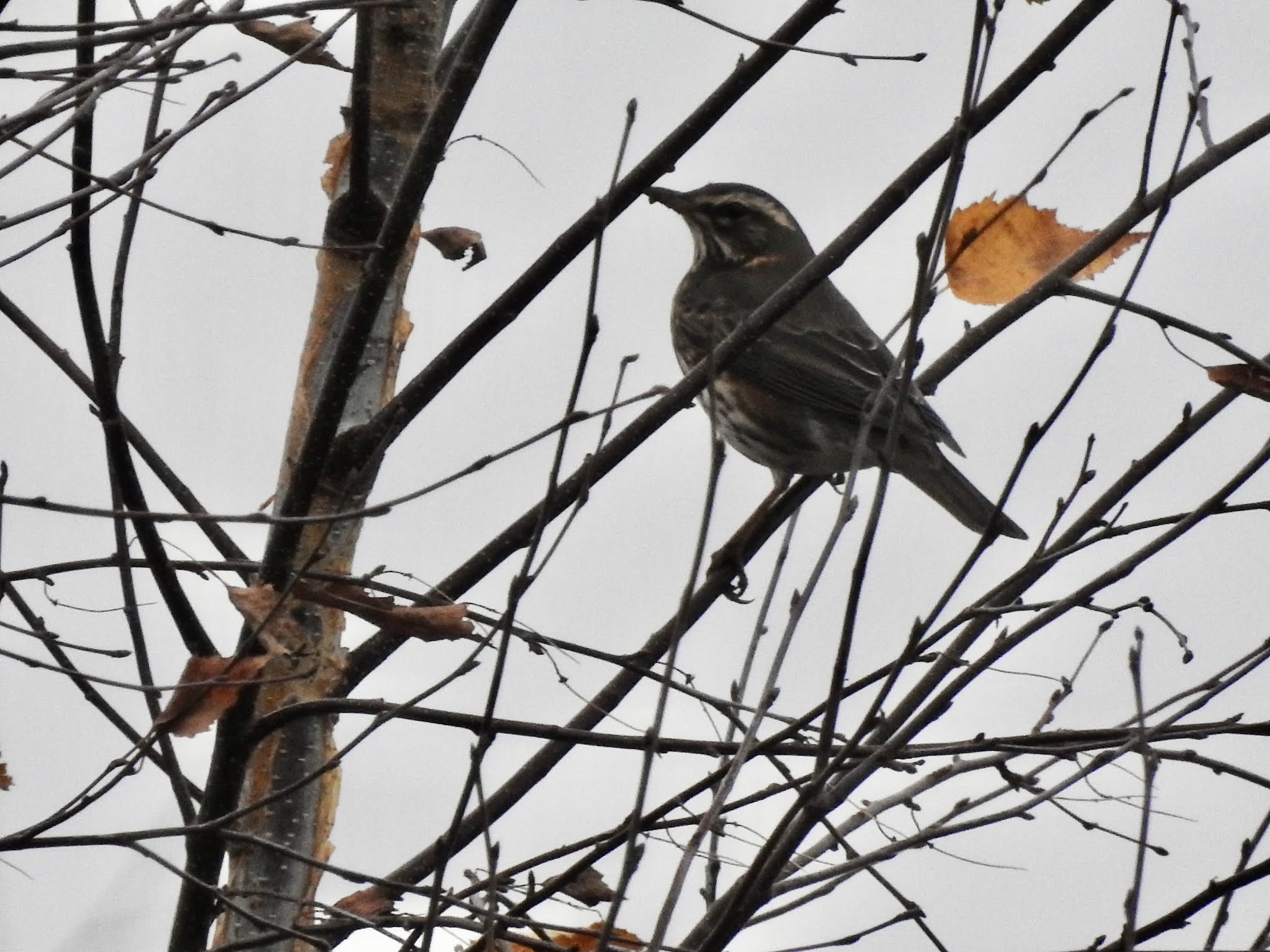
In my absence a flock of 80 or so Stock Doves has formed, outnumbering the Woodpigeons by eight to one. The other species present in substantial numbers were Redwings. We logged 118 in the hedgerows and just two Fieldfares.

Redwing

We had a couple of plans intended to spice things up. To begin with we walked along the road to Bannams Wood, the less said the better. Then we walked through the pool field hoping to flush a Jack Snipe. We had to settle for a couple of Common Snipe. The flash field contained just 27 Teal, two Stonechats, and 15 Black-headed Gulls.

All I can say is thank goodness for my new Circle project. One part of that involves researching all the birds to have occurred therein over the last 200 years. I'm nothing if not thorough. So with that in mind, where should I go if I wanted to see a Brent Goose around here? Bittell and Upton Warren are disqualified for being outside the Circle, and that leaves little grounds for optimism. But they have turned up, and the last place this happened was Box Trees near Hockley Heath. So that's where I went on Friday.

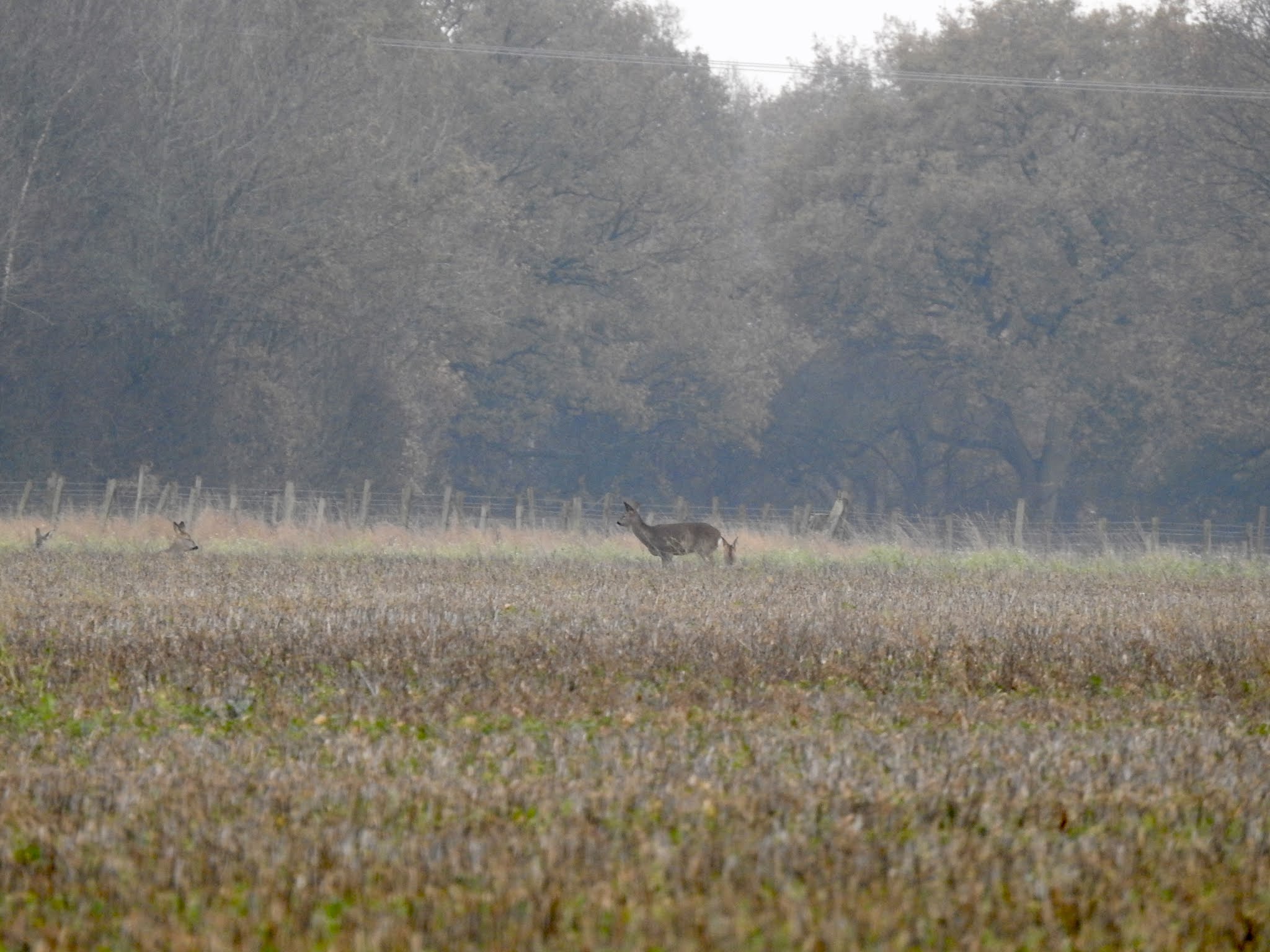
As far as Brent Goose goes I dipped. I was 15 years too late. But I was interested to see the site which gets Golden Plovers in most winters. It's basically a massive stubble field which on my visit contained nothing better than 10 Skylarks, 65 Rooks, and 32 Woodpigeons. Far away at the back of the field was a straggling line of Roe Deer. 

A very big field.

Roe Deer

This kind of huge stubble field is quite rare around here, so it was worth a look. No doubt if I'd been brave enough to trespass into the stubble the small bird count would have shot up.

Brent Goose - Four records.

The first I can find is one which was recorded by F Coburn as having been shot at Earlswood on November 6 1897. Almost exactly a hundred years later one was found grazing on a football pitch at Arrow Valley Park on February 3 1997 by N Evans, what a sight that must have been. The third was a first winter bird found by Alan Dean at Earlswood on January 13 2002. Finally, the most recent was one found by Mike Inskip at Box Trees on December 27 2006.

All my data is sourced from the West Midland Bird Club annual reports or from published sources such as "Notes on the Birds of Warwickshire" published in 1947 and written by C A Norris.

I do have a sneaky postscript though. Back in about 2011 (pre Blog) I was visiting Morton Bagot and got talking to a chap wearing bins. Anything about? I asked. Rather startlingly he replied that a week earlier he had flushed what he was pretty sure was a Brent Goose (it might have been two), from the side of the pool. I hoped he would submit the record, but maybe he didn't because it has not appeared in print. I believe the date was in November. 

Not everyone submits their records to the County Recorder, and that's certainly their prerogative, but it always strikes me as a shame when the opportunity to add to ornithological history is missed.

Wednesday, 1 December 2021

Wednesday December 1 - The Thrift

 This morning, to continue the recent theme, I headed due west to the edge of the Circle and a one km square occupied by a wood called The Thrift. It felt like exploring, but when I came to add my records I found I'd been there three times in spring 1997.

The Thrift

As you can see, the area is 50% mixed woodland, and 50% farmland (half arable and half pasture). What the map doesn't convey is that it was also quite hilly.

I enjoyed my winter walk even though the birdy offerings were pretty much as expected. I made counts of 90 Redwings, 19 Blackbirds, 42 Goldfinches, 10 Siskins, and 19 Lesser Redpolls for example.

Common Buzzard

The Thrift

The highlights came at the end of the walk. The small copse shown at the northern edge of the map contained a mixed flock of Siskins and Goldfinches, but also a Brambling. This called several times, but despite my best efforts I was unable to see it. Walking away from the wood after giving up, I was pleased to see a flock of 40 Skylarks flying over one of the arable fields. This is the first substantial lark flock I've seen this winter.

The fact that I can't remember my previous visits to the Thrift has made me look at these visits some 25 years ago. One seems to have been a casual reference to the presence of Buzzards as I walked from Feckenham passed the wood. More significantly another was an April visit where I listed just a few highlights, but these included six Tree Sparrows. 

It just goes to show that although Tree Sparrows were good enough to reach my notebook in 1997, the fact that they have not remained in my memory suggests that they were no big deal back then. They would be now. Morton Bagot lost its Tree Sparrows in 2011/2012, and I suspect they went from all around here at the same time. One thing I hope to establish in my expanded area of interest is whether any have hung on, unnoticed in some neglected part of the Circle. I can think of several other "lost" species it would be worth looking out for.

I expect to be back at Morton Bagot at the weekend.

Monday, 29 November 2021

Monday November 29 - Coldcomfort Farm

 This morning I visited the real Coldcomfort Farm, perched on a snowy hill near Coldcomfort Wood (which I also had a look at). This was my latest attempt to explore areas of The Circle, although I have to admit I have been there in previous years.

Brrr !

I began by wandering back across the A435 towards Alcester, bringing me a chance meeting with another local birder, Paul Hands (aka The Squire). I then turned about face and headed in the direction of Coldcomfort Wood.

Pretty soon I spotted a distant Red Kite perched on a dead tree. I later saw it flying towards the wood. A nice start, but not as exciting as it would have been twenty years ago.

Red Kite

The owner of the last house along the track has set up some feeders at the edge of the wood, and I could quite easily have spent an hour watching as numerous woodland birds visited. The best were a couple of Marsh Tits, and a Nuthatch, while some Lesser Redpolls peered down from an overhanging birch.

Instead I wandered into the wood, hearing a Raven, but not seeing a great deal. My main focus today had been to look for farmland birds, and once back in the frosty arable landscape I gradually started to score.

Numerous Redwings were accompanied by one or two Fieldfares (strangely scarce this year). Pied Wagtails and a single Meadow Pipit were the precursors to a flock of 40 Linnets, and a handful of Skylarks.

Fieldfare (and a Redwing trying to sneak into shot)

A couple of the Linnets

At one points a couple of flocks totalling 145 Greylag Geese followed by a pair of Mute Swans flew south, presumably heading for Salford Prior Gravel Pits (outside the Circle). One or two Black-headed Gulls were followed by an adult Common Gull. 

Eventually I recorded a couple of fly over Yellowhammers, a species I was hoping was still here. The last act was provided by a flock of 17 vocal Golden Plovers hurrying south.

Golden Plovers

I am hoping to discover which fields these birds are feeding in, but for the time being I was just delighted to see them at all.

Finally some news from Tony Kelly. He has been to Arrow Valley Lake this lunchtime and reports that there are now eight Goosanders there.

Saturday, 27 November 2021

Saturday November 27 - storm plan

 A night of strong northerlies knocked over one of our bins, and the morning dawned distinctly snowy. I felt I really should be out birding, and by late morning decided to head for the nearest body of water to see if anything had turned up.

Rather tamely the water in question is Arrow Valley Lake, and although it can produce the goods, usually it doesn't.

This morning I diligently sifted through 123 Black-headed Gulls to no avail, but did at least see some of the Arrow Valley specialities. These were three Little Egrets and a drake Goosander.

Little Egret

Goosander

So no storm blown waifs, but there was a Kittiwake just north of the Circle at Bittell Reservoir/Cofton Reservoir, so it was a viable plan.

Thursday, 25 November 2021

Thursday November 25 - He shoots, he scores!

 This morning I set out on my latest exploration of a part of the 10km circle around our house. I chose a 1km square just west of Lowsonford purely because it was 10kms directly east of our house. 

The area looked like pretty ordinary farmland, the fields consisting of improved grassland and containing just a handful of Meadow Pipits. There were a few conifer shelter belts, a stream with a wooded edge, and one or two plantations. These yielded the expected Siskins, Redwings, and other common birds. I had no great expectations and was thoroughly enjoying the walk before I reached a collection of farm buildings called Coppice Corner Farm.

I always check the roofs of farms, and on this occasion a distant grey passerine was standing on the apex of one of the barns. It could have been a Dunnock, but I knew enough to make sure. To my delight it proved to be a Black Redstart. I edged closer, and after several periods when the bird would disappear before alighting on a neighbouring roof, I got a series of record shots. The best (by far), is shown below.

Black Redstart

I couldn't see any issues about releasing the news. The bird was visible from a footpath, and they're not that rare, so I sent a tweet.

Astonishingly, Mark Clarke turned up before I'd even got back to the car. 

Yesterday was rather less exciting. I decided to call into Earlswood Lakes on my way back from my Mum's. There had been some Goosanders, some Snipe, and a possible Yellow-legged Gull lately, so it seemed worth a look. I have rather missed the boat because the work on the dam has been completed and the lakes are back to normal. Lots of water, and no edge. Also no Goosanders etc. But at least I bumped into first John Sirrett, and then Jim Winsper, so there was plenty of time for a catch up.

John directed me to the stump, a place where seed had been put down so that photographers could get images of common woodland birds. This gave me the opportunity to take my best ever shot of a Marsh Tit, one of two which were regularly visiting.

Marsh Tit

When I came to put the record onto Birdtrack I surprised to be asked for a description. However, this was only because the lakes are right next to the West Midlands county border (but are actually in Warwickshire). I must have been a millimetre out when I set the site up on Birdtrack all those years ago. This woodland tit avoids the conurbation if it can.

Other birds seen while I was there were two Grey Wagtails, a Little Egret, 13 Tufted Ducks, and 18 Great Crested Grebes. I see from Birdtrack that John S counted 16 Tufted Ducks, and 26 Great Crested Grebes as well as 70 Mallard, a few Canada Geese and a couple of Greylags. Nice one John.

Earlswood Lakes are worth a look in poor weather and is very well watched, but Wednesday's visit was entirely typical of my experience.


Sunday, 21 November 2021

Sunday November 21

 This morning Dave and I were back at Morton Bagot hoping to find something worthwhile. It was sunny but cold, the fresh north-westerly making me regret not having pulled the winter coat out of the wardrobe.

Although we had each noticed an apparent influx of Blackbirds on our respective journeys, we struggled to find anything else encouraging. In fact the visit was quite discouraging. We bumped into a couple of guys who had been carrying out Deer control, and although we had heard no shots, there seemed to be very little to look at.

At the flash field about 50 Teal, and a Wigeon was a pretty typical return. A few Siskins and Redpolls were not really close enough to photograph, but I tried anyway.

A female Siskin

Lesser Redpoll

A little brown job flew into a bush in front of me and looked "interesting" before disappearing. In the absence of any calls, or a view of its head, I was forced to write it off as a poorly seen Wren. 

It was turning into one of those days.

I also thought I'd share an image of some landscape altering recently completed by a farmer whose sheep pasture stretches towards Bannams Wood.

A former hedge

Back in the late 1970s I remember attending my first West Midland Bird Club AGM where the club secretary, the late Alan Richards, decried the loss of hedgerows in the region. Forty years on it seems that little has changed.