Sunday, 24 February 2013

Sunday February 24

A cold grey day with occasional light snow flurries. News of a Shag yesterday afternoon at Marsh Lane GP looked likely to divert Dave's attention, and so it proved. I was birding alone and events later in the visit left me wishing he had been with me.

I decided to do the whole area, and started at Church Farm. The walk down to the main pool produced the Tawny Owl, which was showing well in its usual tree. Although the landscape seemed frozen, I was encouraged to see that the pool was almost entirely ice free. Amongst the Mallard and Teal I soon discovered the first Shelducks of the year.

The pair of Shelducks
 I was quite relieved to see them because although they have been annual since 2010, and bred in 2011, they left early last year due to unsuitable waterlevels, and I was wondering whether they would give the place another chance. Sharing the pool with them were six Coots. Inevitably the Shelducks flew off as soon as I tried to get past them, but fortunately I relocated them on the Flashes. The total number of Teal there was 45, while 75 Lapwings flew over to the pasture on the hill where they joined 290 Starlings. There was no sign of the Little Owl though.

I continued to Stapenhill Wood, flushing a Sparrowhawk en route, but the wood contained nothing better than a single Bullfinch. The plantation formerly known as the ridge field contained a handfull of Skylarks plus 80 Fieldfares and a few Redwings. After a quick look around Netherstead Farm I headed along the hedge-line towards the south end. Peering over a gate I found myself looking at an adult Peregrine perched on a fallen tree in the centre of the old Curlew field.

The Peregrine
I took a record shot of it as this was my first since a brief encounter on New Year's Day. By the time I got level to where it sat, the bird was nowhere to be seen. The remainder of the south end was disappointingly birdless, so I made my way back along the road to Netherstead Farm, where a Coal Tit on the feeders looked likely to be the only bird worth noting.

However, as I walked back to the road all hell broke loose from Spernal Wood as Jackdaws and Woodpigeons burst out in a chaotic melee. I quickly got onto the cause of the panic, an Accipiter sp. Quite a large Accipiter sp. The shape of the tail and protrusion of the head looked interesting, the bird itself looking brown above with a barred upper tail and noticably pale below. It swept upwards and flew along the top of the ridge and then away over the trees. Five minutes later more Jackdaw cacophony, and suddenly an Accipiter appeared in front of me before banking and heading back to the wood.

Was it a male Goshawk? I'm not sure. I am struggling to decide exactly how big it was. Definitely smaller than a Buzzard, possibly Crow sized. I could have done with seeing a bird of known size right next to it (but everything was trying to be as far away from it as possible), and I could have done with a second opinion.

Sunday, 17 February 2013

Sunday February 17

Initially the weather looked superb today, sunny and still. However, shortly after I arrived a bank of fog appeared, and it then remained misty all morning. I struck lucky with my first year tick of the day as I was driving up the access road past Netherstead Farm. Chirping cheerfully at the top of the hedge was a Tree Sparrow, phew. I was starting to get a bit worried that this normally ever-present species might have disappeared from the patch. Certainly last year's wet summer and the subsequent reduction in the amount of game crop available has affected many of the finches and buntings, and with them the Sparrows. Dave was a little tardy this morning, and by the time he arrived we could not relocate the Tree Sparrow.

A further arrival was five Coots, one on the dragonfly pools and the remainder on the main pool. There was nothing else on the pool beyond about 20 Mallard so we decided to walk through the marsh. This produced 19 Common Snipe, and one Jack Snipe.

The flashes were ok; 37 Teal, about 20 Lapwings, two Wigeon, and a Green Sandpiper. But on checking a likely looking tree beyond the gate I could see a small grey lump against the bark. A switch to the scope confirmed that it was our first Little Owl of the year.

The Little Owl
This species is another that is just about hanging on here. This is probably the same bird that was present last year, although it has changed tree!

We headed slowly back, and a second attempt to get Dave the Tree Sparrow produced instead his first Brambling this year. It was in the copse by Netherstead farm with about 25 Chaffinches.

This was a day for winkling out the trickier resident and wintering species rather than adding genuine new arrivals. But spring is just around the corner, and I can't wait to see what it brings.

Wednesday, 6 February 2013

As bad as it gets

A lousy day overall. I was late for work (stuck on the motorway), then the delivery I was hoping would arrive early failed to show up at all by the time I was on my way home at lunchtime.

I had half a day to take Lyn to the doctors, but surely a bit of birding after we were done would brighten the mood. Forget it. A cold northerly chilled the bones, and I wandered around for an hour seeing nothing more exciting than five Long-tailed Tits.

The tree-planters were working away, and I got barked at by their dogs. Even the normally friendly labrador at Church Farm growled at me.

Birding is supposed to be fun.

Sunday, 3 February 2013

More tree-planting

It was a bit touch and go whether I would be able to get out this week. I have been off work since Wednesday with acute viral bronchitis, according to the doctor, and my recovery has been frustratingly slow. There was a great deal of concern from Lyn that going out birding would make it worse (my Mum chipped in by phone, her advice to Lyn was"tie him down". Thanks Mum).

Fortunately I was able to put forward a convincing enough case that I was very nearly better, which allowed me to negotiate a two hour window of opportunity this morning. Thus it was that I joined Dave at Netherstead, and within a few minutes another year-tick was added in the form of three distant Golden Plovers which were flying with 150 Lapwings to the west of the patch. Goldies are pretty much guaranteed to occur at some point in a year but are very hit or miss, and are sometimes not seen until the autumn.

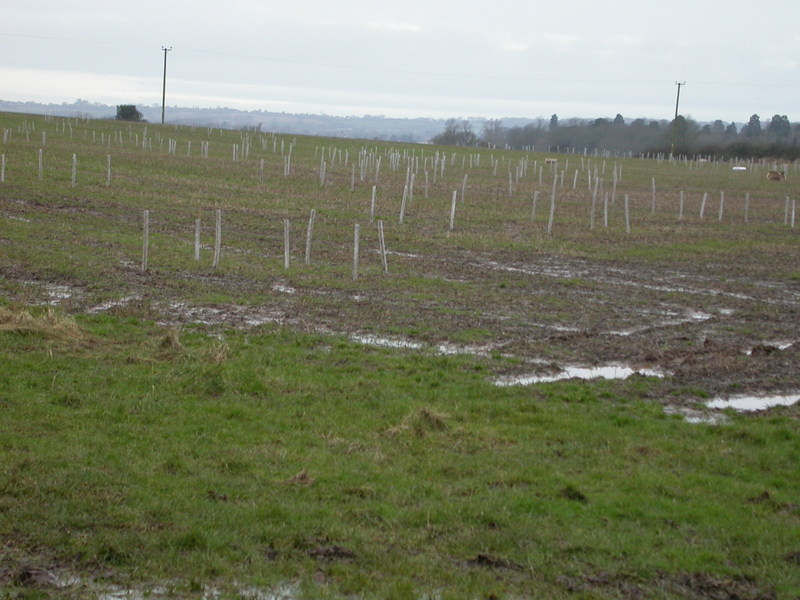
A less welcome discovery was that the tree-planting has now extended to the large ridge field, one of the two best fields for Skylarks on the patch. It is hard to imagine that this will lead to anything other than a gradual reduction in their numbers, and this is a great shame as Skylarks are struggling to find the sort of sensitively managed arable farmland they need in this part of Warwickshire.


No doubt it will look lovely by the end of the century
  Anyone wanting to see the reason for the habitat change can vist the website of the Heart of England Forest project. The idea was born from the mind of a man called Felix Dennis who has a lot of money and a sincerely held belief that his legacy to the area should be the planting of native woodland species over as large an area as he can acquire, with general access to members of the public.

It is hard to disagree with these sentiments, but I searched his site hoping for some reassurance that other habitats might, where appropriate, be maintained. All I could find was a reference to woodland glades and ponds, so it looks as though for the Skylarks, Lapwings, and Yellowhammers etc (birds which really need his help) it could be time to move on...except that there will be nowhere else for them to go.

Anyway, back to today. We actually located 35 Skylarks over the field in question, and 65 Linnets in the neighbouring set-aside field which I think is protected until 2019 by the stewardship scheme. An extra Mute Swan flew over the resident pair and then disappeared towards the little fishing pool just north of the patch. This was not far enough as far as the local Swans were concerned and they soon headed there too. The inevitable pitch battle could just be made out from our self-imposed boundary.

The flash looked pretty poor. A single Green Sandpiper and not much else. However, 250 Fieldfares, 250 Starlings, 50 Redwings, 230 Black-headed Gulls and a single Common Gull were all scopable beyond the flash field. Then Dave drew my attention to a pair of Wigeon which flew past us to provide our second year tick. Like the Golden Plovers, pretty much guaranteed to be seen eventually, but more of an autumn speciality.

We met up with John, who had flushed three Wigeon before we had got there, and was later to see them again on the Flash. For our part, Dave then managed to locate an extremely distant Golden Plover for John's year-list, as it fed amongst Lapwings in a ploughed field about a mile away.

Sunday, 27 January 2013

An unexpected duck

Heavy overnight rain and a rapid thaw saturated the site but also produced some unexpected surprises. I started at Netherstead Farm, and bagged my first year-tick, an adult Herring Gull before Dave arrived. It was noticeable that there were a lot of birds airborn in the strong south-westerly wind.

We headed for the main pool, which turned out to be overflowing with water, but to contain only a pair of Mute Swans. The flashes were much more productive though. We could see John scoping something, and as we reached him he showed us a smart drake Gadwall. This was the first here since July 2010, although I see from my Birdtrack records that I have seen the species on four previous occasions. As I erected my scope I was told the ducks were all flying. When they returned, there was no Gadwall, hence no photograph.

A drake Gadwall

Fortunately many of the 90 or so Mallard which John had estimated, and 115 Teal, did return straight away. Amongst the Teal we could see at least 20 Snipe.

On the way to the pool we had noticed many Gulls on the pastures beyond Stapenhill Wood, and we continued to the mound hoping to see the Gull flock. In the end we had to venture just beyond Stapenhill Wood to get a reasonable view of the floodwater. The sight that greeted us was little short of miraculous. Approximately 700 Black-headed Gull were stretched across the field, a new record count.


A part of the Gull flock is just visible in the distance.
I was sure there had to be a good Gull amongst them, but eventually, buffetted by the gale, we could only find 31 Lesser Black-backed Gulls, 13 Herring Gulls, and an adult Common Gull with the Black-headed Gulls. Compensation came in the form of a third year-tick, a humble Meadow Pipit which flew over calling.

I persuaded Dave we should drive to Church Farm and from there try the flashes again. This manouevre failed to add much to the day, just a single Grey Heron.

The year list has now reached 69. 


Saturday, 26 January 2013

Big Garden Birdwatch

As usual I took part in the RSPB's Big Garden Birdwatch this morning, and as usual the birds failed to co-operate in the allotted hour.

My stunning results were:

Blackbird 1
Blue Tit 2
Robin 1
House Sparrow 4

This was in spite of there being plenty of food out for them. The usual hard luck stories ensued; the Fieldfare which Lyn has been seeing all week put in a brief appearance but failed to return during the hour, and even more annoyingly, two Long-tailed Tits feeding on the tree just beyond the garden visited two minutes after the hour was up.

I noticed that psycho the Blue Tit has decided to waste another year of his life attacking his reflection in a window of the house just beyond our garden. No doubt he will carry on all spring as he did last year. Stupid bird.

Sunday, 20 January 2013

Sunday January 20

I wasn't sure what state the minor roads would be in today, so decided to drive to St Mary's church Oldberrow and walk the ten minute journey to the patch boundary. In fact it wasn't too bad, and after making the surprise discovery of two Ostriches/Emus (not sure which) in a field along the road, I started seeing wild birds by about 8.40am.

In fact one of the first birds I saw was quite unexpected as a Green Sandpiper flew out of a stream and landed on a fence post.
The Green Sandpiper
I suppose tringa waders often perch prominently in the breeding season but I cannot remember seeing a Green Sandpiper doing so in the UK. I continued to the pool, which was largely frozen and lacked birds entirely.


The main pool
By the time I got to the flashes it was snowing steadily. My initial optimism at the sight of plenty of birds ebbed away as I eventually established that only the regulars were present; 20 Canada Geese, 82 Greylag Geese, 59 Teal, 91 Mallard, 44 Lapwings, 20 Snipe, and four Moorhens. In truth many were hunkering down in the damp snow covered grass and it was impossible to be sure that I had seen everything.

I carried on and was feeling resigned to gaining no year-ticks today. That was until I reached the tin shed. As usual I squatted down to peer into the gloom, but as I did so a beautiful Barn Owl ghosted out and floated off over the thicket. My feelings of awe and elation were mixed with guilt as clearly the bird would have been much better off spending the day undisturbed. Hopefully it found a dry bolt hole somewhere. I just about manage to record this species each year, but never more than one sighting per annum.

This was to be my only year-tick today, so I am now on 66. I headed past Netherstead Farm and then back along the road into the teeth of what was now a bit of a blizzard. The only noteworthy discovery was a potentially Waxwing-friendly cotoneaster in the garden of the property adjacent to Bannams Wood. A bush to keep an eye on this winter I think.