Saturday, 9 August 2014

Saturday August 9

With ex-hurricane Bertha on the way it seemed sensible to switch my birding day to this morning. Sunny and only a light westerly breeze. Unlike last weekend, plenty of Warblers were zipping through the bushes. Seeing them properly was a bit of a problem though. While I was chasing after the first of several possible Lesser Whitethroats I came upon a more significant species in terms of the Morton Bagot year. A Willow Warbler.

When I first started birding in the Midlands 30 + years ago, this species was everywhere and easy to see. Over the years they have definitely got scarcer and whilst I would admit that Morton Bagot doesn't contain classic Willow Warbler habitat, I suspect it used to be commoner here too. This year has been particularly bad. I recorded just a single bird singing on one April date in spring, and didn't even see it. So today's migrant was the second of the year, and the first I have actually seen.

All this explains why I considered it to be sufficiently scarce to require a photo for the year list...no matter how bad it was.

90. Willow Warbler
 All I can say in my defence is that it looked better in the scope. I managed two shots, and unfortunately it was preening when my finger hit the shutter for the better of the two. (Its head was behind a leaf for the first). Check out the primary projection, about the only ID feature showing.

The rest of the walk round produced just the usual stuff. At least five young Whitethroats showed well, with a family party of Yellowhammers in the same bushes.

Whitethroat
The Flashes contained 13 Green Sandpipers, two Snipe, 11 Teal, 70 Lapwings and over 100 Greylag Geese. There was no sign of the Shoveler though.

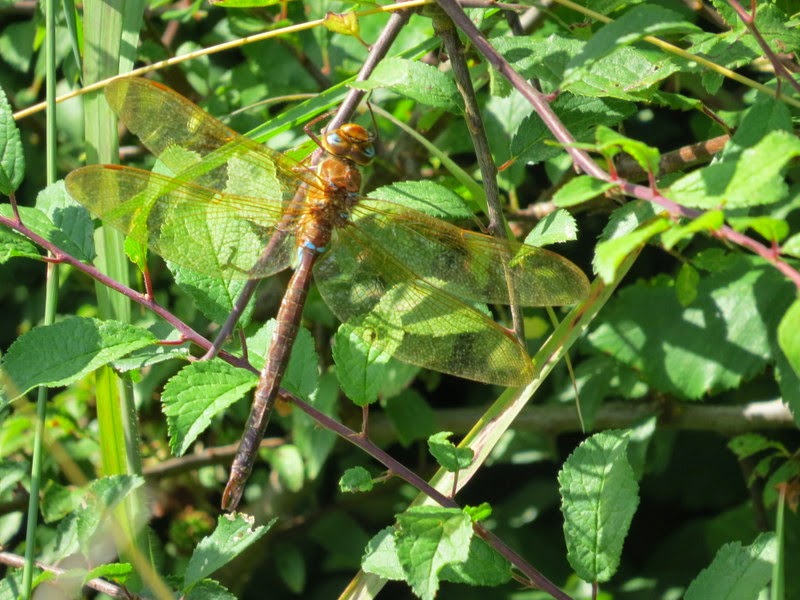
On the way back I finally got a shot of one of several Brown Hawkers. They seem to be having a good year.


The only other things worth mentioning are that there were a few Black-headed Gulls heading south, about 10 in all, and a second female Tufted Duck now has a brood (of one duckling) this time on the pool west of the flash.

Wednesday, 6 August 2014

Wednesday August 6

This evening was still and sunny at first. Gradually this gave way to almost complete cloud cover. Birding a small patch is all about dreaming of the big one, impossible dreams, and the occasional little victory.

This evening's bonus bird came as I was gazing at the flotilla of newly released Mallard on the main pool wondering if they would ever pull in something different. Scarcely had this thought floated away when something new did indeed drop in. A Shoveler, the first since March, and only the second in the last two years.

Shoveler
The remainder of the pool was filled with the usual stuff, although I did notice that the single female Tufted Duck with its brood of six had been joined by two more females.

At the Flashes I immediately regretted not packing my scope. At least 12 Green Sandpipers were split between the two flashes, and four Common Snipe were newly arrived on the nearest. Six Teal there were forced to swim nervously into the water as a Fox skirted the back of the pool.

Passerines this evening consisted of a Whitethroat, two Chiffchaffs, two Reed Warblers (one of which was singing despite a beak full of insects), 50 Goldfinches, 40 Swallows, 20 House Martins, and two Swifts.

The forecast for the weekend is for a return to wind and rain. I hope they have got it wrong.

Sunday, 3 August 2014

Sunday August 3

Sunny, breezy, fluffy clouds. Oh dear, a fluffy cloud day. Over the years I have nurtured a growing dislike of this type of weather. Blue sky and fluffy cumulus clouds scudding across from the south-west = no birds.

This is doubtless a drastic over simplification, but today was pretty typical. The breeze strengthened to the point where it was difficult to see passerines. The ones which did pop out were almost exclusively Chiffchaffs.

Chiffchaff
I reached the flash where I was pleased to count 13 Green Sandpipers and the Common Sandpiper plus  110 Greylag Geese and the juvenile Shelduck. Perhaps it wouldn't be such a bad morning after all. For a change I decided to enter Stapenhill Wood. This tiny wood has been left to its own devices for many years and consists of many rotting stumps, tall Ash trees, and a jungle of hawthorn and blackthorn. I was soon fighting my way through shoulder high nettles and brambles remembering why I so rarely go into it. The rotting wood is no doubt great for beetles etc, and also for fungi.


Unfortunately, despite buying a book on the subject, I remain entirely ignorant on the subject. This is some kind of bracket fungus.

Returning to my car I decided to try the flash again. En route I spotted the Little Grebe on the pool, and also proof that the pair had bred successfully.

Little Grebe chick
At the flash the cows had decided to visit the near flash en masse, and this had one beneficial effect. The Green Sandpipers were no longer spread out, but were (apart from one party pooper) all lined up for a group photo.

12 Green Sandpipers
All dots of course, but the cows were not content to leave it at that. They edged forward and flushed most of the waders to the near edge where I could get a better photograph to give you some idea of what a Green Sandpiper actually looks like.

A Green Sandpiper
This is about as close as I can get unless the waterlevel starts to drop on the main pool. That was about it. I recorded a single Swift and three Teal, two Whitethroats, and three Reed Warblers. The autumn migration will have to wait for another weekend.

Wednesday, 30 July 2014

The late shift

This evening I didn't get to the patch until 8.15pm for no better reason than a desire to watch the cricket highlights.

It was a sunny, quite still evening, and the reed-bed at Netherstead immediately provided me with a little reward as an agitated Reed Warbler mobbed me.

Reed Warbler
I arrived at the pool just in time to see a birding couple heading back up the slope to Bannams Wood. I failed to recognise them, and wondered what they had seen. At the flash I was initially met with a birdless scene. Not a thing on the nearest flash, and only Geese and a few ducks visible on the furthest. Eventually I spotted a Green Sandpiper, a few Teal and the Shelduck. Then a cow arrived for a drink and spooked a previously unseen Common Sandpiper. Things were looking up.

The Redstart started calling in the hedge, and I just caught a flash of orange but not enough to determine age or sex. Another call, this time Common Sandpiper. It had evidently flown to the nearest flash. The light was fading but I got a record shot.

Common Sandpiper
More calls, this time Green Sandpipers. Seemingly from nowhere six Green Sands joined it. Presumably they had all been hiding on the furthest flash. Satisfied that I wasn't going to see anything else I started to head back. Eight Swifts appeared, and hawked late flying insects over the pool. Scanning the pool itself, a movement caught my eye. A fluffy grey tail disappeared behind a patch of sedge. I thought I knew what it was, and sure enough I was soon proved right.

Eat your heart out Springwatch
This was my first daylight Badger here. I did see one in the car headlights once, and the discovery of the occasional corpse proves there is a healthy population, but for a diurnal birder like myself this was, as they like to say on the telly, quite a treat. The final bird of the evening was a seventh Green Sandpiper, this time on the pool.

Not a bad evening.

Sunday, 27 July 2014

Pacific Golden Plover

This weekend turned out to be all about numbers. Yesterday was great. We went to see a Henry IV Part II in Stratford followed by a splendid meal with friends in the rooftop restaurant. Marvellous. On the other hand, birding being a numbers game, one or two things were niggling away. To start with, on my walk back from the paper shop I spotted a large bird heading west over our house. I sprinted the 50 yards back to the house, found my bins, and dashed to the garden. It had gone. I think it was a Kite, but not convincing enough to get on the garden list. Then, just before our friends arrived my pager told me there was a Pacific or American Golden Plover at Middleton RSPB.  Oh heck. A last check of the pager before we set out. It was American G P , phew! Don't need it. Later that day, in the evening, I glanced at my pager again. It had been a Pacific GP. Not just a Mids tick, but a British tick to boot.

It was a warm night and our bathroom got a new moth. Marbled Beauty. I log them, but I've never bothered to count them up. Its not like they're birds.

So, this morning the PGP was still there. Off I went. It's so long since I went to the Tame valley that the RSPB reserve at Middleton didn't exist. So that was a tick too. I was slightly disappointed with it. Not enough signs (hard to believe at an RSPB reserve). A lot of my fellow twitchers looked distinctly lost. If I'm honest, the Pacific Golden Plover was a bit disappointing too. It wasn't the bird's fault, it was in stunning summer plumage, but it was also miles away. A dot, which kept disappearing behind vegetation. Too far away to photograph with my little camera. But since when did that stop me. Record shot coming up.

Its about 5 o'clock from the Little Egret !
Still a tick is a tick. Bird number 294 for the West Mids, and 436 on my British list. There were some other birds there but I was pining for my patch and by 10.45 I was back at Morton Bagot.

Strictly speaking there is nothing to report for the rest of the morning. But my competitive juices were still flowing and photo-ticks presented themselves. First up was one of two Nuthatches chasing each other around in the copse at Netherstead.

88. Nuthatch
In my now restricted morning, I marched to the flash where another species which has avoided my camera so far was waiting for me.

89. Starling
My excuse for putting this completely duff shot onto the blog is that I have lost patience with the species. There were stacks last winter, but they were all either flying over or feeding distantly on fields to the north of the patch. Amazingly none breed here, so I just get the odd wanderer from Redditch. They like to keep company with Lapwings and hence its now on the photo-list.

I did get a couple of shots of other birds which I like a bit more.

Raven
Wren
The flashes also contained 4 Green Sandpipers, 79 Lapwings, seven Teal, a juvenile Shelduck, and 34 Greylag Geese including a white one.

Wednesday, 23 July 2014

Wednesday July 23

This evening it was warm and sultry. Perfect for biting flies! I met fellow sufferer Mike Lane as he was lugging away half a ton of camera equipment including his hide. At least he'd seen some birds. He mentioned a Cuckoo (presumably juvenile) and also that up to three Little Egrets have been visiting College Lake in Studley lately.

I continued to the flash where things seemed pretty stable. I saw four Green Sandpipers, two Shelducks, 65 Lapwings and five Teal.

Juvenile Shelduck
Lapwings and Shelducks
The highlight of the evening was not the invisible Redstart (still calling) nor the visible Chiffchaff (also calling) but was my first Southern Hawker dragonfly of the year which was attracted to the flies buzzing around my suffering form. I was cheering it on, feeling like a human bird table, well dragonfly table strictly speaking.


Sunday, 20 July 2014

Sunday July 20

It was a largely overcast morning, but pretty warm with hardly any breeze. Dave and I started from Netherstead as usual, and steadily accumulated pretty typical bird species, including several family parties of Whitethroats, and also juvenile Sedge Warbler, Kestrels, and Green Woodpeckers. At the main pool the first brood of Tufted Ducks this season totalled six ducklings.


Perhaps it was the presence of this brood which caused us to hurry past and get to the flashes. Here, the despair I exhibited in midweek was proved to be unfounded. The near flash was full of water, and birds. Specifically two adult and three juvenile Shelducks, 67 Lapwings, seven Green Sandpipers, a Redshank, and two Teal.

The three juvenile Shelducks
During our walk we had been noticing that there were a lot of Skippers on the wing, some tatty Large Skippers, and about equal numbers of Small and Essex Skippers posing their usual identification challenge.

Essex Skipper showing its diagnostic dipped in ink antennae tips
We reached a gate over which we often peer. The hedgerow on the far side of the field can be good for migrants. Today came up to the mark when Dave spotted a juvenile Redstart shivering its tail and allowing me the opportunity of a poor quality photo year-tick.

86. Redstart
A little further on I got a nice shot of one of several Common Emerald Damselflies.

Common Emerald Damselfly
The area of long grass at the back edge of the patch is great for insects at this time of the year, and a faint "tip" at my feet led me to find two male Dark Bush Crickets squaring up to one another.

Dark Bush Crickets
The thistle heads were full of Gatekeepers and Meadow Browns, and also a single Small Copper. However, one butterfly which has been a little scarce here this year was pointed out by Dave.

A really tatty Red Admiral
We completed our circuit. Dave had to leave earlier than usual so I decided to head back to the flashes with a plan in mind. Last night I had phoned Mike Inskip to see if he had seen anything on his patch lately, and he said he had found some newly emerged Small Red-eyed Damselflies. I therefore headed back to the pool where they had been found last year, and sure enough about a dozen were present exactly where we saw them in 2013.

Small Red-eyed Damselfly
This species only turned up in the UK for the first time as recently as 1999, but since then they have successfully colonised pools across much of southern Britain. Including here.

I returned to Netherstead feeling pretty pleased with the day, and found it had one more card to play. The 50 or so hirundines were panicking over Netherstead and in their midst was a female Sparrowhawk.

87. Sparrowhawk
A photo year-tick to round the morning off.