Sunday, 12 July 2020

Sunday July 12

A warm and sunny morning, ideal for bird ringing and for insects.

The ringers were here, and I watched them process a second calendar year Wren. They had had a good morning, catching a juvenile Grasshopper Warbler, and controlling a Great Tit which had been ringed elsewhere. 

Grasshopper Warbler - Tony & Leigh Kelly

Sedge Warbler - Tony and Leigh Kelly


Wren

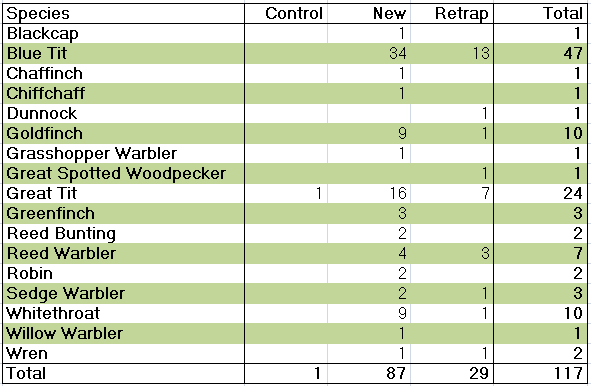
Courtesy of Tony and Leigh Kelly, the full ringing details for a combination of this morning's visit and last week's are:

                                              
We decided to walk along the road a short distance hoping to see some woodland butterflies. in fact our highlight was a woodland bird, as a Siskin flew over calling.

Back in the fields we checked out a line of trees where we had seen Purple Hairstreaks last year, and sure enough a couple of these tiny butterflies were fluttering around the canopy.

Purple Hairstreak

On balance we felt that butterfly numbers were slightly lower than last week, although there were still a lot. 

At the flash field we found that most of the mud had disappeared, and the six Green Sandpipers present were tight against the sedge at the far side of the nearest flash. The only other waders seen were 25 Lapwings.

Dragonflies included more Emperors and Brown Hawkers, but the only species posing was a Blue-tailed Damselfly.

Blue-tailed Damselfly

There were plenty of grasshoppers and crickets in the grass, and I chose to get a shot of a male Roesel's Bush-cricket.

Roesel's Bush-cricket

The one other creature which was present in higher than usual numbers was Homo sapiens. Perhaps because of the weather, or maybe relating to cancelled holidays and post-lockdown joie de vivre, the usual cyclists and horse-riders on the road, were joined by walkers, runners, and even picnickers in various places along our usually quiet circuit.

It's good to see that this lovely corner of England is being enjoyed by everyone....he said.

Saturday, 11 July 2020

Pine Hawk-moth in garden

A chilly night (8 degrees) did not bode well for GMS trapping overnight.

However, it only takes one moth to make it worth it. That moth was a superb Pine Hawk-moth which was new for the garden (and for me).

Pine Hawk-moth

This species was formerly mostly known as a migrant, but is spreading north and west from a foothold in the south-east of England. There were 25 recorded in Warwickshire in 2019.

One other moth was new for the year this morning. I caught two Scalloped Oaks, a rather smart moth.

Scalloped Oak

Of the rest, the most unusual was a Bright-line Brown-eye which was the second this year, the last being in April.

The full list was:

Bird-cherry Ermine 1
Eudonia lacustrata 1
Crambus pascuella 2
Water Ermine 1
Pine Hawk-moth 1 (nfg)
Scalloped Oak 2 (nfy)
Common Footman 8
Uncertain 3
Bright-line Brown-eye 1
Dark Arches 1
Smoky Wainscot 1
Heart and Dart 3


Wednesday, 8 July 2020

Wednesday July 8

I have to admit to a degree of midsummer birding apathy this week. Until today the wind, cloud and rain have put me off.  Indeed it took me until early afternoon to finally convince myself, with the wind having dropped and muggy overcast conditions prevailing, it might actually be worth the effort.

So I parked at the church and did the shortened circuit aimed principally at checking out the flash field. And I have to say it looks quite good.


The only issue being that the 25 Lapwings present were not accompanied by anything new and exciting. Having said that, I counted five Green Sandpipers and four Teal, an improvement on the weekend.

Most of the usual warblers were present and I spent an inordinate amount of time trying to get a clear shot of an agitated Sedge Warbler before finally giving up and heading home.

Tuesday, 7 July 2020

Garden moth update

With the week due to be largely wet, I decided to put my trap out last night. It remains rather cool and as a result the morning saw a fairly modest, for July, catch of 57 moths of 21 species.

Only one of these was new for the year, an Early Thorn, a second generation emergence.

Early Thorn

Actually most of my morning was taken up trying to understand why two grass moths were so different from one another in size. This led me to the incorrect conclusion that the smaller one might be Crambus uliginosellus. I sent a tweet. Steve Whitehouse then replied with a text. What I didn't know was that this species is not local, as the books say, but is very scarce or possibly extinct on Hartlebury Common where he had looked for them. He pointed out that the white streak did not appear to go 2/3 way along the costal edge. This meant it was just a very small example of the common Crambus pascuella.

Crambus pascuella (confirmed by gen det)

Oh well, you live and learn. Thanks to Steve Whitehouse for the prompt guidance.

The full list was:

Bird-cherry Ermine 3, Brown House Moth 1, Ruddy Streak 2, Twenty-plume Moth 1, Lozotaeniodes formosana 1, Codling Moth 2, Eudonia lacustrata 1, Garden Grass Veneer 6, Crambus pascuella 6, Single-dotted Wave 1, Early Thorn 1 (nfy), Peppered Moth 1, Common Footman 13, Scarce Footman 1, Uncertain 3, Dark Arches 3, Marbled Minor ag 1, Smoky Wainscot 1, Heart and Dart 6, Shuttle-shaped Dart 1, Large Yellow Underwing 2

There's a twist. @UKmothID replied to my tweet saying it "does look very good for C uliginosellus, yes". I emailed the photos to the County Recorder and he has stated that it needs to be retained in case it is just that. It would be a first for Warwickshire if correct. 

I'll keep you posted.

And the answer is: female Crambus pascuella. Oh well.

Sunday, 5 July 2020

Sunday July 5 - back on the patch

Self-isolation over, I was able to join Dave for our traditional Sunday stroll. It was rather windy (westerly) and was sunny and cloudy in equal measure.

It felt as though I had never been away, particularly bird-wise. The same two Grasshopper Warblers  were reeling, and a Little Owl was perched in the oak-tree at the flash field. Here we counted five Teal, two Green Sandpipers, two Little Ringed Plovers, 18 Lapwings, two Black-headed Gulls, and two Sand Martins with a handful of other hirundines.

Green Sandpiper
One bird which features because of the enhanced numbers present was Goldfinch. A flock of about 50 were taking refuge in the hedge bordering the Morton Brook.

I had hoped to say a bit more about birds, but I'm afraid that stasis was the order of the day. It fell to a mammal to produce the morning's highlight. An Otter surfaced in the Kingfisher Pool, the first since my original sighting last September, and a patch tick for Dave. Last time I had photographed it and wished I'd filmed it, this time I tried to film it and wished I hadn't. It surfaced several times, but I basically managed to record two minutes of water surface ripples plus three brief head up moments. Not worth putting on the blog.

Instead its back to insects. I estimated 160 Meadow Browns, 120 Small Skippers, 30 Ringlets (Dave thought more), and a good selection of other common grassland butterflies. The hedgerows added one or two Commas, and my first Gatekeepers of the year.

Gatekeeper
Comma
As for dragonflies, the wind didn't help. But I did see Brown Hawker for the first time this year, plus a latish Four-spotted Chaser, three or four Broad-bodied Chasers, and two ovipositing Emperors.

Female Emperor ovipositing
The ringers did not appear to be on site, (unless our mid-morning start missed them completely) but I've had an email from Tony Kelly with the results of their most recent session here, on Friday June 28. Here is a summary of the 59 birds caught:

Blue Tit 11 (2)
Great Tit 6 (1)
Chiffchaff 2
Blackcap 1
Whitethroat 11 (1)
Robin 1
Dunnock 3
Greenfinch 7
Goldfinch 17 (4)

They also saw Barn Owl and Raven among other things.


Friday, 3 July 2020

A windy night of garden moths

First the good news: the relevant family member has tested negative for covid19 so no more voluntary social isolation.

It was garden moth survey night so the trap went out despite rather windy conditions. The best two moths, the only ones new for the year, were grabbed before midnight. They were the very attractive Swallow-tailed Moth, and the somewhat misnamed Willow Beauty.

Swallow-tailed Moth
Willow Beauty
Also spotted last night was a Brimstone Moth. Not the first this year, but unlike on previous occasions, it was resting in the trap this morning.

Brimstone Moth
None of the above is scarce, and indeed neither were any of the others on this morning's list.

One that I feel is almost certainly a Tawny Marbled Minor will have to remain as Marbled Minor ag unless UKMothID decides its such a classic that it is unlikely to be any other kind of Marbled Minor.

Marbled Minor ag
The full list was:

Light Brown Apple Moth 1, Ancylis achatana 1, Codling Moth 3, Pycita roborella, Garden Grass-veneer 12, Crambus pascuella 2, Brimstone Moth 1, Swallow-tailed Moth 1 (nfy), Willow Beauty 1 (nfy), Uncertain 6, Dark Arches 1, Marbled Minor ag 1, Heart and Dart 4.

Birding tomorrow.

Wednesday, 1 July 2020

More garden moths - 30 June/01July

A cloudy night with the temperature holding up at 14 degrees C.

Excluding a few escapees and a very worn noctuid which the expert told me to ignore, I ended up with 72 moths of 33 species. I needed UKmothID to reidentify a micro to give me the second of two new species for the garden.

The one I got right was Limnaecia phragmitella a tiny wetland moth which may have come from either Arrow Valley Lake or Ipsley Alders.

Limnaecia phragmitella
The other one was a pretty little tortrix which I have been told is Gypsonoma oppressana, which the books say is locally distributed in the UK. The caterpillar feeds on poplar so it is not such an unexpected arrival on the garden list.

Gypsonoma oppressana
The remainder included the following which were new for the year: Yellow-tail, Silver Y, Smoky Wainscot, Clouded Silver, Ruby Tiger, Single-dotted Wave, Lozotaeniodes formosana, and Blastodacna hellerella/atra. The last species named is an either/or which can only be identified under a microscope.

Yellow-tail (the underside view is the most useful for identification)
Silver Y
Smoky Wainscot
Clouded Silver
Ruby Tiger
Single-dotted Wave
Lozotaeniodes formosana
Blastodacna hellerella (confirmed by gen det)

The Silver Y is a common migrant, while the rest are presumably resident locally. While I was minding the trap last night, at least two large pale moths which I suspected were Light Emeralds fluttered around the fence but did not settle. I wonder how many other moths miss the trap.

The full list was as follows:

Bird-cherry Ermine 5, Blastodacna ag (nfy1, Crassa unitella 1, Limnaecia phragmitella (nfg) 1, Cnephasia ag 1, Red-barred Tortrix 1, Clepsis consimilana 1, Lozotaeniodes formosana (nfy) 1, Cydia striana 1, Gypsonoma oppressana (nfg) 1, Codling Moth 3, Phycita roberella 1, Eudonia lacustrata 1, Eudonia mercurella 1, Crambus pascuella 7, Garden Grass-veneer 7, Single-dotted Wave (nfy) 1, Treble Brown Spot 1, Riband Wave 3, Clouded Silver (nfy) 1, Yellow-tail (nfy) 1, Ruby Tiger (nfy) 1, Common Footman 2, Silver Y (nfy) 2, Coronet 1, Uncertain 5, Dark Arches 2, Dun-Bar 1, Smoky Wainscot (nfy) 3, Heart and Dart 11, Flame 1, Large Yellow Underwing 1, Double Square Spot 1.