Saturday, 4 January 2014

Garden birding

This morning I am resigned to waiting in for a man who is to measure our front room for a new carpet. Not quite the high powered birding weekend I had envisaged.

Still, it allows time to play with the camera. An ornamental rowan we planted a few years ago is suddenly discovered by the local birds when the berries are ripe enough to eat, and for about a week we enjoy watching them strip it.

Mostly Blackbirds, but we do get some less regular visitors, such as:

male Blackcap
Song Thrush
and

Redwing
Must dash. Carpet man has just arrived.

Thursday, 2 January 2014

It's a new year, and we're off (sort of)

January 1 dawned grey and damp, and neither I, nor Mike, could visit our respective patches.

My excuse was that I was in Glossop celebrating the new year with friends. My only birding was achieved on the walk down the High Street, where I got a shot of some Black-headed Gull action before my camera ran out of battery.


Today, January 2, I got the dreaded text from Mike. He was up and running with a Woodcock at Middle Spernal Pool. This is a species I haven't seen on my patch for over a year.

However, although he is off the mark, his actual list was a pretty modest 29 species. Mike was keen to point out he doesn't get the variety of farmland birds I do (excuses, excuses).

I suspect Haselor Scrape will be a valuable string to his bow as soon as he remembers its part of his patch.

The forecast looks pretty poor for the weekend, so I might have to be a bit more flexible to make the most of any dry weather.

Sunday, 29 December 2013

Eureka

I have treated myself to a new camera. A Canon Powershot SX50, and went to the patch to road test it and compare the results with my old Nikon Coolpix digiscoping camera. All went well as far as photos are concerned.

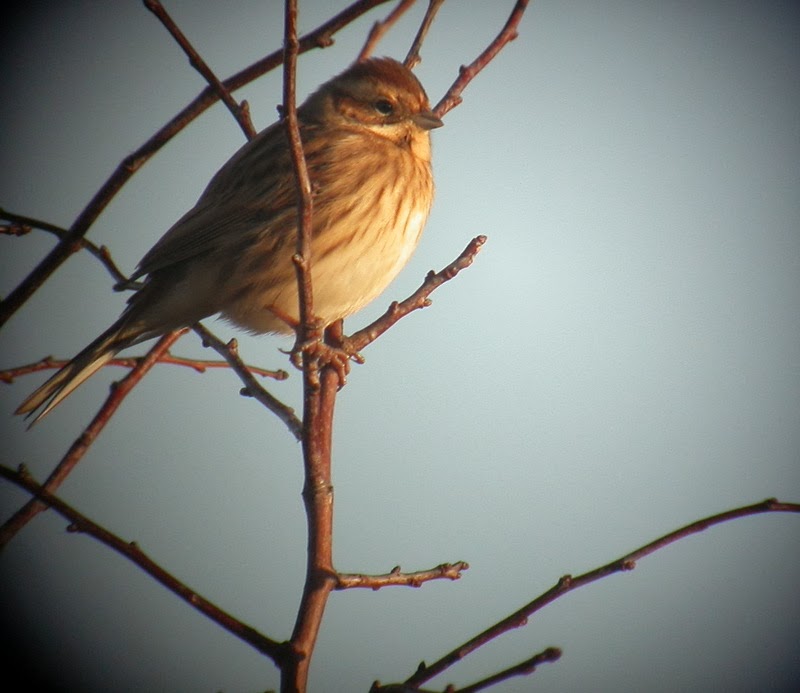
Here is one I took by digiscoping a Reed Bunting


and here is one with my new camera:


The results look pretty similar, but the digiscoped image is cropped, while the shot taken with the new camera is not.

Brother-in-law technical support not required, a universal card reader has done the trick.

Anyway, on the camera is a very nice photograph of a Little Owl, a dodgy photo of a Grey Wagtail, and several shots of Reed Buntings etc. Hopefully I will be able to share these with you at some point.

Now is that time:


It was a cold and frosty morning, and with frozen water everywhere I didn't see much else.

A quick summary of the year reveals that I have equaled my previous best year here, (2010) recording 118 species plus Feral Pigeon. Highlights were the Marsh Harrier, Great Grey Shrike, Mealy Redpoll, Whooper Swans, and Short-eared Owls.

There were a number of other good species for the patch, like Whimbrels, Red Kite, Ringed Plover, Black-tailed Godwit, Goshawk, Merlin, and Corn Bunting, while several more expected species only just sneaked onto the list with one day only sightings, eg Greenshank, Common Sandpiper, Oystercatcher, Little Egret and (disastrously) Tree Sparrow. Birds I failed to record in 2013 included Great Black-backed Gull, Shoveler, and Pintail. The only species I know to have occurred without me seeing it was Crossbill, seen by Matt Willmott...Oh, and a Common Tern seen by Jon Yardley. I had almost airbrushed that one from my memory as I was there at the time, but not close enough to see it.

2014 promises more competition. I still intend to try for a photo list, and Mike is still up for trying a rival list at Middle Spernal Farm Pools plus Haselor scrape, and yes I have signed up for the Patchwork challenge again.

Happy New Year to everyone reading this blog.

Thursday, 26 December 2013

Buntings & Bullfinches

A foggy start, but today was to see another addition to the year-list.

As I wasn't sure how long the fog would linger, I began by trying to get a shot in the can, and settled for this obliging Fieldfare at Netherstead Farm.


I decided to tackle the south end first, and found about 150 Linnets, about 50 Chaffinches, and 45 Fieldfares down there. I also began logging Buntings, having noticed that they have been well represented in recent visits. Almost as an afterthought I also started counting the Bullfinches. For some reason the patch seems to be an irresistible draw for them this winter, and I ended up with a minimum of 12 (smashing my previous record; although it had been just four).

Back to the Buntings, I actually didn't count all that many Reed Buntings (just 20), but there were more Yellowhammers than usual. I ended up with 32 (less than half my best count which was in 2007) but more than I have seen this autumn.

Just beyond the dragonfly pool field I started walking along the hedge towards Stapenhill Wood. I could see a Reed Bunting perched up, and another Bunting beyond. This was 20% larger and rather nondescript, and not yellow. It began to dawn on me that I was looking at a Corn Bunting. I gently tried to get my scope off my back and onto my tripod, which is where everything went wrong. The bird clearly had its eye on me and decided to fly off. I saw it was fat bodied and  didn't see any white outer-tail feathers. Sadly it ignored my muttered requests to land, and I watched it keep flying north-west until lost from view.

This is the fourth record for the site, and my second. Three of the previous records were also in mid-winter, so I guess they may occasionally move north with Yellowhammers from their nearest breeding sites south of Alcester.

So sadly, no photo to show. Here is a Robin in the fog instead!


A short time later I heard a Golden Plover, and a little afterwards a small flock flew over, giving a day total of 14. The various water courses were pretty disappointing again; 101 Lapwings, a Wigeon, two Teal, and five Snipe was all the flashes could muster.

There are still quite a few Meadow Pipits about, I would estimate about 15 today, and the Stonechat is still present at the pool.

Sunday, 22 December 2013

Another red-letter raptor day

Sunday December 22 started off sunny, a bit cold, and breezy. Dave got to the patch before me, but had little to report. We started off with a view of the female Brambling, but as we reached the small pond en route to the main pool it was apparent that it was going to rain. A thick black cloud caused us to clamber over a fence and walk on the sheltered side of the hedge leading to the pool. This was to prove to be a very good idea indeed.

About half way along the hedge a bird flew out and then banked before heading across the field and away. In the short time available we were able to identify, and get excellent views of the bird; a female Merlin.

female Merlin
This was a great pull-back for Dave, and was a far better view for me than the distant dot I had seen a couple of weeks ago. We noted its barred tail and lack of striking head markings. A minute later Dave picked up another raptor, this time flying along the fence on the far side of the field. It was a Sparrowhawk, and we watched as it landed in a bush across the field. A Kestrel and a Buzzard were also seen as we sheltered from the shower.

In the distance, a flock of 25 Wigeon were wheeling around over the flash, so that needed to be our next destination.

The rain eased and we set off again. Only 100 yards further on I picked up another raptor, this time flying over the pool. Close to Buzzard size but with a longer and distinctly rounded tail I called out "what's this?", and then "Goshawk" as it swung round and started to return the way it had come. I realised Dave hadn't seen it at first, so nudged him and pointed as it continued its progress back towards Bannams Wood. He got onto it before it started to get distant, and we watched until it disappeared over the crown of the wood. Fantastic.

The flashes were devoid of any Wigeon, and we recorded only nine Teal, 2 Green Sandpipers, and 21 Snipe plus a few Lapwings and Black-headed Gulls. A few sorry looking Greylags limped around the field, and we suspected they had been shot at.

On the walk back a few large Gulls were seen heading west, mostly Lessers plus four Herring Gulls. Not enough birds to give any realistic hope of something different. With five raptor species under our belts we were already pretty pleased with ourselves, but more was to come.

Scanning across towards Bannams Wood we saw that the Goshawk was visible again, and above it a small raptor turned out to be a Sparrowhawk. I got the scope up for a better look, but the Goshawk had drifted off. However, Dave then spotted another bird and drew my attention to it. He had finally broken his duck for the year as we watched a Peregrine circling over the wood. Our sixth raptor of the morning.

This third sighting of a Goshawk here in the course of a little over a month does raise a few issues. Do I continue to mention its presence if I see it again? On the one hand the species still suffers persecution from egg robbers, but on the other it is still winter and I notice that its sites are mapped on the new BTO Atlas, and that the species is clearly on the increase and spreading its range. I don't really want to suppress sightings from my own blog, but if they start displaying in February I may have to do so.

Tricky one.

Tuesday, 17 December 2013

Tuesday December 17

A rare midweek visit coincided with a bright sunny day. A Green Sandpiper flew over the car at Netherstead Farm. I quickly got stuck into trying to photograph birds, and came up with a few images from the hedgerow bordering the dragonfly pools.

Female Reed Bunting

Mostly Buntings.

Female Yellowhammer
The rest of the site contained mostly just the usual suspects, although a female Tufted Duck was a surprise at this time of year. The flashes were very disappointing, just 10 Common Snipe, although 140 Lapwings were flying around.

I was surprised to see that the Stonechat was still present, and then managed to see and photograph the Tawny Owl in its usual spot.

Tawny Owl
Finally, I walked back along the road and then found a female Blackcap at Netherstead Farm. Quite scarce in winter here.


Sunday, 15 December 2013

Sunday December 15

The weather had calmed down overnight and the morning was fairly mild, fairly bright, and fairly boring. I tramped around seeing nothing better than 18 Wigeon, five Teal, 150 Lapwings, a Brambling, a Grey Wagtail, and a Goldcrest. The last three would be useful additions when the new year begins.

I am trying to decide how to spice up the birding next year. In 2013 I took part in the Patchwork Challenge, but I found it a bit disappointing because only three other Midland patches took part throughout the year, and the site dealt only in numbers. It would have been more interesting if the participants had been invited to show the list of the species they saw. So I don't think I'll bother next year.

This doesn't mean I won't be doing a list though. Quite the opposite. I have talked Mike into competing against me with a list of birds at Middle Spernal Farm pools just down the road. Our sites are quite similar so I think it could be a good contest. Unfortunately Mike doesn't blog (or even own a computer) so I will have to keep his list on my blog.

Also, I started wondering how many species I had photographed here last year, and came up with a tally of 54, including today's offering:

A Linnet
So that's another list for me to keep. Yes I know, what a sad b****d, but I regard it as fun so its going to happen, and I can't wait.

Expect an increase in fuzzy, distant bird images.