Wednesday, 31 July 2024

Wednesday July 30 - Too hot ?

 A summer heatwave can be a little too much. I went birding at Morton Bagot yesterday, just missing the coolness of early morning, and found that the nearest flash has an even wider margin of mud, and roughly the same number of Green Sandpipers and Lapwings as we saw on Sunday. The wait for something unusual goes on.

At the church I noticed a small group of Swallows on telephone wires, and was left to reflect that the four adults and three juveniles probably represents one successful pair and one failure. 


The flip side of all this hot weather is that it should be good for insects. The butterfly totals have been down this year, maybe because of the cool spring, but a warm night meant there should be lots of moths.

I put the trap out in the garden and caught 370 moths of 51 species. That sounds pretty good doesn't it, but the majority were micros; 131 Ypsolophas (Ermines) and 154 Water Veneers forming the bulk. 

My only garden tick was a micro, albeit a reasonably large one. A single Eudonia pallida (known as Marsh Grey or Pallid Grey depending on which book you read) was one I had been hoping to see for years. They are described as fairly common, and I suspect that closeness to a reed-bed is the deciding factor.

Pallid Grey looking suitably pale in an egg box

The rest of the catch contained no great surprises, although Gold Triangle (another micro) was only my third.

Actually, that's not entirely true. The one big surprise was the lack of any Large Yellow Underwings (or any of the Yellow Underwing species). I'm sure I would have been catching loads of them in previous summers.

Maybe things are just as bad for moths as butterflies (they're all the same thing really anyway).

Sunday, 28 July 2024

Morton Bagot - Sunday July 28

 It was a sunny and warm morning. I met Dave at Netherstead and it wasn't long before we found a decent bird. A juvenile Peregrine was sitting on the nearest pylon, the first of that species since March, and the first juvenile this year.

Juvenile Peregrine

The ringers had been hard at it since the early morning and had caught their first juvenile Grasshopper Warbler of the year, along with a Willow Warbler and a host of regulars. We were late on the scene but were still in time to see a juvenile Sedge Warbler which had just been caught.

Juvenile Sedge Warbler


We headed on our usual circuit and 400 metres further on located a Garden Warbler in the hedgerow. This was probably the bird of the day.

At the flash field we could only manage nine or ten Green Sandpipers, although I'm sure more were out of view. Teal numbers have climbed to five, Lapwings were up to 37, and a Little Egret haunted the furthest flash. 

We saw two Red Kites, but they were too distant to age. 

As it was warm there were lots of insects on the wing including Brown Hawkers and loads of Emperors. We saw several Peacock butterflies, a species which I've found as scarce as all the other butterflies this year.

Dave is something of a fly magnet, constantly getting bitten by flesh flies. However I was thrilled to see a "different" fly resting on his back. 

Chrysops caecutiens according to my app.

I've looked it up and it does indeed seem to be a Splayed Deer Fly C caecutiens, which had obviously thought it had landed on a blue Roe Deer. I'm not sure Dave was all that impressed.

Friday, 26 July 2024

Morton Bagot - Friday July 26

 First the good news. I counted 17 Green Sandpipers which equals the site record.

Wren

Now the bad news. I haven't really got to the bottom of why I'm having trouble uploading photographs to the blog, but as you can see I have found a way for now. 

Thursday, 25 July 2024

I'm just going to have to lump it

 The Morton Bagot list is set to go into reverse. Following the decision of the IOC (International Ornithological Committee) to lump all the Redpolls into one species, I have now lost Mealy Redpoll from my list....in a way. 

My Morton Bagot list has slumped to 158 species. Of course I've still seen Mealy Redpoll here, I just can't add it to my species list. Lists matter to a lot of birders and I can't deny I do like listing. On the other hand I won't really miss Mealy Redpoll because identifying them is very hard. 

The driving force behind the change is the science of genetics, and I gather further changes are likely. I shouldn't complain because throughout my birding life I have benefitted from far more splits than lumps. I can still remember when Water Pipit was split from Rock Pipit, a change that everyone thought was long overdue.

I'm grateful to the IOC for giving me something to write about, because the birding has been very quiet lately.

I did pop down to the patch yesterday hoping for some change, but it was all pretty much as I'd left it. The highlight was a Sand Martin heading south, while a Grasshopper Warbler continues to sing in the chat field.

I was only able to count 10 Green Sandpipers on the nearest flash, the Lapwing flock remains stable, and Teal numbers have doubled....to two.

The really bad news is that I can no longer upload photos to the site. I'm going to have to find out what's going on.

This could be the last post.


Sunday, 21 July 2024

Sunday July 21 - Morton Bagot

 After a week of birding abstinence I was keen to make the most of the weekend. Saturday dawned dull and overcast and remained that way all day. The highlight for me was finally meeting Redditch birder Mike Holley on site.

Mike was very happy with his morning and has kindly shared some of his photos. The most interesting was his shot of a Red Kite which I believe shows a juvenile bird. This is good circumstantial evidence that they have bred in Bannams Wood this year.

Red Kite - Mike Holley

He also saw three juvenile Stonechats before we headed for the nearest flash which now looks in great nick. We counted the Green Sandpipers and found a newly arrived Teal. Earlier I had heard a Grasshopper Warbler singing from the Chat field, but chose not to try to see it.

One of the juvenile Stonechats

Juvenile Great Spotted Woodpecker - Mike Holley

This morning I returned in bright sunshine and hadn't got very for before discovering a Garden Warbler, a good sign. This was my first here this year, the site doesn't yet attract them regularly.

Garden Warbler

I reached the nearest flash and was pleased to find there were even more Green Sandpipers than yesterday. I counted 16 individuals plus a Little Ringed Plover, only the second here (and my first) this year. The Teal was still there and also the usual two Little Egrets.

Large raptors were very much in evidence. At least seven Common Buzzards and three Red Kites, Mike's juvenile and two adults.

My favourite moment of the day came on the walk back along the Morton Brook. I had just stopped to try to photograph a probable Essex Skipper when a small bird leapt out of the grass and flew past me calling a loud "tick" repeatedly. I knew immediately that it was a Grasshopper Warbler and having not actually clapped eyes on any of this year's singing birds, I was keen to see it well. As it turned out all I had to do was stand still and watch as it approached me, calling constantly.

 Grasshopper Warbler

You'll notice that it has been ringed, presumably by Tony K this year. I don't know why it was so obliging, but I suppose it is likely that there were recently fledged juveniles nearby.

In the end I didn't confirm any of the Small Skippers were definitely Essex Skippers, but I did see my first Southern Hawker dragonfly of the year.

A pretty good weekend's patch birding.

I nearly forgot, I also added a common micro-moth to my very limited site moth list when I noticed a Carcina quercana in a hedge. Unfortunately my attempt to take its picture was an abject failure.

Friday, 19 July 2024

Friday July 19 - Mostly moffs

Birding opportunities have been scant this week, but at least we now have a new carpet and my late mother's flat has been cleared of furniture. However this morning following a warm sticky night as I was in the garden preparing to investigate my moth trap I heard the screaming of Swifts overhead and looked up to see 20 of them careering overhead. This modest count was still the largest number I have seen this year as their UK population continues to decline.

As for the moths, well this was easily my biggest night this year. I counted 221 moths of at least 39 species. Typically the majority were micros, in particular the tiny Yponomeuta moths which are often impossible to identify to species level. Most were Yponomeuta evonymella (Bird-cherry Ermine) no doubt a reflection of the overgrown state of our garden. Some were definitely some of the other Ermine species. The common one I'm missing is Willow Ermine, Yponomeuta rorrella, but I had a few candidates.

Willow Ermine Yponomeuta rorrella (confirmed by gen det)

Fortunately most of the other species, even the micros, were easier to separate. I still did my best to overlook one of two other species which were lifers. To be fair, I knew the insect in question was something I hadn't seen before, I just didn't realise it was a moth. Fortunately I was curious enough to take a photograph and ask Obsidentify what it was. The name Homoeosoma sinuella meant nothing to me and it was some time later that I discovered it was the latin name of the pyrallid moth called Twin-barred Knot-horn.

Twin-barred Knot-horn

It was rather good for Pyrallids and I also recorded only my second Grey Oak Knot-horn Acrobasis consociella, and several other species which are less than annual.

My last lifer was a macro-moth, but a very small one. As far as I can tell the Short-cloaked Moth is not rare locally, but I'd never seen one before.

Short-cloaked Moth

At least I knew it was a moth.

Sunday, 14 July 2024

Sunday July 14 - Morton Bagot

 The sun was out, the ringers were ringing, and Dave joined me for a stroll around the patch. It definitely feels like everything is back to normal. We also saw no unusual birds, so certainly a typical visit.

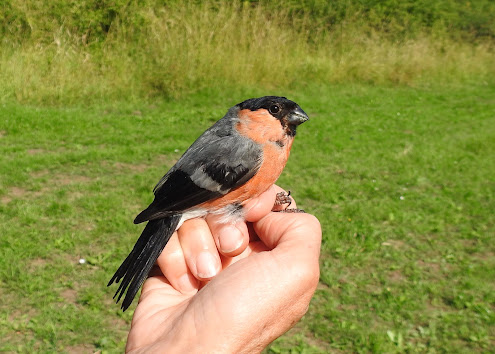
By the time we left them the ringers had caught 74 birds including 11 Whitethroats, two Goldcrests, and a male Bullfinch.

The Bullfinch

Our circuit had a few minor highlights such as a Red Kite which flew low overhead, a Little Egret and four Green Sandpipers at the flash field, and a fly over Cormorant.

Red Kite

The warm weather was good for seeing dragonflies. These included several Ruddy Darters, and a few Small Red-eyed Damselflies which were new for the year.

Ruddy Darter

Small Red-eyed Damselfly

I also did another 15 minute butterfly count and managed 44 butterflies (plus Large and Small Skippers) of six species. This was a lot better than zero butterflies in 15 minutes at Hillers Garden Centre yesterday (admittedly in cool overcast conditions).

Things are looking up.