Sunday, 29 September 2024

Lower Bittell Reservoir - A fool's errand

 Earlier this year I noticed that the BTO were asking people to volunteer to count gulls at gull roosts. I used to do this so thought I would apply to count the one "vacant" locality within my circle of interest; Lower Bittell Reservoir.

Now I know what you are thinking. Surely Lower Bittell doesn't have a gull roost. That's what I thought too, but maybe my knowledge was out of date.

I didn't hear anything after I applied, but I assumed that once I logged on to their website I would be able to enter data anyway.

It turns out I couldn't. Presumably my application went unnoticed. This was probably just as well because, guess what. There were no gulls whatsoever roosting (or even popping in for a look) at Lower Bittell this evening.

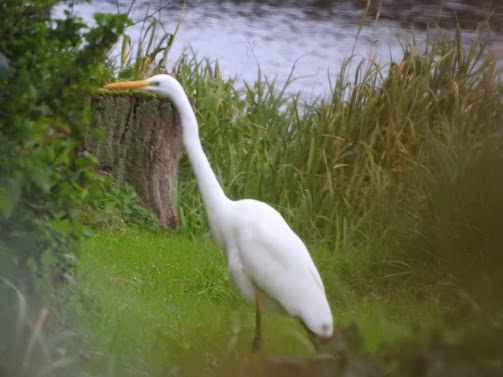
At least I got a Bittell tick out of it. Great White Egrets are semi-resident there nowadays, but in my very few recent visits I had managed to miss them until this evening. In poor light, photographed through a hedge, I managed a horribly out of focus record shot.

This may not have been the best bird recorded though. I also heard a Water Rail squealing from reeds below the locked entrance gates.

All in all it was an evening I'd prefer to forget.

Saturday, 28 September 2024

Saturday September 28 - Morton Bagot

 This morning I was joined by Mike Holley for a walk around the patch. We arranged to meet at the church, and I was a little early so had the opportunity to assess whether there was much overhead migration going on.

The answer was a qualified yes. Meadow Pipits and Skylarks hinted at the winter to come, while a few Swallows headed south. Once Mike joined me, I suggested we start at Netherstead and inevitably it became more difficult to keep track of the numbers moving south. I totted up a modest 30 Meadow Pipits, eight Skylarks, and five Swallows at the end of the morning but I'm sure many more were missed. A single Siskin call represented the first of the autumn.

We met up with the ringers who mentioned catching Linnet as well as plenty of Meadow Pipits. After leaving them, having already seen a Stonechat near Netherstead, we added three more in the scrape field.


Other species which seemed more obvious than usual included Reed Buntings, Blackbirds, and Song Thrushes. I'm never sure whether the early autumn thrushes are simply local birds which have competed their moult and are now only interested in fattening up for autumn, or are actually the forerunners of an autumn arrival which will soon include Redwings.


We finally reached the flash field and were a little disappointed, but not surprised, to find that the water level had risen to the extent that there was virtually no exposed mud. As a result we saw only 17 Teal, one Snipe, and heard a Green Sandpiper.

During the morning we logged eight Chiffchaffs and three Blackcaps but nothing rarer. Mike professed himself to be quite content with the morning's list, while I had to admit my enjoyment of it would have been enhanced if we'd winkled out something a little less run of the mill.

Thursday, 26 September 2024

Thursday September 26 - Not birding at Earlswood

 I'm not supposed to be birding at the moment. The latter half of the week has been taken up by a series of routine hospital appointments for Lyn (and therefore me), so I cleared all thoughts of birding out of my mind.

But yesterday a Whatsapp ping came from John Oates at Earlswood. He'd found a Rock Pipit at the bottom end of Windmill Pool. Thirty minutes later it had moved to the causeway, so I cracked and went for it. It was pouring with rain and I dipped. My only compensation was the first Snipe on the rafts there of the autumn.

This morning John confirmed it was still there, and after a brief bit of negotiation I went to try again. I arrived just before the Malthouse car-park gates had been opened, so parked in the lane itself. Shortly after I'd got out of the car two Ring-necked Parakeets flew over. 

I joined John and Janet on the causeway and John tried to point the Rock Pipit out. The problem was that it was walking along the bottom of the dam and was only viewable from the causeway looking into glaring sunlight. Eventually I spotted it and we tried walking down the dam to get a better angle. This failed and the bird was flushed by a dog-walker, allowing us to see it flying off towards Engine Pool.

Now I had to leave, so I'm doubly grateful to John who has allowed me to post a superb photograph he took of it before I got there.

The Rock Pipit - John Oates


Tuesday, 24 September 2024

Tuesday September 24 - Morton Bagot

 After several days of heavy rain and easterlies, the east coast of Britain has been reaping the rewards. Yellow-browed Warblers have been outnumbering Chiffchaffs at places like Spurn. So with the wind finally dropping and conditions set fair with a very light westerly this morning I was trying to figure out where a Yellow-browed Warbler might be if it made it as far as Morton Bagot.

It's a big if. I targeted Bannam's Wood first and then swung down into the scrub of the rest of the site. The result was 11 Chiffchaffs and three Blackcaps. Oh well, back to the drawing board. 

At least birds were moving. I logged 44 Swallows, 52 House Martins and 30 Meadow Pipits over during the morning. Other small wins were a calling Yellowhammer flying high overhead, and a Peregrine being mobbed by a Sparrowhawk.

The flash field continues to hold the usual Teal (41), Snipe (six), Lapwings 16), and Green Sandpipers (three). The only hint of the unusual being a drake Shoveler on the back flash, and a female Wigeon on the nearest.


It was quite mild, so insects remain on the wing. The most noteworthy being a very dozy Small Copper which refused to open its wings for the camera.


Looking back at the weekend, the ringers claimed the biggest prize with a fly-over Great White Egret on Saturday. I tried Earlswood in the rain on Sunday, but apart from a flock forty distant hirundines moving when the rain briefly abated I saw nothing unremarkable.

Typical Midlands birding.

Thursday, 19 September 2024

Thursday September 19 - Morton Bagot

 With the wind firmly in the east, you might think there should be an opportunity to find something unusual. 

Mike Holley had a go yesterday and did better than I did today. After a brief glimpse of the Black Redstart (which I could find no trace of today), he followed up with a Hobby, two Shovelers, 10 Snipe, about 55 Lapwings, and seven Green Sandpipers. Not bad at all.

This morning after dipping on the Black Redstart, I slogged round without seeing all that much. Several Chiffchaffs remained vocal and a few Swallows and a House Martin encouraged me to think that there may still be a few summer migrants around. I also saw a single Stonechat on the tree-guards.

The one brighter note was that the farmer has mowed or strimmed the flash field since my last visit, so it is now possible to see any ducks or waders which are there. I was reasonably happy with counts of three Green Sandpipers, 34 Lapwings, 45 Teal and 12 Snipe.

A few of the Snipe

The Lapwings were quite jittery so I'm pretty sure there was a raptor about, maybe Mike's Hobby.

My gut feeling is that the Black Redstart has now gone, but you never know it could have been hiding somewhere.


Monday, 16 September 2024

Sunday September 15 - Morton Bagot (and some garden mothing)

 With Dave away birding on Scilly, I was joined by Jonathan Bowley who was keen to see his old stamping ground and particularly the Black Redstart. 

This morning the bird was a little elusive at first until Jon spotted it on a television aerial on one of the barns. We then settled into my normal circuit, noticing a constant trickle of Swallows and House Martins heading south in the first hour.

The ringers were in situ and were catching Meadow Pipits, while we headed for the old pool field where we counted five Stonechats and two Whinchats. At least four Whitethroats were still around along with a few migrant Blackcaps and Chiffchaffs. The flash field contained the usual Green Sandpipers, Snipe, and Teal, and before we left the site we saw a Red Kite cruising along in the distance.

Unfortunately all the birds I saw were too distant to encourage me to get my camera out, so I was left with the prospect of an unillustrated blog post. To get around that I decided to put my moth trap out overnight to see what was around.

The result was an impressive 74 moths of 18 species including two new for the year, and two new for the garden. One of those was quite a good moth. The White-point was largely regarded as a migrant and only appeared in Warwickshire for the first time in 2017. However the species has since spread from the south-east and is now recorded in moderate numbers each year.

White-point Mythimna albipuncta

The other new one was one of the few micros I caught. The Meal Moth is associated with grain stores and is thus a rather urban beast. They are not especially uncommon, but its still taken me seven years to catch one.

The rather worn Meal Moth Pyralis farinalis

Oak Hook-tip

Perhaps it's not quite time to give up on moths, even the very common Oak Hook-tip is not quite annual in the garden so there should be scope for more discoveries in future.


Friday, 13 September 2024

September 13 - Morton Bagot

 If Morton Bagot is good for anything, it's good for chats. This morning I parked at the church and duly ticked off the Black Redstart which shows no sign of leaving. Later on I added two Whinchats and two Stonechats to the day list. They were accompanied by a single Whitethroat, a warbler which seems to consider itself an honorary chat. They say that Dartford Warblers will often accompany Stonechats, and even follow them to the Midlands. One day maybe.

Black Redstart photographed on Wednesday by Mike Holley

Whinchat on Wednesday - Mike Holley

Stonechat - today

The ringers are back from their holidays and were concentrating on catching Meadow Pipits. September sees the start of that species' annual migration to southern Britain or western Europe as far south as Spain.

Meadow Pipit

In calm, sunny conditions the patch was generally quite quiet. Teal numbers were lower, but Snipe were up to seven, and Green Sandpipers about the same (three). Other birds seen included Kingfisher, Raven, and Red Kite.

This mid-September lull is typical as the last of the summer visitors leave and we await the arrival of the first winter thrushes from mid October.

But as always in birding, anything can turn up in the meantime.