Sunday, 9 September 2018

Sunday September 9

After opting not to take part in the West Midlands Alldayer (partly because I'd thought it was going to rain all day - pathetic I know) I was on site for my usual Sunday morning slot. It was a rather cloudy start, but soon brightened up. A light to moderate south-westerly was not especially encouraging.

The early signs were not good, but a Sedge Warbler which flew from the hedge by the pond was likely to be my last this year. Hirundines grew in number through the morning ending up at about 100 split 60/40 in favour of House Martins over Swallows. My first 10 Meadow Pipits of the autumn flew over the pool field and landed in the weedy field beyond.

Warblers were hard to pin down and apart from a few Chiffchaffs and the aforementioned Sedge Warbler, I recorded just a single Lesser Whitethroat. A couple of other tackers failed to reveal their identity though.

At the Flash field 192 Greylag Geese dominated, but the furthest flash did contain a single Shoveler, standing out from the dross. I wasn't sure if it was new for the year, but it appears I did see one in March.

Shoveler with Greylags
Waders remain disappointing; just four Green Sandpipers and 21 Snipe, while the Shoveler was accompanied by 34 Teal. One oddity was a Little Grebe bobbing up and down in the deepest part of the nearest Flash; the first of those since the spring.

The sun came out on the walk back, and I found myself looking at insects. Small Coppers seem to be having a better year, I saw four without really trying. Several second generation Small Heaths were on the wing along with several Small Whites and a Speckled Wood. One patch of nettles was being devoured by a host of Peacock caterpillars.

Peacock caterpillar apparently unaware of the large Spider to his right.
Dragonflies comprised a few mature Common Darters and several Migrant Hawkers, one of which was kind enough to pose for me.

Migrant Hawker
I'll be back with the Richards on Friday, but judging by the bounty on offer today, we'll probably be picking blackberries.


Sunday, 2 September 2018

Sunday September 2

After a brief sunny start a large cloud bank blocked the sunshine until late morning when the sun returned. An extremely light breeze, possibly south-east.

In ideal conditions it took a while to finally see a decent bird. The Greenshank flew from the pool and headed for the flash. When I got there, further calls indicated it was flying again, but this time I didn't see it. Fortunately, about 15 minutes later it reappeared and I got some rather distant shots.

Greenshank (with Teal and Mallard)
Other birds present included 41 Teal, 22 Snipe, and four Green Sandpipers. The Greenshank flew silently away after about 20 minutes, but I'm pretty sure it was heading back to the pool. A Little Owl called a couple of times, and a large tit flock was carrying Lesser Whitethroats, a Blackcap, and Chiffchaffs.

The grassland gave me a Roesell's Bush Cricket and many grasshoppers. I was dismayed, but not surprised, to find that I could not hear a stridulating Meadow Grasshopper. The sound of grasshoppers in the field must have been amazing. The joys of getting old!
Roesell's Bush Cricket
As I reached my car I spotted a bird under a farm vehicle. It turned out to be a young Wheatear, my first of the autumn.

Wheatear
It was remarkably static, allowing prolonged views, eventually coughing up a pellet.

Saturday, 1 September 2018

Saturday September 1 - news from the patch

Chris Lane has got down to Morton Bagot this morning, and found the first Greenshank of the year plus a Redstart and a Yellow Wagtail.

A good start to the month.

Monday, 27 August 2018

Monday August 27

A mostly cloudy morning with a few very light showers and a light westerly wind.

This is one of my favourite times of the year for birding, but the weather and wind direction were a potential adverse factor.

After about an hour of not even seeing a passerine migrant, unless you count the 30 or so House Martins harvesting insects in the lee of the Netherstead plantation, I was beginning to think I was wasting my time.

I eventually reached the Flash field and counted an impressive 224 Greylag Geese and 38 Canada Geese. The nearest flash contained only four Green Sandpipers, four Snipe, 23 Teal, and 24 Black-headed Gulls. I decided a token bird photograph was in order.

Green Sandpiper and Pied Wagtail
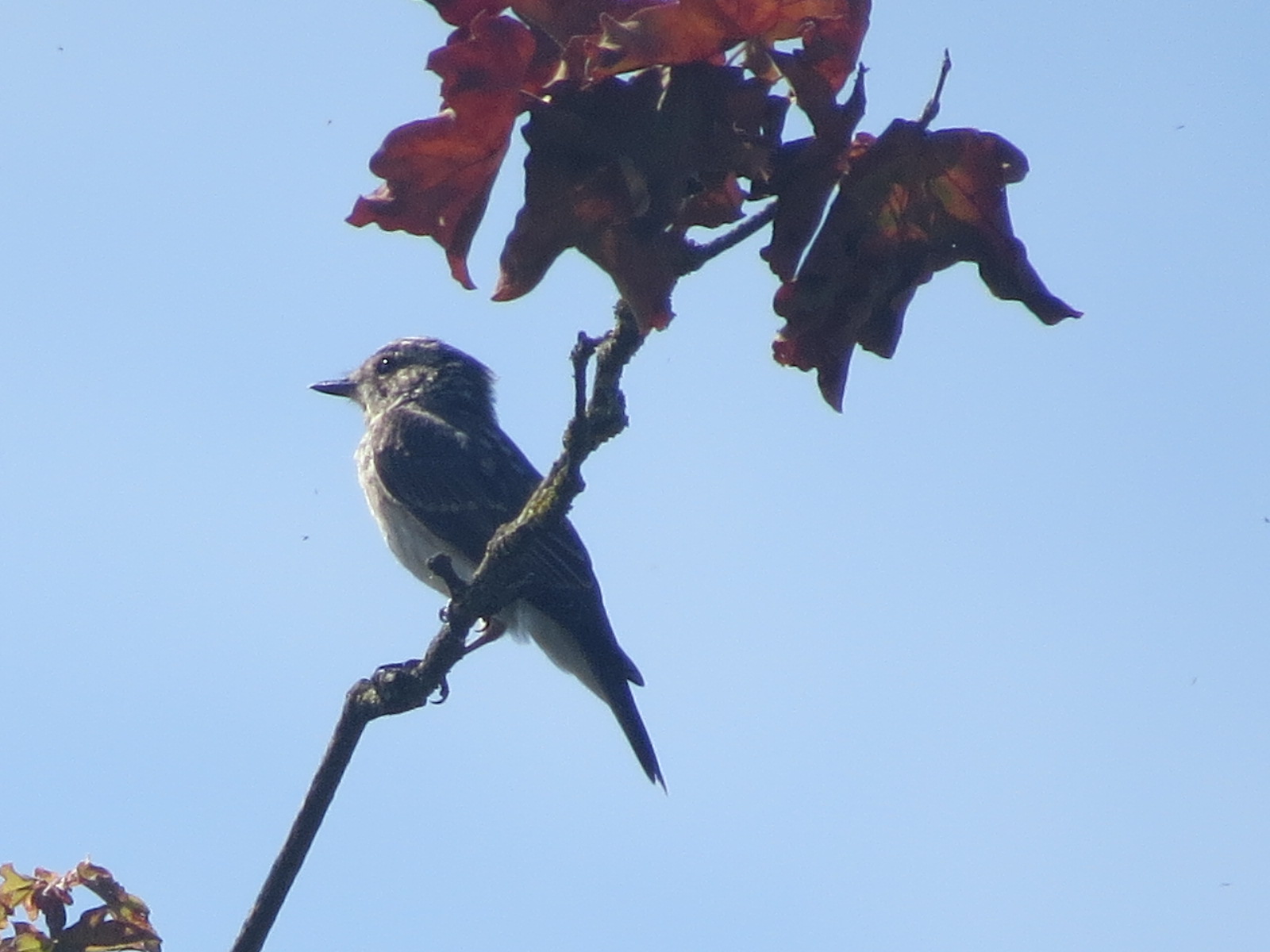
Fortunately my fortunes started to improve a little when I spotted a Sand Martin over the water, and then a few other migrants in the hedge. A Spotted Flycatcher was the pick of the bunch, which comprised two Blackcaps, two Chiffchaffs, and a Whitethroat.

Spotted Flycatcher
A Sparrowhawk stirred things up, and a Little Owl started calling.

On the walk back I turned my attention to insects, the highlight being several crickets of a species called Long-winged Conehead. This is a fairly recent colonist to the Midlands, and I only saw my first here last year.

Long-winged Conehead
Other creatures noted included at least a dozen Dark Bush Crickets, a Lesser Marsh Grasshopper, about six shieldbugs I took to be Dock Bugs, and one or two butterflies; two Small Coppers, a Small Heath, a few "whites", and three Speckled Woods.

Speckled Wood
Finally I noticed several strangely shaped growths on an Oak Tree. They were sticky to the touch, and after some very brief research I discovered they were Knopper Galls.


The Galls are produced by a tiny wasp Andricus quercuscalicis, which only reached the UK in the 1960s, but is now widespread. Apparently the Oaks manage to take these galls, which are the result of eggs laid in budding acorns, in their stride and the trees do not suffer unduly.

Sunday, 19 August 2018

Sunday August 19

Cloudy with a moderate westerly which eased during the morning.

Our initial impression was that there were not many migrants about, but managed to pull a Yellow Wagtail out of the hat as it flew from the pool and headed away, initially over the flash field, before veering away to the east.

The water level in both flashes looked ideal, and once again there were plenty of waders; three Lapwings, 10 Green Sandpipers, and 17 Snipe as well as 14 Teal and several Pied Wagtails. More significantly for us was the presence of an adult Ringed Plover.

Ringed Plover
This was the first this year, and the species is just less than annual. Not quite worth a fist pump, but definitely the sort of lift we needed.

The rest of the visit was a bit quiet. Insects were few; a Speckled Wood, a Small Heath, one or two "whites", a few Ruddy darters and hawkers, and a single Dark Bush Cricket.

Muntjac
Always nice to see a Muntjac, but this deer could arguably be considered a pest species because of the damage they do to the woodland understory.

Sunday, 12 August 2018

Sunday August 12

Following an encouraging overnight forecast I was a little dismayed to find that they had got it wrong and the morning was actually pretty wet. In fact, I decided to wait until after lunch in the expectation of drier weather. Not much drier as it turned out.

Although there were plenty of tits around Netherstead, and about 40 low flying House Martins across the site, there was precious little evidence of passerine migrants.

The only hope was the flash field. As usual it looked good but hosted only the usual suspects; six Green Sandpipers, 10 Teal, 12 Lapwings, and 18 Snipe (a considerable increase on last time).

Snipe
I was disappointed to see evidence that whoever farms the land beyond the Kingfisher Pool had grubbed out an Alder at one end of a hedge. I hope he stops there.


Sunday, 5 August 2018

Sunday August 5

A warm and mostly sunny morning with a very light southerly breeze.

Dave was able to join me and he soon spotted the first passerine migrant of the day, a Whinchat, near the Dragonfly Pools.

Whinchat
We continued to the pond in hedge, now bone dry, where we found a little flock of migrants. We followed them down the hedge and ended up with counts of 10 Common Whitethroats, five Lesser Whitethroats, several Chiffchaffs, a Willow Warbler, and a juvenile Spotted Flycatcher.

Willow Warbler
Spotted Flycatcher
Further evidence of migration came with a trickle of Swifts (nine in all) heading south.

The Flash field contained a lot of cattle. They were sheltering under an oak until they saw us and abandoned the shade for the thrill of getting as close as they could to us standing on the other side of the fence. To our amusement, the sheep in the field saw their chance and rushed to replace the cattle under the shady oak.

As for birds, we counted five Green Sandpipers, 37 Lapwings, a Snipe, and nine Teal. It was at this time we added a rather unsatisfactory year-tick. High up and off to the north we could hear a tern calling. We scanned the sky for at least a minute while the tern or terns called about a dozen more times. We couldn't see a thing. Given the time of year and the weather it was almost certainly a Common Tern as opposed to Arctic, but it would have been nice to actually see it.

Green Sandpiper

There were still plenty of insects about, more Small Heaths than recently, and still a few Common Blues and at least one Brown Argus. Dragonflies included the first Migrant Hawker of the year and at least 30 Small Red-eyed Damselflies.

A single Toad was sitting, covered in slime, watching the dragonflies with great interest.

Toad
By midday it was too hot to do anything further and we slouched off home.