Sunday, 22 August 2021

Sunday August 22 - The bar is raised a notch

In my birding calendar there are certain dates which spur me to extra effort, and higher expectations. For me, the three weeks after August 20 are when early autumn migration reaches a peak. The bar is raised and hope is high.

This morning Dave joined me as usual, and we started looking. Thunderstorms overnight may have forced migrants down, but the heavy rain will have raised the flash levels. There was plenty of bush-bashing (not literally) to do on the way, and a single Willow Warbler was subtly different from the numerous Chiffchaffs diving for cover.

Willow Warbler

We had met Mike Lane on his way to try to film Goldfinches from his photographic hide. Our own path took us to the old pool where Dave spotted two Hobbies streaking away from us towards the flash field.

The flash field revealed higher water levels as we had feared, but we still counted five Green Sandpipers, five Snipe, one Lapwing, 17 Teal, and 33 Mallard. It's still underperforming.

Apart from Whitethroats we were not finding many migrant passerines, so it was something of a relief to discover two Whinchats in the weedy strip where the Red-backed Shrike had been.

One of the Whinchats

As usual, they were difficult to approach. Walking back across the field Dave tripped over a hole in the ground. Peering into it we discovered the remains of a wasps nest. 

Wasp nest

We were a bit slow on the uptake, and it took a suggestion from Mike Lane before we realised that the nest had almost certainly been dug out by a Badger. I think you can see claw marks on the wall of the chasm.

Another feature of the morning was a constant stream of large gulls heading towards Redditch. We counted at least 51 Lesser Black-backed Gulls and a Herring Gull. The most likely explanation I can think of is that they were birds which had been loafing on a ploughed field somewhere. 

So not a bad visit, but the bar is now set higher, and I'm even harder to please.

I nearly forgot about the moths, a bit like last night when I was too captivated by the 100 Cricket Final on the television to remember to open the trap to allow them to escape. Lyn reminded me, but by then a thunderstorm was raging and I would guess they were not best pleased to have been kept waiting. Actually the trap is so leaky that most had already found a way out.

This all relates to Friday night when I had caught about 120 moths of 32 or so species. They were largely familiar ones, but did include a tiny Caloptilia semifascia which was new for the garden. This species of leaf-miner is sometimes given the name Maple leaf-borer, showing that it is another scarce maple chewing moth taking advantage of the Field Maples near the house.

Caloptilia semifascia

The full list was:

Yponomeuta ag 3,    Bird-cherry Ermine 8,    Caloptilia semifascia 1 (nfg),    Brown House Moth 1,    Chequered Fruit-tree Tortrix 3,    Light Brown Apple Moth 2,    Eudemis profundana 1,    Brimstone Moth 3,    Cydia splendana 2,    Phycita roborella 3,    Agriphila tristella 2,    Agriphila geniculea 16,    Pyrausta aurata 1,    Mother of Pearl 4,   Orange Swift 2 (nfy),    Riband Wave 1,    Yellow Shell 1,    Lime-speck Pug 1,    Willow Beauty 2,    September Thorn 2,    Dusky Thorn 2,    Straw Dot 2 (nfy),    Copper Underwing 6,    Vine's Rustic 2,    Common Rustic ag 2,    Flounced Rustic 12,    Flame Shoulder 2,    Shuttle-shaped Dart 2,    Large Yellow Underwing 35,    Lesser Yellow Underwing 2 (nfy),    Lesser Broad-bordered Yellow Underwing 10,    Square-spot Rustic 3

I also had to give up on several too worn to identify.

Thursday, 19 August 2021

Thursday August 19 - So much better

 You may have picked up on a rather negative vibe attached to my last post. Well today proves you've just got to forget the bad day and try again.

For a start the weather was better, sunny intervals and a light south-westerly. Admittedly I arrived to discover I'd forgotten my notebook, and as a compulsive note-taker this could have been an issue. But no, I soon found a hedgerow with plenty of warblers in it. They were mainly Whitethroats, plus a gorgeous Lesser Whitethroat. Enough to lift the spirits.

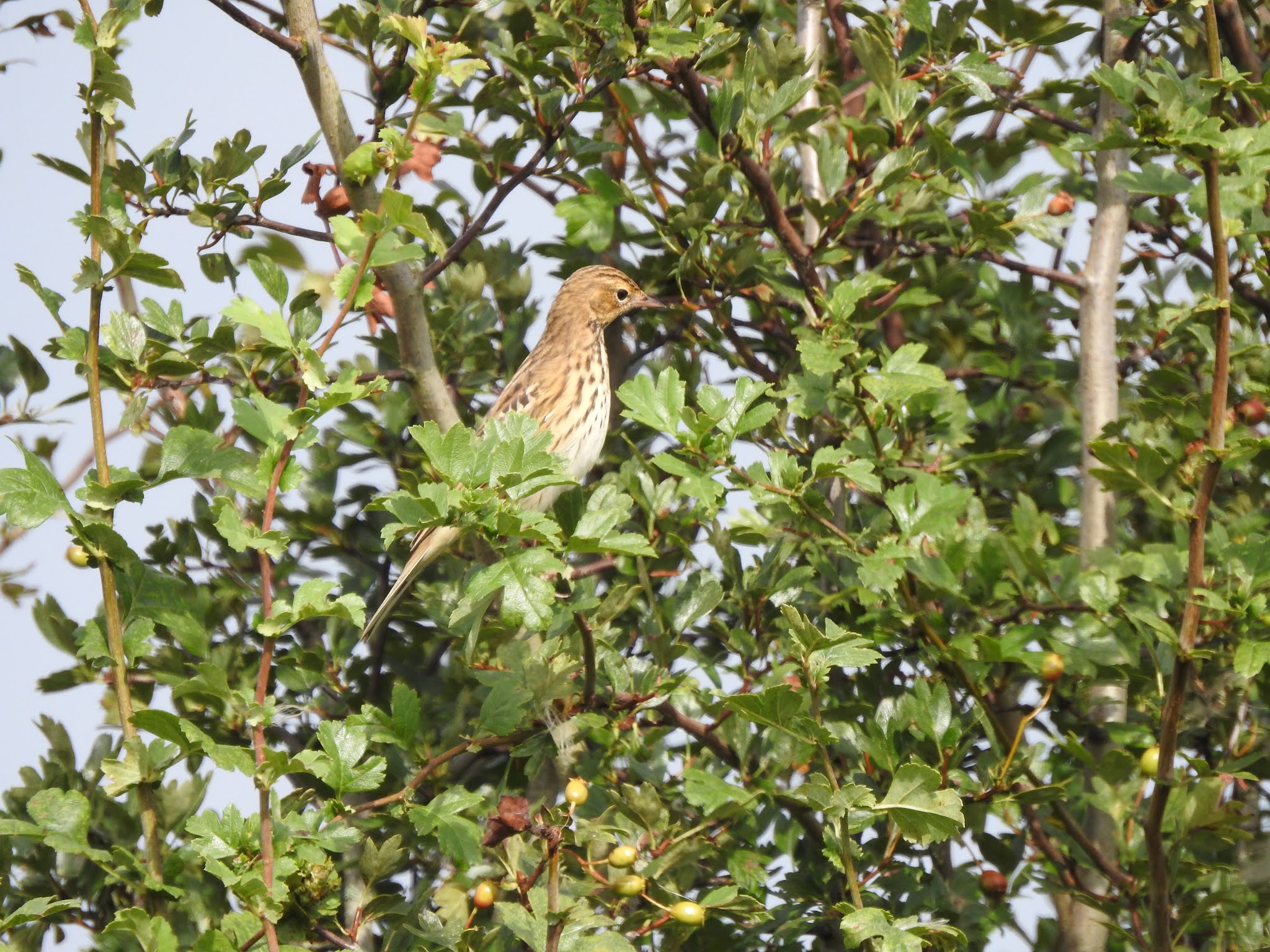
I reached the old pool field and soon spotted a distant Whinchat, the first of the autumn. I decided to walk on the pool side of the hedge in the hope of sneaking up on it. As it turned out, three quarters of the way along the hedge there was no sign of it. But scanning produced something better, a Tree Pipit, first of the year.

Tree Pipit

It was showing well, pumping its tail methodically. It was tempting to switch to video mode in the hope the bird would call. Shortly afterwards, a call was heard, but it was from a spot to my left. There was a second bird present.

The second Tree Pipit

Annoyingly, every time I stopped filming, one of the birds would call. Eventually I managed to film the second bird as it called. In the following clip the bird calls twice soon after the start, listen for a short "speez" call. I'm not sure what the other calls are. I have heard Tree Pipits making sort of conversational "seep" calls, but it could be a young Wren or something nearby.


I moved on to the flash field which was a little disappointing. The 41 Lapwings were still present, but there was only one Teal, one Green Sandpiper, and one Snipe. I flushed a Sparrowhawk as I approached and maybe that was the reason for the shortage of birds.

Back at Netherstead I counted 92 Goldfinches as they flew out of a birch tree.

It's nice to reflect that although this year's waterbirds have been uninspiring, I have seen just about all the passerine migrants that are likely in a year. There's no negativity here.

Tuesday, 17 August 2021

Tuesday August 17 - quiet

 A cloudy morning with a brisk north-westerly breeze. My last visit encouraged me to think that its all started happening, waders are on the move, you just can't fail. 

Well I suppose waders are indeed on the move, the Greenshank having disappeared. The wind direction and strength meant that most of the birds on the flash were sheltering against the western edge, which meant they were more visible than usual.


I counted seven Green Sandpipers (the most this year I think), 41 Lapwings, two Snipe, at least 16 Teal, a Grey Heron, and 22 Mallard

The remainder of the visit was hampered by the breeze. Warblers were hiding (I could hear them), and I was left clutching at straws. Something was being mobbed in Stapenhill Wood, but I didn't see whatever it was. Instead I counted the mobbing birds; four Whitethroats, a Blackbird, several Tits and two Nuthatches. A calling Marsh Tit put in a brief appearance.

A flock of corvids just west of the recording area turned out to comprise almost entirely Rooks, 114 of them. Then 47 Goldfinches appeared, the first sign of the usual autumn flock. 

Kestrel

You get days like this, and by mid-morning I clumped off back up the slope to my car.


Sunday, 15 August 2021

Sunday August 15 - Waders and a rare moth

 A cloudy morning started slightly alarmingly when I discovered a grub living in a cocoon in my welly sock. I'm afraid it had to go. 

Dave and I set off to look for migrants, finding only the usual warblers (although these included a couple of Willow Warblers) and an impressive flock of 19 Long-tailed Tits before we met Paul walking from the direction of the flash field. He told us he had seen three Spotted Flycatchers in a hedge somewhere towards Bannams Wood, and that there were some waders on the nearest flash. Encouraging.

We hurried to the flash and could indeed see waders. Initially about four Green Sandpipers, but on reaching the main watchpoint I spotted something different. We made a tentative identification (I had left my tripod in the car), before moving to a position where we could confirm the presence of the first Greenshank of the year.

Greenshank

It remained at the far edge of the flash before deciding to head to the furthest flash where it could render itself invisible. At least 12 Lapwings, 12 Teal, and a few Mallard were also present along with a Kingfisher which made a brief appearance.

We failed to locate any flycatchers on the way back, but at least a Southern Hawker was posing on a fence post.

Southern Hawker

Anyway, as promised in the title of this post, I have also seen a rare moth. On Friday night the air temperature dropped no lower than 14 degrees, and as a result there were a lot of moths waiting for me in and around my garden trap on Saturday morning.

The exciting one was sitting quietly, cryptically, on one of our concrete fence posts. Spotting it was the hard part, identifying it fairly straightforward. I had a pretty good idea it was a Tree-lichen Beauty before checking my field guide. Unlike many moths, it is very distinctive.

Tree-lichen Beauty hiding in plain sight

The books say that this is a southern species, once recorded only as a migrant to southern counties. But in the last few years they started breeding in the south-east and spreading north. The first for Warwickshire was in 2017, and there were another seven in the county in 2019. I don't have any more recent information. Although our garden is in Redditch (Worcestershire), moth recording is based around the vice-county system, which puts us in Warwickshire. I am not aware of any Worcestershire records for this species, but it seems likely they will be arriving there soon.

Among the 40 or so other species I recorded were several which were new for the year, and one extremely small dark one which may (or may not) be Aproaerema althyllidella new for the garden if correct. It is currently awaiting examination by an expert.

The full list (excluding the above) was:

Yponomeuta ag 3,    Blastobasis adustella 2,    Mompha propinquella 1 (nfy),    Ruddy Streak 1,    Brown House-moth 1,    Chequered Fruit-tree Tortrix 2,    Dark Fruit-tree Tortrix 1 (nfy),    Acleris forsskaleana 1,    Eudemis profundana 1 (nfy),    Codling Moth 1,    Cydia splendana 7,    Bud Moth 1,    Light Brown Apple Moth 1,    Phycita roborella 2,    Euzophera pinguis 2,    Agriphila tristella  1,    Agriphila geniculea 2,    Pyrausta aurata 1,    Mother-of-Pearl 1,    Oak Hook-tip 1 (nfy),    Kitten sp 1 (nfy),    Double-striped Pug 1,    Lime-speck Pug 1 (nfy),    Brimstone Moth 3,    Yellow Shell 1,    Willow Beauty 1,    Dusky Thorn 4,    Knot Grass 1,    Tree-lichen Beauty 1 (nfg),    Common Rustic ag 5,    Pale Mottled Willow 1,    Vine's Rustic 3,    Copper Underwing ag 6 (nfy),    Cloaked Minor 1,    Flounced Rustic 6 (nfy),    Dun-bar 1,    Shuttle-shaped Dart 1,    Large Yellow Underwing 19,    Flame Shoulder 2,    Square-spot Rustic 1 (nfy).

Sadly a couple of the above were found dead in the trap, the very worn partly eaten Kitten sp, and just the wings of the Oak Hook-tip. Several Common Wasps were found in the trap as usual, and I am guessing they are responsible.

The remainder were successfully liberated on Saturday night.


Wednesday, 11 August 2021

Wednesday August 11 - Looking up, and looking down

 I need to start this post with yesterday's events. The afternoon was largely sunny, not too hot with a light westerly breeze. Ideal for Lyn and I to lounge in the garden. After a short burst of the inevitable dead-heading Lyn settled down to read a book, while I found my eyes drawn skywards as usual. 

You may recall that at the end of July I mentioned having seen a few Swifts over the garden, and was reckless enough to suggest that these might be the last of the year. Since then I had seen several more, but I was still pleased to count half a dozen shortly after we settled. Then some more, and more. I thought I'd better start counting. At this point I was still willing to accept these could be the same group circling, but when the next party totalled 93 I realised I was actually watching a true movement.

This image captures just a handful of Swifts

By the time we went in, about two hours later, I had logged 347 Swifts, a Hobby, and a couple of House Martins all drifting west into the breeze. They were all high up, and a casual glance would have missed them, but this was miles more Swifts than I have ever seen from the garden. We were also treated to the spectacle of about 80 Gulls, mostly Black-headed Gulls, with smaller numbers of Lesser Black-backed Gulls, and Herring Gulls presumably on ant patrol, although there was no evidence of our flying ants taking to the wing.

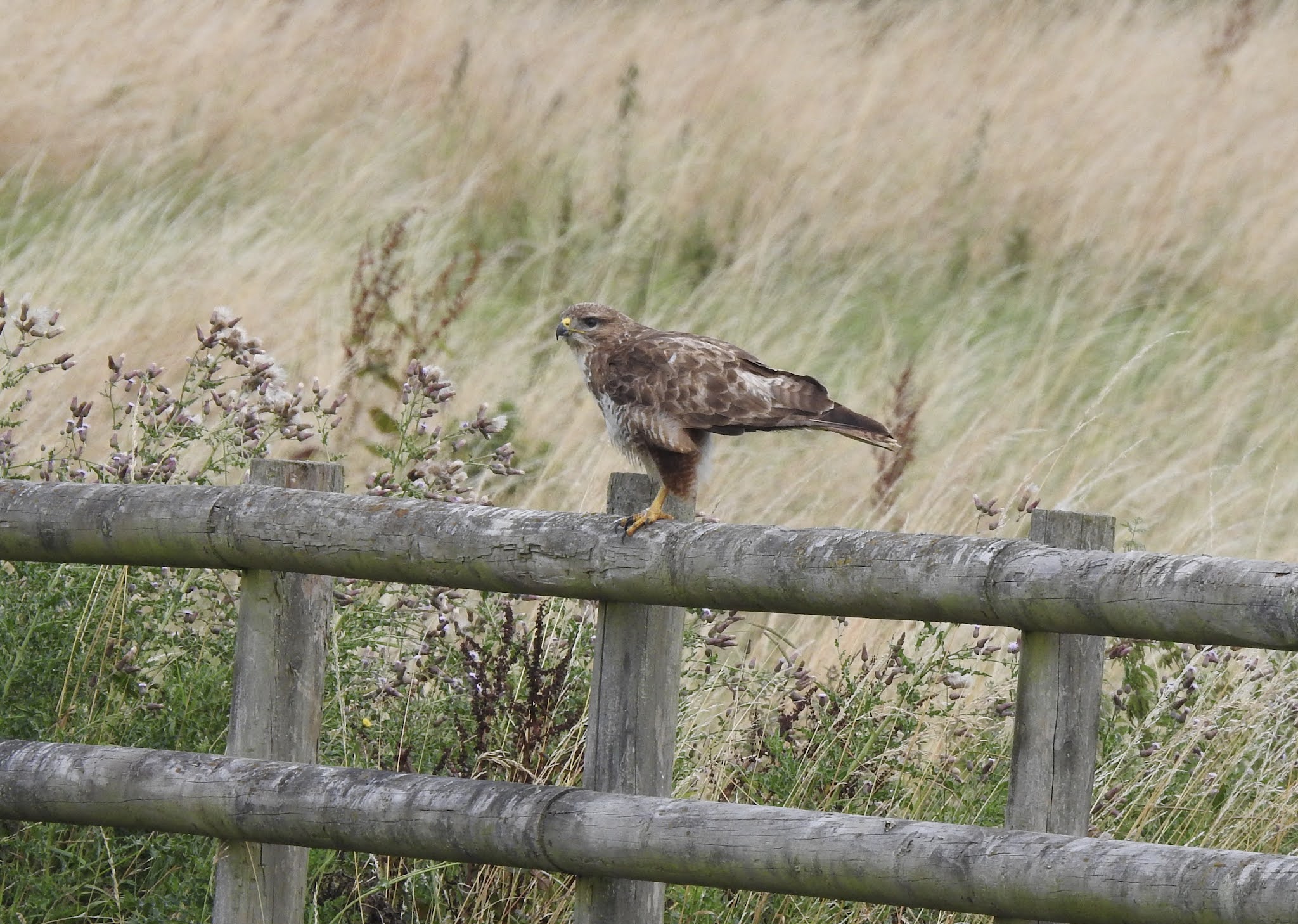
So that brings me to this morning. I arrived at Morton Bagot in time to photograph a Common Buzzard from the car, pressing the shutter just before it took flight.

Buzzard

It's a good time of the year for seeing lots of birds, but you have to time it right. I didn't. A flock of about 60 passerines, mostly Blue Tits with other tits and several warblers was heading down a hedge and away. Ideally you need to be in position as they arrive, and not be left with glimpses of tails as they depart. My best sighting at the end of the access road was a Reed Warbler, again all too brief.

By about mid-morning I was ambling towards where the ringers generally set their nets, when a rumbling noise turned out to be a huge tractor. I stepped aside, but it halted and turned to contain Phoebe who I had met at the Bioblitz event organised by HOEF. She said hi and apologised for the fact she was due to resume the mowing of the weedy field, which could disrupt my morning. Naturally I said this was fine, and I would keep out of her way.

The field was indeed mown flat, with a substantial swathe in the middle (where the Red-backed Shrike had been), left uncut. I followed my usual route, the flash field containing roughly the same birds as at the weekend, minus the Shovelers. Phoebe had kindly explained that the job she was doing was part of the HOEF's conservation plan and would be beneficial to wildlife in the long run. This I accept, but I couldn't help but feel very sorry for all the bugs which had been in the wrong field at the wrong time.

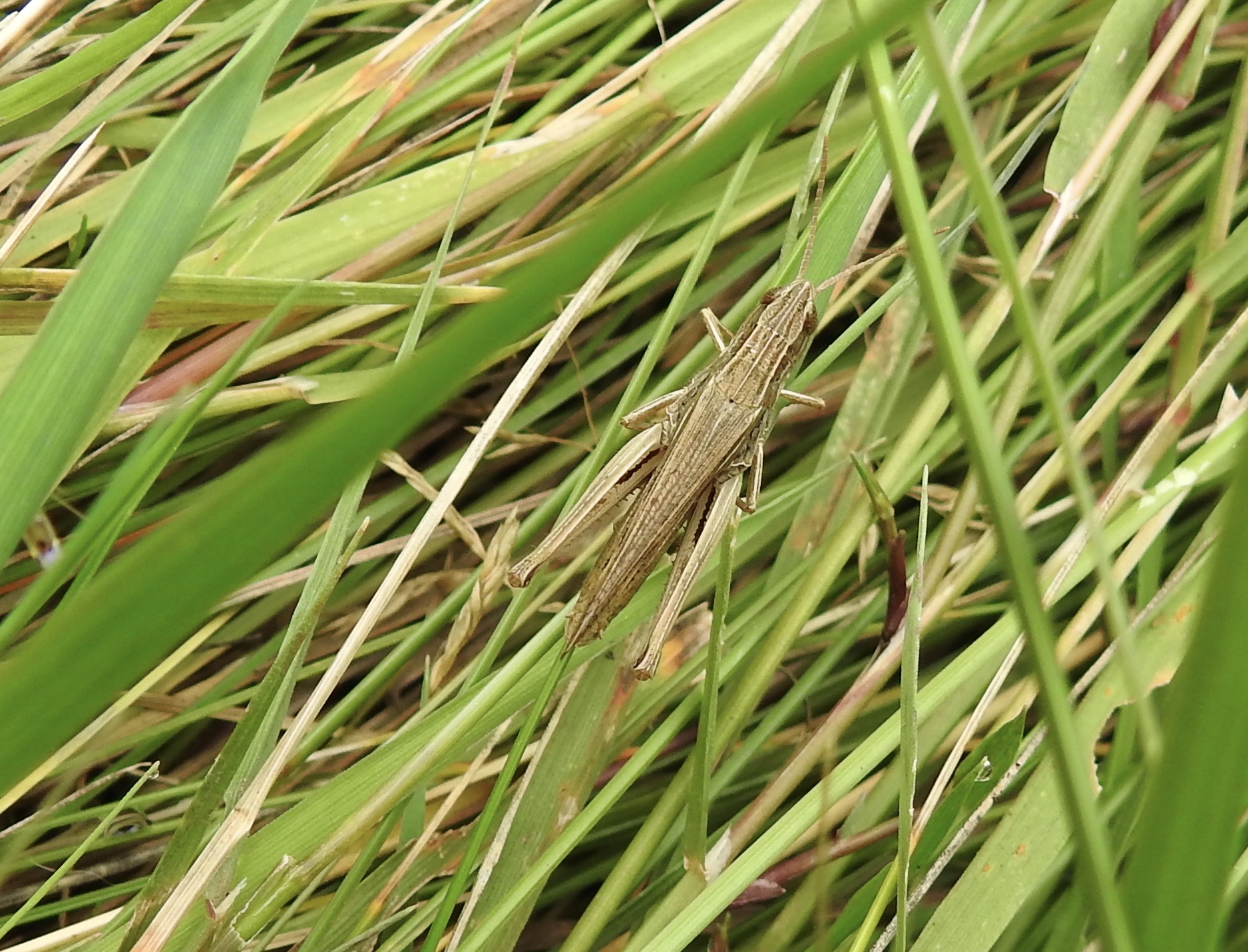
As I reached the sunny bank near Stapenhill Wood, I found that the long grass which had been spared by the mower was alive with crickets and grasshoppers. These had presumably been the lucky ones which been able to hop or crawl to safety. It was quite captivating and I abandoned the birds in order to see what I could find. I'm no expert, but reckon there were Field Grasshoppers, Meadow Grasshoppers, Lesser Marsh Grasshopper (just one if I've identified it correctly), Long-winged Coneheads, Dark Bush-crickets, and Roesel's Bush-crickets. Photographing them was tricky.

Field Grasshopper

Roesel's Bush-cricket

Lesser Marsh Grasshopper

Long-winged Conehead - look at the length of those antennae

None of these were new for the site, but I've never seen so many. Let's hope the conservation measures being put in place brings many more.

Sunday, 8 August 2021

Sunday August 8 - hints of autumn

 A combination of the Olympics, apathy, and pessimism kept me away from the patch all week, but this morning, despite the frequent showers, I met up with Dave for another attempt to resurrect our year.

The sight of five Kestrels hovering over a grassy field at Netherstead was a clear indication of a successful breeding attempt by at least one of the two or three pairs suspected to be holding territory. One bird group that mysteriously disappears in August and September are the thrushes. Blackbirds and Song Thrushes start moulting and can be hard to find. But this morning a Song Thrush dropped onto the gravel path in front of us and started hammering away at a snail shell.

Song Thrush

By the time of the autumn all-dayer (early September), this species will be a challenge to find.

In fact the damp weather made looking for passerines hard work today, so it was time for the nearest flash to step up to the plate. And compared to last weekend's dire performance, it did it's best to please.

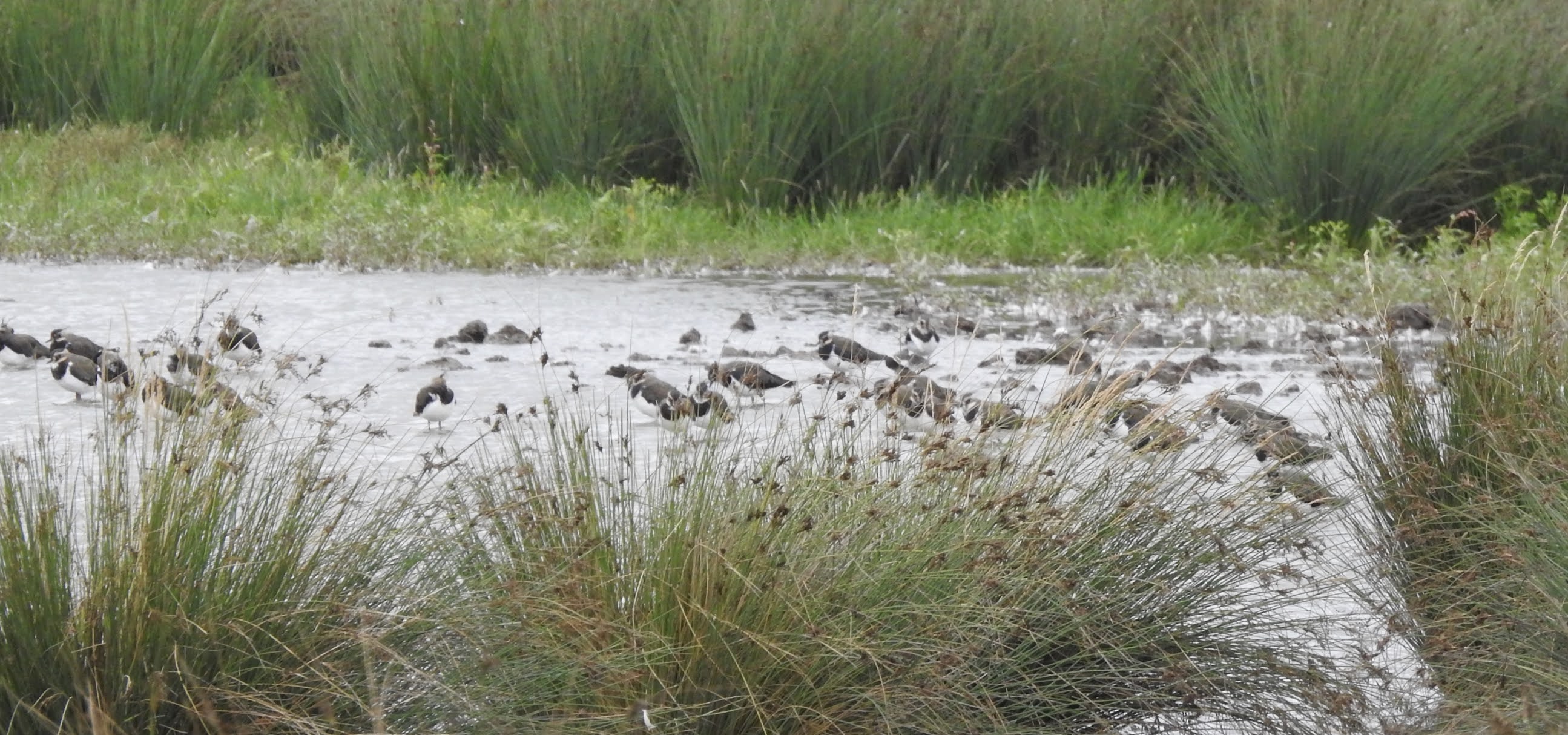
For a start, there was a little more mud and it was occupied by at least 36 Lapwings

Lapwings and mud

We felt that any one of the little blobs of mud sticking up between the Lapwings could be a rare wader (or any wader), but try as we might we couldn't upgrade them to anything animate. 

Never mind, there was always the water surface. Here we found that the 16 Mallard had been joined by 17 Teal (easily the best count for months), and two Shovelers. Year tick!

Shovelers shovelling

Grey Heron

I know its not a lot, but it was a reminder that autumn is underway at last.

We didn't see many insects, but did kick up several butterflies including a Painted Lady and plenty of moths including a Mother of Pearl.

Mother of Pearl


Speaking of moths, I had better report on Friday night's effort. The temperature fell to 11 degrees and it was pretty windy so I wasn't surprised to find a modest 40 or so moths of 26 species in and around the trap. Five were new for the year, but none were unexpected. The full list was:

Carcina quercana 1,     Blastobasis adustella 1,    Aleimma forsskaleana 1,    Chequered Fruit-tree Tortrix 1 (nfy),    Red-barred Tortrix 1,    Celypha striana 1,    Cydia splendana 4,    Codling Moth 1,    Phycita roborella 4,    Eudonia mercurella 1,    Eudonia lacustrata 1,    Agriphila tristella 1 (nfy),    Agriphila geniculea 1 (nfy),    Agriphila straminella 1,    Yellow Shell 1,    Brimstone Moth 3,    Dusky Thorn 2,     Smoky Wainscot 1,    Flame Shoulder 3,    Common Rustic ag 3,    Marbled Beauty 1 (nfy),    Dark Arches 2,    Shuttle-shaped Dart 1,    Large Yellow Underwing 1,    Lesser Broad-bordered Yellow Underwing 1,    Six-striped Rustic 1 (nfy).    


Sunday, 1 August 2021

Sunday August 1

 It's a quiet time of year for birding, so I was pleased to receive notice that the ringers were back in action at Morton Bagot on Saturday morning. I couldn't join them because I was identifying moths in our garden for the GMS, but they have kindly shared their results.

Whilst sitting around waiting for birds to enter their nets they heard Grasshopper Warbler and saw Barn Owl. It pays to start early. Their catch was:

Chiffchaff 2,    Blackcap 1,    Sedge Warbler 1,    Lesser Whitethroat 1,    Wren 1,    Robin 1,    Greenfinch 3

Lesser Whitethroat - per T Kelly

Sedge Warbler - per T Kelly

This morning Dave and I arrived in steady drizzle, but fortunately it only lasted an hour. It was pretty hard going, and although we did find a party of four Lesser Whitethroats we were unable to match the ringers' success. One curiosity was the transformation of the nearest flash from a muddy slick to a lagoon with barely any edge. The 18 Lapwings and one Green Sandpiper were all standing up to their haunches in the shallow end. I suppose it may have been the recent rain, or possibly the farmer can control the water levels.

With few birds on offer, the humid conditions once the rain stopped did at least allow close examination of any insects that crossed our path. The first Essex Skipper we found being content to sit on my finger (later transferred to Dave's to allow a photograph).

Essex Skipper showing black tipped antennae

It's the best time of year for looking for crickets and grasshoppers, and I can still just about hear their rasping songs.

Meadow Grasshopper

If my hearing was more sensitive I'm sure they would have been deafening. 

I wish I knew more about plants. Among the few I can name are many that I can't. But you can always take a picture and then thumb your way through a Field Guide until you see something similar. I believe this is Yarrow. Probably.

Yarrow

As for moths, we saw several Shaded Broad-bars, Silver Ys, and hundreds of grass moths (all the ones I looked at were Agriphila straminella), but the best way to record them is by catching them.

Which brings me to Friday night's efforts. It was a shade cooler than recently and the garden catch was consequently down to a more manageable 59 moths of 29 species. None were new for the garden, but I did find a Canary-shouldered Thorn, which was my first since 2018.

Canary-shouldered Thorn

My full list was:

Bird-cherry Ermine 16,    Diamond-back Moth 1 (nfy),    Blastobasis adustella 1,    Bryotropha ag (thought to be terrella) 1,    Acleris forsskaleana 1 (nfy),    Celypha striana 1,    Cydia splendana 2,    Codling Moth 1,    Phycita roborella 3,    Eudonia mercurella 2,    Eudonia lacustrata 1,    Garden Grass-veneer 1,    Agriphila straminella 1 (nfy),    Riband Wave 4,    Brimstone Moth 1,    September Thorn 1,    Canary-shouldered Thorn 1 (nfy)    Black Arches 2,    Swallow Prominent 1,    Dingy Footman 1 (nfy),    Common Footman 3,    Scarce Footman 1,    Coronet 1,    Common Rustic ag 5,    Dark Arches 1,    Heart and Dart 1,    Dun-bar 1,    Bright-line Brown-eye 1,    Shuttle-shaped Dart 1,    Small Broad-bordered Yellow Underwing 1.