![]() |
| Chiffchaff |
![]() |
| Blackcap |
![]() |
| Stonechat |
![]() |
| Sedge Warbler - per Tony and Leigh Kelly |
![]() |
| Ivy Bee |
![]() |
| Either Ectemnius cavifrons or E cephalotes |
![]() |
| Chiffchaff |
![]() |
| Blackcap |
![]() |
| Stonechat |
![]() |
| Sedge Warbler - per Tony and Leigh Kelly |
![]() |
| Ivy Bee |
![]() |
| Either Ectemnius cavifrons or E cephalotes |
![]() |
| Stonechat |
![]() |
| Whinchat |
![]() |
| Whitethroat |
![]() |
| Tufted Duck - deceased |
It has to be said that birding at Morton Bagot can be a little predictable. This morning the conditions were excellent, bright with high cloud and hardly a breath of wind. The first few Meadow Pipits of autumn were making their way south, mostly only heard. The majority of the warblers have now departed, leaving only Chiffchaffs (14 of them), and the odd Blackcap.
Also still around are at least two Whinchats, and several local House Martins and Swallows, while an excited party of 21 of the latter headed determinedly south, the youngsters twittering constantly.
![]() |
| Whinchat at Netherstead |
The flash field was remarkably quiet; just 10 Teal, nine Snipe, two Green Sandpipers, and a Grey Heron. Perhaps a raptor had caused a clear out. The only ones I saw were a couple of Sparrowhawks bothering the local Long-tailed Tits along the Morton Brook.
![]() |
| Southern Hawker |
A few dragonflies and butterflies were on the wing, but just usual residents. My most unexpected find was in a field corner where soil had been dumped, which now sported a crop of extraordinary tall flowering plants.
![]() |
| Great Mullein ? |
Not being a botanist, my identification is based on a trawl through my various books.
Fortunately, moths are a lot harder to predict, and the last few days have been very entertaining.
Since Friday, I have added five species to my garden/life list. These have ranged from the very common (how have I not had one before?), to the scarce (possibly a fourth for Warwickshire). Most were micros, and the first was very small indeed. On Friday morning, my only trap being an open bathroom window, I noticed a speck on the wall as I cleaned my teeth. Further investigation revealed that it was a tiny moth.
![]() |
| Gracillaria syringella |
The photo gives no idea of scale, so to assist with this I ask you to bear in mind that the plastic lid it is resting in is approximately the diameter of a one pence coin, and the moth hardly fills it. Without the aid of the camera or a hand lens the colours and pattern are impossible to see. As usual I consulted my reference books and was a little disappointed to find the moth described as widespread and very common. Having said that, two moth-ers I shared the photo with on Twitter both said they hadn't seen one either.
With the overnight temperature on Friday night set to drop no lower than 15 degrees I put the trap out and awaited developments. I awoke to find about 70 moths inside, and soon came across a good one.
![]() |
| Antler Moth |
The Antler Moth is a medium sized macro moth which is not infrequent in the county. Apparently it prefers upland grassland (not an obvious habitat around here), but will obviously make do with lowland grass. I couldn't see any records for the Redditch area, so its not too surprising that I haven't caught one before.
Also in the trap was a pyralid called Nephopterix angustella. This was the rare one. Don't imagine I knew instantly what it was. My best guess on catching it, was that it might be a late example of Phycita roborella, many of which I've caught this year. Fortunately I soon realised it was something else, and actually it was quite distinctive.
![]() |
| Nephopterix angustella |
The key feature is the little line of raised scales about half way along the moth. The moth itself is about 10 millimetres long which is fairly large for a micro. My book described it as very local and possibly spreading, while the 2016 Warwickshire moth report refers to two in the county that year as being the second and third for Warwickshire. I couldn't find any further mention of the species in subsequent reports.
Several other moths in the trap were year-ticks, the best being my first Spruce Carpet since 2018. However, you never quite know when you're finished. Late on Saturday afternoon I stepped outside and disturbed a small moth onto the brickwork of the house. I suspected this was Eudonia angustea because of its narrow body shape, but as it was part of the tricky crambid group I asked for online confirmation from @UkMothid.
![]() |
| Eudonia angustea |
The expert quickly agreed. This is a common and widespread moth which typically appears in September. It is quite small, the rock-face it appears to be clinging to is actually a magnified house brick. Common and widespread it might be, but a first is a first.
Still I wasn't finished. I always check the trap indoors, and inevitably a few moths sneak out and disappear into the house. So when I turned on the light in the utility room on Saturday evening several moths were fluttering about. Among them was an attractive micro from the enormous family tortricidae. On closer examination I found that, at long last, I had caught a Garden Rose Tortrix. As the name suggests, every garden should have one. In fact our garden, with its several roses, should be knee deep in them. But it's not.
![]() |
| Garden Rose Tortrix |
This species' main feature is its ability to appear in a wide variety of forms and colours. The one I caught is apparently the most common form.
I also grabbed a very tiny moth which at present can only be identified as Bryotropha ag. It may well turn out to be another good one, but I'll need the recorder to determine the species in due course.
The full list was:
Yponomeuta ag 2, Ruddy Streak 1, Bryotropha ag 1, White-shouldered House Moth 1, Brown House Moth 1, Garden Rose Tortrix 1 (nfg), Chequered Fruit-tree Tortrix 1, Nephopterix angustella 1 (nfg), Eudonia angustea 1 (nfg), Garden Carpet 1, Spruce Carpet 1 (nfy), Common Marbled Carpet 1, Green Carpet 1 (nfy), Double-striped Pug 2, Brimstone Moth 2, Light Emerald 4, Dusky Thorn 4, Angle Shades 1 (nfy), Flounced Rustic 1, Common Wainscot 1, Copper Underwing ag 2, Vine's Rustic 4, Antler Moth 1 (nfg), Pale Mottled Willow 1, Large Yellow Underwing 33, Broad-bordered Yellow Underwing 1, Lesser Yellow Underwing 4, Square-spot Rustic 3, Setaceous Hebrew Character 5 (nfy).
OK, strictly speaking this was not the morning after the alldayer, but it was my next visit. I arrived earlier than normal to try to avoid the forecast heat. It was certainly sunny with a light easterly.
I always find myself slipping into big day mode to start with. Walking slowly, sun at my back, feeling quite sharp and optimistic. Determined not to miss a thing. The hedgerows around Netherstead are still decent, Chiffchaffs, a Lesser Whitethroat, seven Blackcaps, and three Whitethroats briefly appear and disappear. There are fewer hirundines over the copse, but that could just be the sunny weather causing them to disperse more widely.
Eventually I hear and see a species we missed on Saturday, a Greenfinch. There are normally dozens of them in early September. The sunny weather does permit some photography, but most birds are too quick for me. A Great Spotted Woodpecker was more obliging.
![]() |
| Great Spotted Woodpecker |
Eventually I found a Whinchat, and maybe two more, but by now it was getting hotter and harder to get good views.
At the flash field a flock of 48 Greylag Geese were present to remind me how ludicrous was their absence on Saturday. On the other hand the Lapwings had disappeared. I counted 82 Teal, but there was still no Garganey so it must have moved on, but four Shovelers, three Green Sandpipers, three Snipe, 11 Black-headed Gulls, and a Grey Heron were present.
My focus started to waver on the way back.
In the corner of the Kingfisher Pool there is dead tree ringed by fungi. As far as the species is concerned I have no idea, but a bit of internet research came up with the Scalycap group, and possibly Golden Scalycap.
![]() |
| Golden Scalycap ? |
By now it was getting seriously hot, and my route took me into the sun. So walking head down with few stops my only chance of finding anything would come if I stepped on it.
Perhaps fortunately, I didn't.
Since recovering from the sleepless rigour of the September alldayer I've been considering the theme of my next post. I could write at length about competitive birding, is it a good or bad thing? But the problem is the "at length" part. It needs a book to do it justice.
Nevertheless, here are a few thoughts. Birding can undoubtedly be competitive if you want it to be. In the 19th century it was who could collect the most skins. In the late 20th century twitching developed, who could collect the most ticks. An offshoot is regional and patch twitching which is the same but with tighter boundaries. Alldayers are a natural progression and introduced the welcome concept of teams. Whose patch is best?
One obvious problem is the lack of a referee. Imagine a football match with no ref. A goal is scored and the forward turns round and says "you know what, I think I could have been offside. I won't count the goal". That's competitive birding, it relies on self regulation. But you can't go up to a team member and tell them they've got it wrong. All you can ever ask is "are you sure?"
We had a couple of awkward moments, amicably resolved, and the final result was correct. I'm sure every team will have had similar issues.
A provisional list of the leading sites was posted on Twitter yesterday. Morton Bagot was not on it. We don't even make the top 20. Naturally I don't mind. It doesn't bother me that Earlswood, just up the road scored 77. I didn't care that they saw a Little Stint. We've never had one, and perhaps we never will. I'm not bothered.
I'm so not bothered that on Sunday I drove the whole eight miles to look at it. I twitched it, or at least I tried to. It had gone overnight. Nooooo! It'd only been there a week.
![]() |
| The consolation prize |
I met up with Matt Griffiths and John Chidwick. They pointed to the two Ringed Plovers it had been with and told me the news. A casual scan across the reservoir revealed several Sand Martins, two Wigeon, and a Coot. There was a Greenshank somewhere, but I'd had enough. Patch envy, another peril of the alldayer.
It's easier than mothing though. I walked into the living room this morning and a little moth was sitting on the ceiling. I didn't recognise it, and have since discovered it is not identifiable from a photo.
![]() |
| Acleris laterana/comariana ag |
Luckily, there's no such thing as competitive mothing. Yet.
This year I had arrived on the patch for the spring alldayer an hour before it got light, and although it paid off, I vowed I would not do so in September. So although I was pre-dawn again this morning, it was just on the cusp of getting light. At 5.35 I saw my first bird, a Barn Owl floating across the fields below Bannams Wood. Unlike in spring there was no bird song, just the constant ticking calls of Robins and the odd startled Blackbird.
For the first time in an autumn alldayer I had assembled a team, but in this pre-breakfast visit I was not expecting to see anyone. By 06.00 I was getting worried. Had I arrived too late to hear my other owl. Then at 06.05 a slightly croaky hoot of a Tawny Owl came from Bannams. Thank God I didn't have to come back tonight.
Down at the old pool I was rejoined by the Barn Owl. It landed on a post before five minutes of active hunting. Fantastic.
![]() |
| Barn Owl in the gloom |
My night's sleep had been disturbed when I had woken too early and had tried to imagine the day ahead. I had categorised the birds into "certainties" and "possibles". As I approached the flash field a hoard of Canada Geese which must have been roosting there, took off and headed out. The flash contained other certainties; Mallard, Teal, Snipe, Green Sandpipers. But there was no sign of the Marsh Harrier or Garganey. However, one "possible" did fly over. A party of seven Cormorants were the first here since the early spring. The furthest flash is very difficult to observe, but I found that by gaining height (and distance), I could see most of the water through the trees lining the Morton Brook. I added nothing certain, but a possible Shoveler was sufficient encouragement for me to try again later. By 07.30 I headed back for breakfast with the list on a rather disappointing 36 species.
At 08.50, thoroughly refreshed, I was back Netherstead. The team was on site and well spread. Mike Inskip was at the flashes, Martin Wheeler was in the same general area, and Sam McVie was making his way across Morton Common. I love the time between about 08.30 and 09.30, its a golden hour when the insects are taking to the wing, but are still too dozy to avoid capture. Birds know this, and I spent an age watching a dozen Chiffchaffs, a Lesser Whitethroat, and Blackcaps frantically catching them in the lee of the copse at Netherstead. Above me, a hundred hirundines dashed around with the same purpose. This could be their last chance to build up sufficient fat to start migrating south.
![]() |
| Chiffchaff |
The guys checked in. Martin had seen Grey Wagtail and Whinchat, and Sam had found a Yellowhammer at Morton Common, and later also added Linnet, Willow Warbler and Mistle Thrush, all birds we needed to see which could prove tricky. Actually the Yellowhammer was particularly impressive because they have been virtually absent all year though still occurring within a stone's throw of the patch.
The plan was to keep apart and try to cover as much ground as possible. Mike headed off on what was to prove a largely fruitless vigil down the south end, although he did find an extra Whinchat. Sam headed up the slope towards Bannams (I think), and Martin returned to the flash. I eventually joined him there, adding Long-tailed Tit and seeing a Holly Blue. Sorry, yes I know its supposed to be all birds.
![]() |
| Holly Blue |
After we gave up on the nearest flash we peeled back up the slope to view the furthest flash which did indeed contain Shoveler, in fact two of them.
The Whinchat count rose to five, all in the untouched centre strip of the now mown weedy field, and back at the Chat field I spotted the first Stonechat of the autumn, a nice male. The last three species before I headed home for lunch were Starling (a distant party heading towards Redditch), Reed Warbler, Treecreeper (Sam), and Skylark (Mike). We were on 60 species by midday.
The afternoon session is traditionally hard going. Its hot, you're tired, the birds are hiding. I started at Netherstead and found a Pied Wagtail there. This species disappears in early autumn, probably drawn away by nearby ploughed fields. Sam called in to report a Coal Tit at the edge of Bannams, and I headed to the south end.
![]() |
| Whitethroat feeding on blackberries |
![]() |
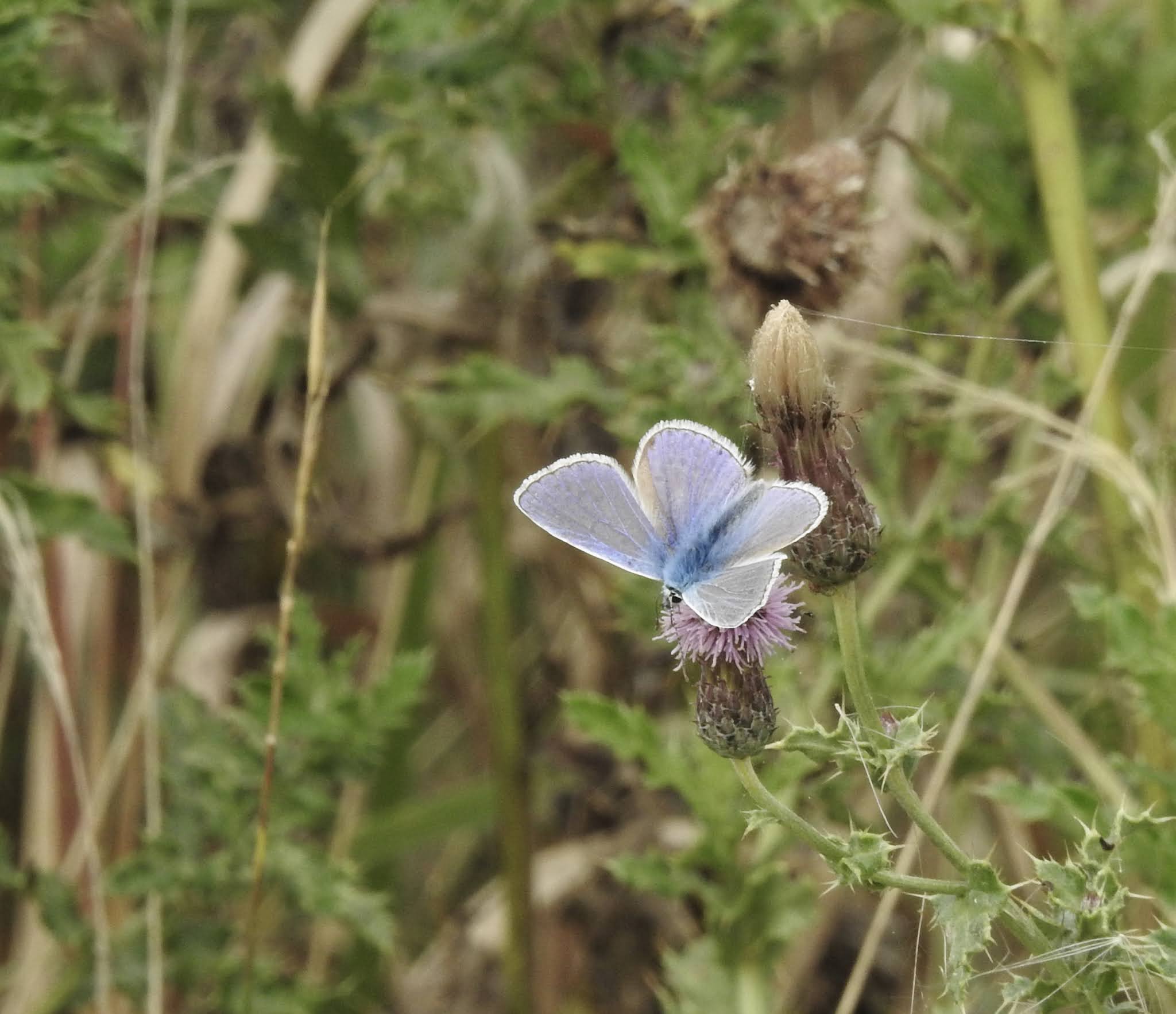
| Common Blue |
I relocated Mike's Whinchat and struggled through a field of thistles surrounded by flights of Goldfinches and distracted by a Common Blue. Several young Whitethroats were feeding on blackberries in a hedge. Mike called to say he was going home (Martin had left at lunchtime), and I saw Sam in the distance birding his way back to his car.
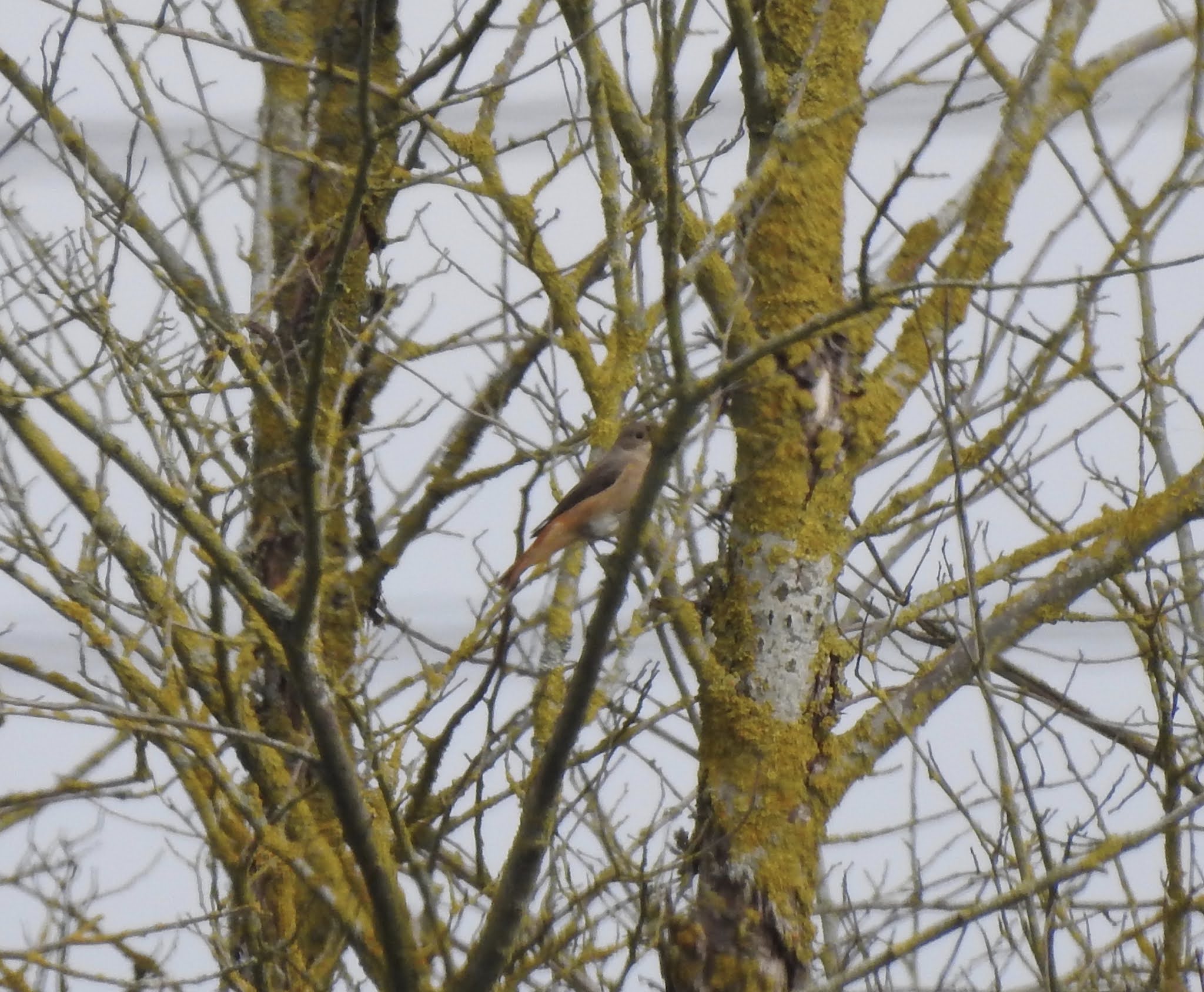
I was not expecting to find a candidate for bird of the day, but a flicker of orange in a row of dead elm saplings turned out to be a Redstart.
![]() |
| Redstart |
I snapped a record shot and rang Sam who returned to join me. Unfortunately the bird was lost down the hedge and we had to give up. Ironically, about two hours later I saw what was presumably the same bird from my car as I headed down the access road at Netherstead on my way home.
In the meantime I was resolved to give the flash field one last look. An immature Herring Gull flew over (species 64), and at the flash I heard a Kingfisher (species 65), before noticing that the Snipe and Teal were showing themselves. I counted 11 Snipe, and 48 Teal. The five Whinchats had relocated to the old pool field where photographic opportunities presented themselves.
![]() |
| Whinchat |
![]() |
| Migrant Hawker |
Noticing that a large party of Canada Geese was occupying the furthest flash, and being painfully aware that none of us had recorded a Greylag Goose today, I made my way back up the slope for one more scope view of the flash. I'm glad I did. No Greylag Goose, but sneaking its way along the back edge was a Common Sandpiper, the first here this year and the last species of the day.
The full list follows:
1. Canada Goose, 2. Teal, 3. Mallard, 4. Shoveler, 5. Red-legged Partridge, 6. Pheasant, 7. Cormorant, 8. Grey Heron, 9. Sparrowhawk, 10. Buzzard, 11. Kestrel, 12. Moorhen, 13. Lapwing, 14. Snipe, 15. Green Sandpiper, 16. Common Sandpiper, 17. Black-headed Gull, 18. Lesser Black-backed Gull, 19. Herring Gull, 20. Stock Dove, 21. Woodpigeon, 22. Collared Dove, 23. Barn Owl, 24. Tawny Owl, 25. Kingfisher, 26. Green Woodpecker, 27. Great Spotted Woodpecker, 28. Jay, 29. Magpie, 30. Jackdaw, 31. Rook, 32. Carrion Crow, 33. Raven, 34. Blue Tit, 35. Great Tit, 36. Coal Tit, 37. Skylark, 38. Swallow, 39. House Martin, 40. Long-tailed Tit, 41. Chiffchaff, 42. Willow Warbler, 43. Blackcap, 44. Lesser Whitethroat, 45. Whitethroat, 46. Reed Warbler, 47. Nuthatch, 48. Treecreeper, 49. Wren, 50. Starling, 51. Blackbird, 52. Mistle Thrush, 53. Robin, 54. Redstart, 55. Whinchat, 56. Stonechat, 57. Dunnock, 58. House Sparrow, 59. Grey Wagtail, 60. Pied Wagtail, 61. Chaffinch, 62. Goldfinch, 63. Linnet, 64. Bullfinch, 65. Yellowhammer, 66. Reed Bunting.
The value of having a team, and of having them well dispersed is clear. No one saw everything but the cumulative total was the best September day list total since I started. My personal total was 62, which compares unfavourably with 63 in 2020, and 64 in 2019.
We're all looking forward to the next one.
I got a text from Tony this morning. He had seen the Marsh Harrier but was catching nowt. This came as a pleasant surprise because the Harrier had last been seen on Tuesday.
So I joined him for a chat. The harrier had been flying, pursued by crows, over the old pool field. I hope it didn't keep going. On my walk to where he'd set his nets I heard a Reed Warbler sub-singing from dense scrub, that would be a good one for tomorrow. Another handy bird was a Hobby which flew over Tony's nets as we talked.
Because of the disruption of the all-dayer I had trapped moths on Wednesday night. This produced over 90 moths including a few new for the year, and one I didn't recognise. Where birds are concerned seeing something I can't identify would set massive alarm bells ringing, but with moths it means nothing. There are plenty of moths I don't recognise.
Anyway, I photographed it and started trawling through the book to try to work it out. I eventually reached Dotted Rustic, and switched to Internet photos which seemed supportive.
![]() |
| Dotted Rustic |
It was in an egg-box surrounded by Large Yellow Underwings and wasn't all that much smaller than them. The above image recalls Square-spot Rustic, several of which I caught, but although they can vary quite a bit, none I saw looked exactly like my moth. Also they are noticeably smaller than this beast which was about the size of a Lesser Yellow Underwing.
![]() |
| Underside view in case it helped |
The interesting bit came when I looked up the status of Dotted Rustic. It seems that it is highly local and fluctuates in numbers, the last time it was moderately common being in the 1980s. Since then it had all but died out in the Midlands, but there had been three in Warwickshire in 2019; two in Bidford and one in Leamington.
Although the flight period is mainly late June and July, it goes through a period of aestivation during August and early September. Presumably mine had just woken up.
I have submitted the record on irecord.com and am hopeful that it will be confirmed.
PS: Not only was it confirmed by Nigel (the recorder), but he also spotted that my two terrible photographs of what I had guessed was Holly Tortrix (to be fair I marked it as uncertain) was actually a new species for me; Epinotia nisella.
![]() |
| Epinotia nisella |