Sunday, 11 December 2022

Sunday December 11 - "sounded rare"

 Some unexpected snow overnight made the drive to Morton Bagot rather more exciting than it usually is. My car slithered to a halt shortly after Dave had arrived, and we set out into some increasingly heavy snowfall.

As it's December we had no expectations of anything unusual, and were happy enough to see a Peregrine land on a pylon, and see a Stonechat (I think Dave saw two) the first for several weeks.

Peregrine

Stonechat

Redwings called as they left a tall hedge, and the Stonechats started tacking. Then we heard another call. It was a sharp, thin call, and immediately set the alarm bells ringing. I shouted "what's that?" and it called again. We scanned around in alarm. It called again, the same call. We could still see nothing. Was it flying over? We conferred and agreed it sounded rare. The call reminded me of Tree Pipit, but it's the middle of December. 

It called once more, but we still couldn't see it. We noticed five or six Meadow Pipits with some cattle, but they all looked and sounded like Meadow Pipits. After hanging around for fifteen minutes we heard no further calls, and decided to move on.

Fortunately this kind of thing almost never happens, but when it does, you are left with a feeling of a missed opportunity. Like England last night! 

The rest of the morning confirmed that the flashes were frozen and lifeless (apart from one Lapwing) and we ended up walking down the brook hoping for a miracle. In the event we flushed a "probable" Woodcock which rose steeply from the ground and away through the trees without either of us getting a decent view, and a first-winter Common Gull which was heading north.

We returned to the cattle field once I had grabbed my scope, and gave the mystery bird another go. All we added was a hunting Fox before the stockman arrived in a truck, setting the cattle off into a bout of excited mooing. 

The Fox

The Fox made a sharp exit, and after hearing nothing else to get us interested, so did we.

Tuesday, 6 December 2022

Tuesday December 6 - Now and Then

 This morning I opted to go exploring, and chose a route in the North Worcestershire area of my Circle, from Forhill to Hopwood via Lea End and back skirting Red Hill. Only I wasn't exactly going to untrodden territory. My Birdtrack notes reminded me that I had been here before...over 40 years ago.

As a recently fledged birder I was cutting my teeth by taking part in the BTO's Winter Bird Atlas, and my visit is dated February 1 1981. 

So I thought it might be interesting to compare the two visits. The habitat seemed broadly similar; fields of pasture and scattered woodland.

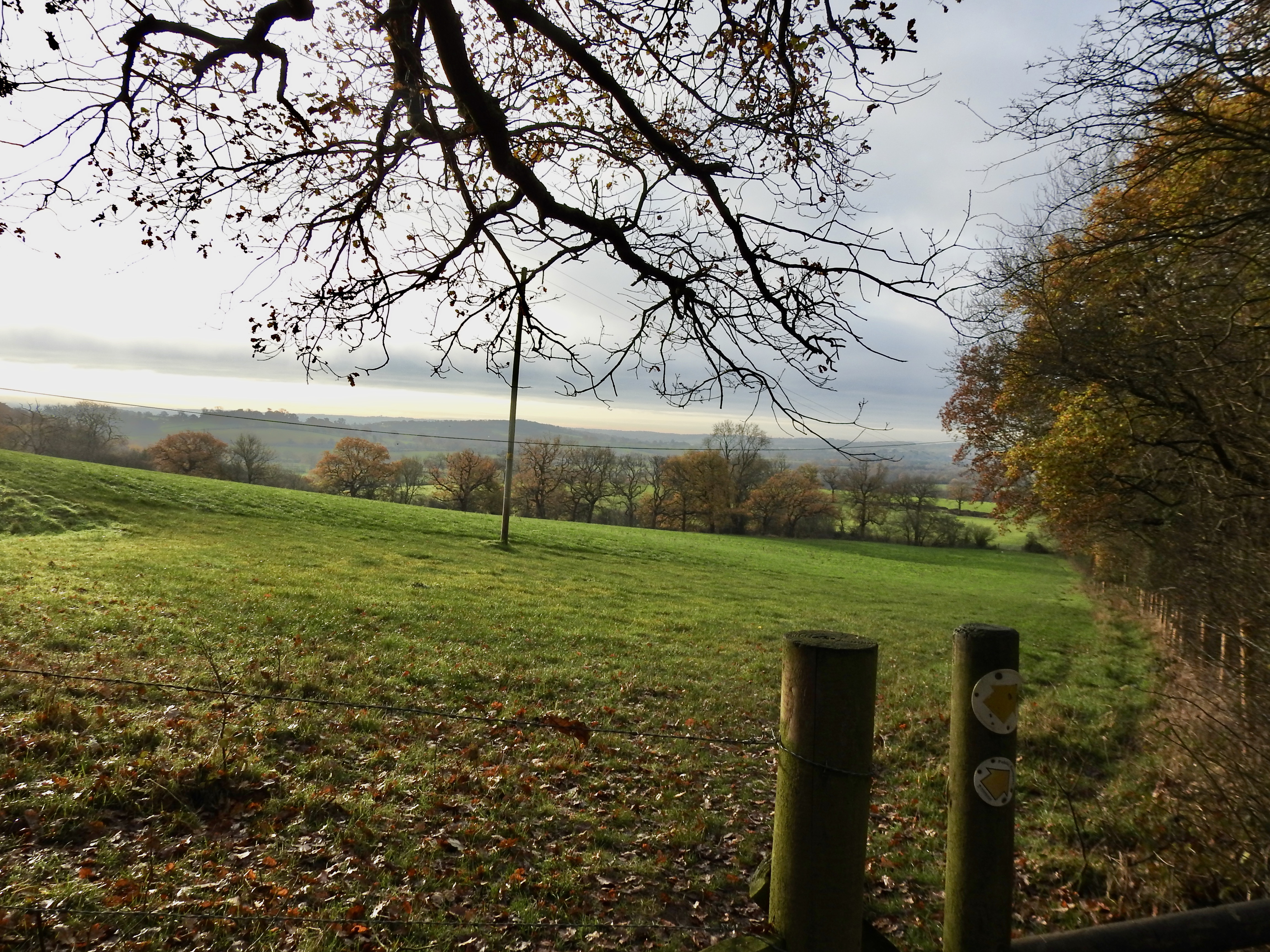
The view from Forhill towards Hopwood

The actual number of species seen was pretty similar, about 26 in 1981 and 24 in 2022. But the species involved, and the numbers seen revealed differences which I think would alarm young birders today.

There were a few positives. In 1981 I had no chance of Buzzard and Raven, and I didn't see any Goldfinches, Nuthatches or Great Spotted Woodpeckers, all in my notebook today. The bulk of species seen were Jackdaws, and Rooks. Blackbirds totalled 13, and that was typical of the counts of most of the the common passerines.

Compare that to my notebook for 1981.

Bittell birders may be interested to know that the scrawl above Lea End is for there


I would draw your attention to the following: A Willow Tit at Hopwood (which I did highlight among the "most interesting"), and the collection of finches, sparrows, and buntings feeding around a sheep feeding trough at Lea End. These included two Corn Buntings, 19 Yellowhammers, and three Tree Sparrows. I can still remember the Corn Buntings, which were definitely a surprise. The rest were just expected.

As for the numbers seen, 18 Blackbirds is a little more than I saw today, but what about 72 House Sparrows compared to just 18 today (and I thought that was quite good).

So what would you rather see, a smattering of Goldfinches and loads of corvids, or loads of Yellowhammers and their ilk? 

The countryside needs more messy bits, like the one shown below near the top of the Wast Hills. I'd like to think that one day the politicians will get that. Perhaps there will be a pot of gold at the end of the rainbow.

Pot of gold? Don't hold your breathe.

Sunday, 4 December 2022

Sunday December 4 - Trying to make things happen

 A cold grey day with a very light easterly. I was just glad to be out birding after a week stuck in the house due to an accumulation of stuff and a funeral in North Wales.

Morton Bagot was the venue and Dave joined me as usual. We tried various options; the hedgerows gave us the usual thrushes etc, the marsh contained just one Common Snipe, the flash field held 15 Lapwings and 37 Teal, and the Kingfisher Pool a Kingfisher appropriately enough.

As we strolled back along the brook Dave suggested we try entering Stapenhill Wood. I took a deep breathe and agreed. Parts of it are almost impenetrable and we soon lost sight of one another. Shortly after I'd freed myself from yet another clump of brambles I heard Dave give a shout. He had flushed a Woodcock. He had evidently made better progress next to the brook than I had in the centre section. I scrambled on, and got a brief view of a Fallow Deer before I found myself approaching the metal barn.

Dave rang to say where he was, and as we discussed the best way of meeting up, the Woodcock flew past me on its way back to the jungle.

Once I finally met up with Dave he had some intriguing news. He had flushed a black bird from the centre of the brook. It was probably just a Blackbird, but he couldn't rule out Dipper. The bird had disappeared silently along the brook. With the whiff of an extraordinary patch tick in my nostrils we returned to where he had seen it, and then walked up and down the course of the Morton Brook, peering through the foliage to no avail.

On the positive side, we did spot a distant Red Kite circling Mars Hill.

Red Kite

In the absence of any potential patch ticks, this sighting was just enough to brighten an otherwise very dull day.


Sunday, 27 November 2022

Sunday November 27 - Morton Bagot

A cloudy morning with no breeze was ideal for birding, but we're getting into winter now. Birds are largely settled so the chances of winkling out anything unusual are slight. Our visit to Morton Bagot was pretty typical for the time of year.

A Yellowhammer, which flew over, vied with a pylon topping Peregrine to take top spot. Tony was ringing and had just caught a couple of Redwings as we joined him for a chat.

Redwing

Redwings (c40), Fieldfares 16+, and Blackbirds 12, all achieved reasonable numbers. We sometimes wonder how many Redwings and Fieldfares you need to look at before you stumble on a rarity. Probably more than a lifetime's worth.

Most of the other usual birds were present on site, but the numbers of most barely reached double figures.

Meadow Pipit

Pied Wagtail

The flash field was disappointing. A handful of Teal, and Lapwings. We also flushed five Common Snipe from the scrapes.

Tony has now sent me his ringing results covering the weekend. He saw a couple of Red Kites yesterday and caught plenty of passerines, plus a Woodpecker.

Great Spotted Woodpecker - female per T Kelly

Song Thrush - per T Kelly

The full catch list was: 

Great Spotted Woodpecker 1
Blue Tit 28 (13)
Great Tit 7 (6)
Long-tailed Tit 9 (9)
Goldcrest 1
Wren 3
Blackbird 4
Redwing 19
Song Thrush 1
Dunnock 4
Meadow Pipit 2
Greenfinch 2
Lesser Redpoll 3
Goldfinch 7

Tony points out that considering the massive number of Blue Tits caught last week (70 birds) it is remarkable that there were another 15 new birds this weekend. In contrast, all the Long-tailed Tits were retraps.

Saturday, 26 November 2022

Saturday November 26 - Tardebigge

 There have been a few Kittiwakes around this month, and several of them have been near misses for the Redditch area. Upper Bittell and Upton Warren both had one, and yesterday the closest of all was one at a balancing lake near Arrow. I got a call from John Coombes, and was a bit slow to react due to the fact I was watching a World Cup match, and I assumed the lake was outside the Circle. Eventually I realised the boundary sliced through the north-west corner, and I went to try my luck. Too late.

So with Kittiwakes still in mind, I decided to give Tardebigge Reservoir a look this morning. This meant parking at the church where Hawfinches had been seen again in the last few weeks. Well it would be rude not to have a look for them. Initially all I saw were Chaffinches and Redwings, and I had decided to head for the reservoir when I met another birder. He had seen them this morning, so I tagged along with him, and in no time he spotted one. At about the same time I got onto one flying over the church. His was still sat in a tree (a silhouette against the sun), so I checked the back of the church only to see my bird bounding away again. So no photos.

The reservoir was a disappointment. Over 100 Black-headed Gulls, the usual dozen Tufted Ducks and a Great Crested Grebe. At least there were large numbers of Fieldfares and Redwings in the trees on the south-west side. 

Still plenty of berries


Back at the church a small group of birders were staring hopefully into the trees, among them Chris Lane who had seen a Hawfinch on arrival. We chatted for a while near the entrance, and as I headed for my car a Hawfinch called and flew away above me. 

I think the phrase I would use to describe these Hawfinches is present but flighty.

Back home, we've had the first two Blackcaps, both males, back for the winter this week. 

Tuesday, 22 November 2022

Tuesday November 22 - Farmland birding

 On an ideal day for birding, mostly sunny and not much wind, I decided to resume my exploration of the Circle. I chose an area of farmland south-west of Redditch, and went on a four hour yomp north of Upper Berrow Farm across a mixture of pasture and arable fields.

The arable bit

What you tend not to get in such countryside is any kind of scarce bird, and indeed I can report that the 40 species seen included not a single stand-out species.

On the other hand, you do see a lot of birds and that can be all you need to feel you've had a good morning. In terms of quantity the top of the tree were Starlings. The northwards walk took in mostly pasture and a few muddy farms, and it was mainly here that I counted 352 Starlings, along with 112 Redwings, and 56 Fieldfares. Ditchford Bank Farm right on the edge of the boundary had most of them, and also a minimum of 17 Collared Doves which is the most I have seen so far.

The arable fields accounted for flocks of 43 Skylarks, 16 Meadow Pipits, 17 Pied Wagtails and 10 Yellowhammers.  The latter were in a field I couldn't get access to, as was a flock of 100 Stock Doves and 200 Woodpigeons. In the absence of any satisfactory bird shots, I decided to photograph the berries of Black Bryony which seemed plentiful in several hedgerows.

Black Bryony

The flowers are extremely inconspicuous, but the berries more than make up for any deficiency. Needless to say I had my identification app to thank for a species I was previously unaware of.


Sunday, 20 November 2022

Sunday November 20 - Morton Bagot

 Yesterday was the day to be out. I was accompanying Lyn to a Craft Exhibition in Stratford ! Meanwhile, Tony K was catching shedloads (mostly Blue Tits) at Morton Bagot, but the place to be was Lower Bittell. While most birders were grilling the Red-throated Diver, Tundra Bean Goose, and finding a Kittiwake on Upper Bittell, one lucky observer was at Lower Bittell as a Spoonbill towered overhead and left to the south-east.

This morning I joined Dave for the usual Sunday amble around the patch. In bright sunshine there was just about enough to keep us entertained.

The new scrapes in the pool field are filling up with water nicely, and the area harboured a Kingfisher, three Snipe, and a male Stonechat.

Kingfisher

Stonechat

We reached the flash pools and could see a pair of Shovelers with the Teal, but we didn't immediately appreciate how many of the latter there were. As luck would have it the whole lot took flight at the arrival of an adult Peregrine. When they briefly landed in the middle of the pool we counted 155 Teal before they were harassed away again, finally landing on the furthest flash.

The drake Shoveler

The Peregrine

Some of the Teal

We also logged about 40 - 50 Fieldfares, a similar number of Redwings, six Greenfinches, a Golden Plover and a Redpoll (both of which we only heard).

Fieldfare

Female Stonechat

The Teal flock was not too far short of the site record count which stands at 197 and dates back to the 2011 winter.

Yesterday's ringing totals were as follows:

70 (16) Blue Tits 
12 Great Tits
1 Skylark
10 (3) Long-tailed Tits
2 (1) Robins
1 Blackbird
1 Fieldfare
4 Redwings
3 (1) Wrens
1 Dunnock
1 Chaffinch
1 Bullfinch
2 Greenfinches
2 Lesser Redpolls
4 Goldfinches

Total 115

Lesser Redpoll - per Tony K

Thanks as ever to Tony for sharing the statistics. One of the Blue Tit retraps had been ringed here on 16 December 2018. The Skylark had been caught on Thursday evening using a thermal image camera.