Thursday, 19 January 2023

Thursday January 19 - Earlswood

 I've been resisting the urge to go to Earlswood this year, preferring to get on with my stated aim of birding along the river valleys. However, there has been a bit of a build up of potential year-ticks there, and when a drake Pochard turned up today, I finally cracked. Well I did only see one for the whole of last year.

I was also interested in seeing the adult Yellow-legged Gull again because an old friend is visiting from Yorkshire in a couple of weeks, and he has never seen one (they are scarce on the coast up there). I thought I'd better get my eye in, they can be very tricky once all the adult Herring Gulls obtain summer plumage.

I quickly saw a good candidate on the water, and provisionally ticked it before it disappeared. Subsequently several other white-headed Herring Gulls were considered to be just that.

Yellow-legged Gull

I eventually reached the rafts and was pleased to relocate the Yellow-legged Gull devouring a dead fish on the deck. No more doubts.

Yellow-legged Gull

On a couple of occasions it took off and I got a shot of its wing pattern as it returned.

A good wedge of black on the primaries

Shortly afterwards I spotted it on the water, and confirmed that there was no longer one on the raft, so decided it must be the same bird.

Yellow-legged Gull

I did also get interested in a second adult grey-backed Gull, and wondered whether there were two present. But without seeing the legs of that one, I wasn't sure.

The Pochard was still present, and I also year-ticked a couple of Goosanders on Terrys before seeing three flying over the causeway (maybe the same birds).

Pochard

Goosanders

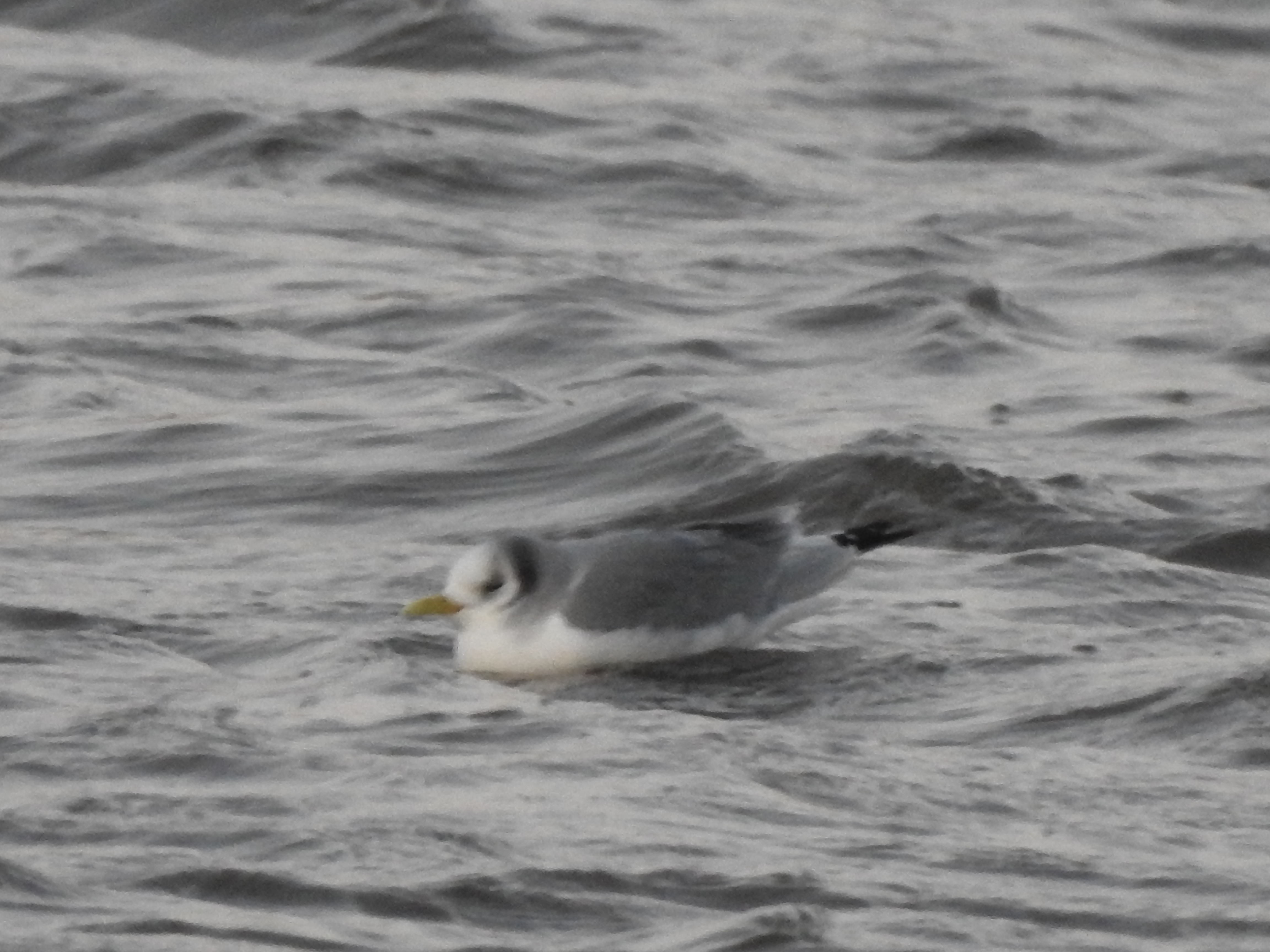
Finally I was pleased to see that the Kittiwake is still present, possibly chuckling to see me again after I had dashed there on the evening of its first day.

Kittiwake

Hopefully it will get strong enough to return to the coast.

PS: The other adult grey-backed Gull was also seen by John Oates, who was equally perplexed. After some Whatsapp chatter, there is a feeling that it could be a hybrid of some kind. My guess would be HerringXCaspian Gull based on a similar looking bird in the latest Gull field guide. I did photograph it, but John had a much sharper one.

Tuesday, 17 January 2023

Tuesday January 17 - Arrow Valley North

 Winter has returned. This morning I drove off with the temperature registering at -5 degrees C. I didn't go far. On the northern outskirts of Redditch the River Arrow flows past the remains of Bordesley Abbey and  I began my walk there, heading north to the Abbey Golf Course and then west to Bordesley Bridge.

In the bright sunshine there was plenty of incentive to get the camera out, and one or two birds were irresistible.

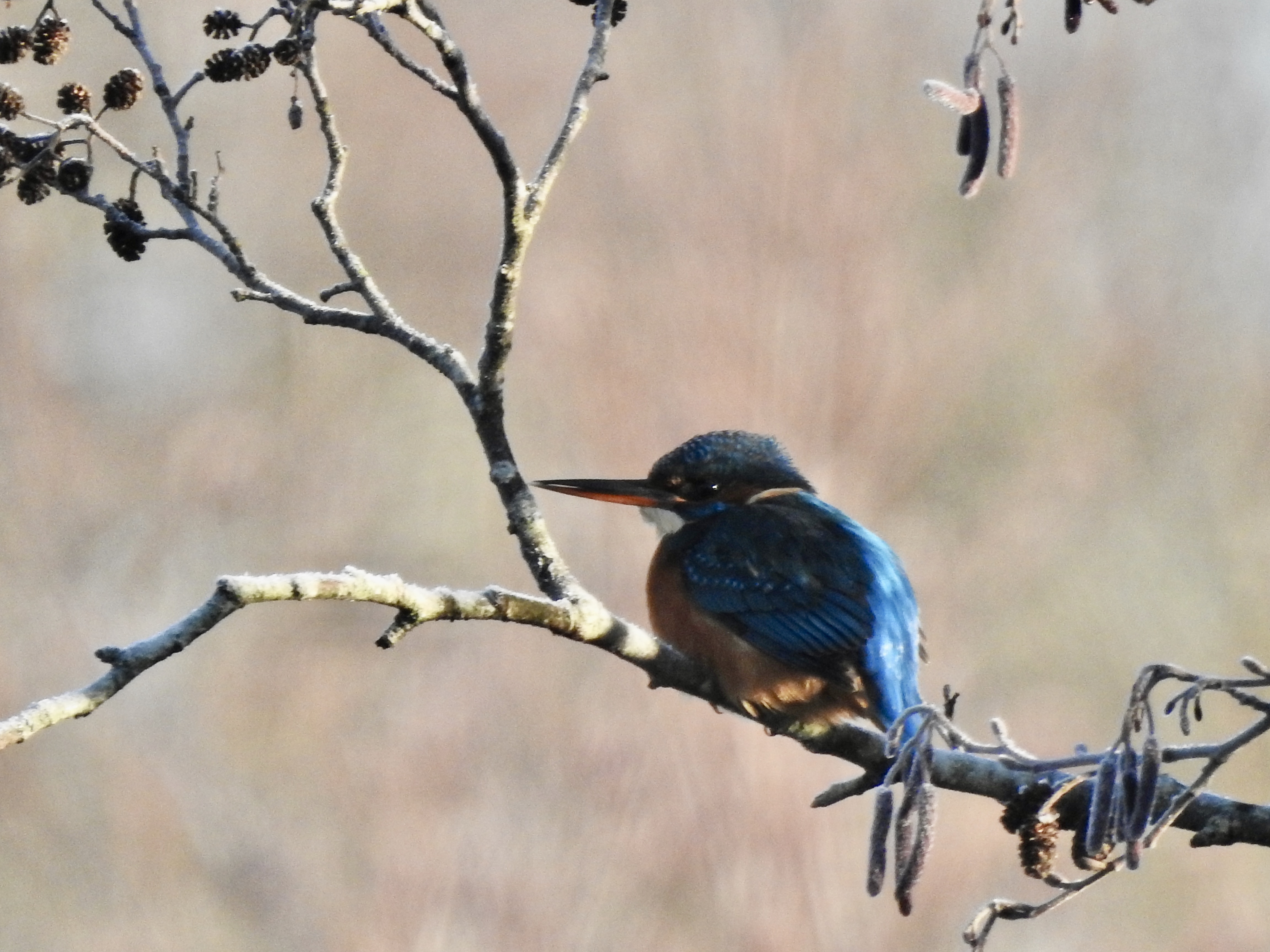
A female Kingfisher

Lesser Redpoll

Siskins

Two Little Egrets

There were double figures of Siskins and a handful of Lesser Redpolls. What I wasn't seeing was anything to move my year-list forwards, although a Little Grebe on one of the golf course ponds was unexpected.

Little Grebe trying to hide behind some Mallard

I do have some Morton Bagot news. Tony K was ringing at the weekend and caught a Jack Snipe in the marsh. 

Jack Snipe at Morton Bagot - per Tony Kelly

I also have some moth news. Nigel Stone took possession of the few specimens I had to take to prove identification and has confirmed that I could add five moths to the garden list including a Beet Moth Scrobipalpa ocellatella which turned out to be in the vanguard of an invasion of the species last year. At the moment it's the first for Warwickshire as it was caught on 9 August 2022 before the majority of them started turning up in traps around the county. However, there is every chance that I will be gazumped by an earlier one.

Beet Moth - 10/8/22


A truly tiny moth caught on 16 June 2022 which was some kind of leaf-miner turned out to be Ectoedemia heringella, only the fourth record of the actual moth in Warwickshire although the leaf-mines are more familiar apparently. They mine the leaves of Holm-Oak.

Ectoedemia heringella - 12/6/22

New for the 10 km square SP06 was Coleophora alcyonipennella, and also Spilonota laricana. New for the garden was Aproeremia (formerly Syncopacma) larseniella. The other three moths, Bryotropha terrella, Bryotropha domestica, and Epinotia nisella, taken were confirmations of earlier identifications which I had chosen to guess at.

Coleophora alcyonipennella - 19/7/22

Spilonota laricana - 19/7/22

Aproaerema larseniella - 8/7/22

Obviously it goes against the grain to take specimens, but for these tiny moths there is no other way of getting the record accepted.

PS: at about the time I was photographing the Redpolls and Siskins I heard what sounded like the squeal of a Water Rail, but it was coming from the fast flowing river. The atypical habitat put me off, so I shrugged and moved on.

Sunday, 15 January 2023

Sunday January 15 - A grim day at Morton Bagot

 This morning was noticeably colder than lately, but started off with a light shower to make us feel at home. I persuaded Dave that we should try walking along the road initially to enhance our chances of finding me a Marsh Tit for my Local Year-list. This nearly paid off when we found a large number of tits visiting a feeder in the village. These included several Coal Tits, and a very brief flight view of what was possibly a Marsh Tit. Unfortunately after about 15 minutes we hadn't seen it again, and we gave up.

Back on the fields we were seeing very little indeed. The flash pools eventually gave up 32 Teal, a Lapwing, and a few Mallard but things were looking pretty grim.

Teal

Its not every day you find a first for your patch and still describe the experience as grim, but that was the case when Dave drew my attention to a Kittiwake in the field beyond the Morton Brook. It was clearly a Kittiwake and definitely dead.

An ex-Kittiwake

Seabirds can turn up inland because they are taking a shortcut on their annual migration, but more likely because they have been battered by storms at sea and, unable to feed, have been blown inland. Some find sanctuary, like the Earlswood bird, but many must die a sad death in a field in the middle of nowhere.

We left it where it lay and continued to the raptor watch point, which we noticed was now smothered in plastic. HOEF have, after a gap of several years, resumed their tree-planting programme here. 


It looks as though they plan to plant in the big field between the pool field and the Morton Brook. The chances of seeing passage Wheatears or Ring Ouzels here may have got that little bit slimmer.

Sigh!

Thursday, 12 January 2023

Thursday January 12 (again) - Twitching a Kittiwake

 You know how it is. You've been out birding in the morning and have written everything up. Time for a nice relax on the sofa. The phone bleeps, but you don't really notice. An hour later it's getting gloomy, you look at your phone. It says Kittiwake at Earlswood a.t.m. The message is timed at 14.23, its now 15.35. Stick or twist?

I twisted. At the end of the road I considered turning round, there had been no news for an hour. I pressed on and arrived at 15.55. The lakes are full of water. My first visit this year, so I tick Great Crested Grebe.

I scan Engine Pool. Nothing. Two Black-headed Gulls are heading away. I must have missed it. I walk across the causeway and half way down Engine Pool. Further scans fail to produce the bird or any birders. I give up, it's obviously gone. Back at the causeway there's a Whatsapp message from the finder Matt. It says "it's the only gull still present, it's by the eastern floating island".

I turn around and gather pace. Half way down I scan the vicinity of the nearest floating island. Nothing. He must mean the other island. I hurry on and scan the area round the second island. Nothing. I spot Matt and walk towards him. "It's gone hasn't it" I say. Matt looks over my right shoulder. "No, it's still here". Good grief.

Kittiwake

I saw it at last, but I don't think I deserved it.

Thursday January 12 - Jurassic birding

 The big news this week concerns a Hen Harrier or two filmed near Morton Bagot, but not recently. 

The exciting discovery dates back to the winter of 1992/93 when film-maker Jeremy was active locally. The footage is fantastic and can be viewed here. It covers the period October 19 1992 to March 15 1993. The sightings began at Badbury Hill, a kilometre east of Morton Bagot, and resume at Lower Spernall and Middle Spernall, ending with the last sightings at Spernall Park. 

Exactly how many birds were involved is uncertain. All the footage is of female Hen Harrier(s), but Jeremy did also see (but not film) a male over nearby Stoopers Wood. What all this land has in common is that back then, in the Jurassic, it was farmland managed for shooting. No doubt Finches and Buntings abounded in the Quinoa planted with Pheasants in mind, and the profusion of small birds would have tempted the Hen Harriers to stick around. Nowadays it is all owned by Heart of England Forest, so its fantastic in the spring and summer for biodiversity, but maybe not quite as good in the winter. 

Many thanks to Jeremy for sending me the footage.

I wish we could have the best of both worlds, plenty of forest and also land for the Quinoa and other Pheasant-cover, but without releasing any Pheasants. Perhaps there would be more finches etc in the winter to interest birders (and Hen Harriers, Great Grey Shrikes etc) and fewer Foxes and Crows, so more Curlews and Lapwings could have successful breeding seasons. 

Anyway, jumping off my soap box, I resumed my exploration of the Arrow today. I manage to scramble my way to Alvechurch STW, approaching from the north. I needn't have bothered. It was hopeless. But half way back to the car was something which made it all worthwhile. I was counting Black-headed Gulls flying south and had just got past 150 when I noticed a goose in their wake. Assuming a Greylag for the day-list I dutifully raised my bins and discovered it was actually an Egyptian Goose. I didn't see one at all last year, so a scramble for the camera ensued. By the time I got a shot the bird was heading into the distance, so I got just one barely identifiable image. 

Egyptian Goose

I would contend that if you look very carefully you can just about make out the snow white upperwing coverts. Not my best effort I will admit.

Before the rain resumed, I had time to walk a footpath south-west from Lye Bridge which skirted a hitherto unknown fishery with just enough phragmites to support a couple of wintering Reed Buntings.

Reed Bunting

I also added a couple of Grey Wagtails to the local year list.

Sunday, 8 January 2023

Sunday January 8 - Morton Bagot

 Another day of mild south-westerly breezes. Time for another patch visit. Dave joined me as usual, and we got off to a bright start when we located the Barn Owl just visible in its roosting spot. 

Between 30 and 40 Redwings were flying around, but year-ticks were awaiting us at the flash pool. A Little Egret was standing with 15 Teal on the furthest flash, and eventually a flock of 25 to 30 Lapwings joined them. The Egret later flew towards the Morton Brook where it showed extremely well.


Little Egret

A little further on we found another creature which was worth a shot or two. A Red Fox was patiently awaiting a movement in the grass from a small mammal it had evidently heard. I took some video hoping it would pounce, but after five minutes of non-activity I gave up. I won't subject you to that, but will show the moment it finally looked round. We were downwind so it was unaware that we were there.

Red Fox

We did quite well for mammals, seeing Brown Hare, Muntjacs, a Roe Deer, and more unusually four Fallow Deer, but that was about it for another weekend.

Friday, 6 January 2023

Friday January 6

Since my last post I've added just one new bird for the year, a female Blackcap in our garden. 

Tony has been doing a bit of ringing at Netherstead, targeting the top pool where all the Pied Wagtails had roosted. The morning he did it produced instead an excellent tally of eight Reed Buntings caught. He also saw a Grey Wagtail which remains stubbornly off my list for the year.

Female Reed Bunting - per T Kelly

Today I decided to stick to my guns and potter around in the next section of the River Arrow, just east of Alvechurch. Things started well when I had an excellent view of a Kingfisher, and was then invited by a friendly chap, Joe, to explore his garden and woodland where I'd just seen it. In a perfect world this would have led to the discovery of something unusual, but I'm afraid it did not. 

It's always nice to talk wildlife to people when you are out birding, and today was most notable for the number of friendly folk who stopped to chat.

The River Arrow at Alvechurch

Just south of where I took this photo lies the Alvechurch Sewage Treatment Works. Numerous Black-headed Gulls were commuting between it and Bittell Reservoirs five miles to the north. I've checked the map, and I can't see any way of getting close to it on public roads or footpaths.

I'm going to need a friendly sewerage worker!