A cloudy morning with periods of light drizzle. Very mild with a light southerly breeze.
I chose to walk along the road from Netherstead to Church Farm, hoping to find something exciting like a Black Redstart on one of the buildings. As usual the plan failed, and the best I could muster was a Grey Wagtail and two Mistle Thrushes.
Cutting down to the pool and flash field, the searching produced a Stonechat, 57 Snipe, two Green Sandpipers and 29 Teal. Then the rain really pepped up and I got absolutely soaked walking back.
Ironically, as I made my soggy way across the strip field I flushed the only decent bird of the day, a Jack Snipe.
I ended by driving to the south end, where 167 Linnets on the wires were frequently disturbed by nearby gunfire.
What a wash out.
Friday, 30 October 2015

Sunday, 25 October 2015
Sunday October 25
Perfect weather conditions, calm with high cloud and good visibility.
Dave and I had a good look round, and there were encouraging signs, most notably a flock of 350 Linnets with at least 35 Lesser Redpolls in the crop at the south end.
The woodland areas produced at least six Goldcrests, and four Blackcaps.
Most of these birds were seen in the first hour, and thereafter things became quieter. There was no evidence of any arrivals at the Flash field, with 42 Snipe, 10 Teal, and two Green Sandpipers present. Although there is no duck shooting on the patch this year, it is still taking place locally so there seems little prospect of improvement until the end of January.
Rather frustrating.
Dave and I had a good look round, and there were encouraging signs, most notably a flock of 350 Linnets with at least 35 Lesser Redpolls in the crop at the south end.
The woodland areas produced at least six Goldcrests, and four Blackcaps.
 |
| Blackcap |
Rather frustrating.
Thursday, 22 October 2015
Thursday October 22
With a slightly restricted morning in prospect, I split the visit into two sections. From Netherstead I ambled around, seeing a Grey Wagtail, a Stonechat, and 60 Linnets. I then drove the Church Farm and did a circuit of the northern end.
The weather was coming from the west, and was cloudy and a little breezy. There wasn't very much passage going on, but I did see 47 Starlings heading west. I also finally got a photographic monkey off my back as I at last managed a photograph of a Goldcrest.
These tiny, zippy little birds have defied my attempts to focus on them with my bridge camera for over a year. If I ever find a Firecrest here, there's not much danger it will be proved with a photograph.
Thrush passage was much less dramatic than last week, but many are now feeding in the hedgerows. I logged 61 Fieldfares and 85 Redwings.
A few Lesser Redpolls and Siskins flew over, while the flash field produced five Green Sandpipers, 26 Snipe, 10 Teal, 45 Greylag Geese, and six Lapwings.
Yellowhammers vary quite a lot from bright males to dull first-winter females. This is about as un-yellow as they get.
Unless its a Pine Bunting of course!
The weather was coming from the west, and was cloudy and a little breezy. There wasn't very much passage going on, but I did see 47 Starlings heading west. I also finally got a photographic monkey off my back as I at last managed a photograph of a Goldcrest.
 |
| Goldcrest |
Thrush passage was much less dramatic than last week, but many are now feeding in the hedgerows. I logged 61 Fieldfares and 85 Redwings.
 |
| Fieldfares |
 |
| Redwing |
Yellowhammers vary quite a lot from bright males to dull first-winter females. This is about as un-yellow as they get.
 |
| Yellow(ish)hammer |
Sunday, 18 October 2015
Sunday October 18
Cloudy with a light northerly breeze. This was a memorable visit despite no year-ticks being unearthed, and only 48 species being seen. The saving grace was the quantity of birds on offer.
For a change, Dave and I decided on a clockwise circuit. This meant more time being devoted to the fields, and none at all to the woodland margins. We began at the south end where we found the first of at least 29 Lesser Redpolls (a record), and the first of seven Stonechats (another record).
I have a love hate relationship with Redpolls. They are great little birds, but they do your head in because you have to check every one to rule out the continental species, Mealy Redpoll. Added to this is the difficulty of identifying what used to be races of one species, Lesser Redpolls varying from one individual to another according to age and sex.
Although there did seem to be a large one among the birds we saw, we never got to grips with it and we ended up identifying all the ones we saw well as Lesser. This one caused us a few problems though.
Rather grey around the head, but thought to be too brown mantled, and the wing-bars had too much brown in them for a Mealy. There is a new article coming out soon in the Frontiers of Bird Identification series which I understand will include a chapter on Redpolls. I'll certainly be buying it.
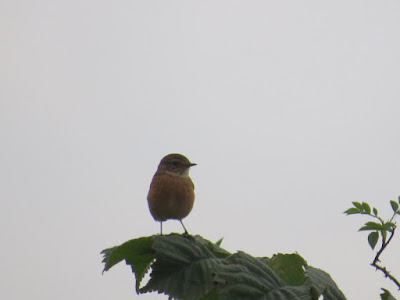
The Stonechats were a pair in the ridge field, two pairs around Netherstead, and one male at the south end. Here is one of the females at Netherstead.
The other two species to break records were thrushes. We saw over a thousand Fieldfares and Redwings flying over, all going north-west, the break down being 576 Redwings and 437 Fieldfares. There were also a couple of flocks which were too distant to fully identify.
It was one of those days when there was never a dull moment. Other counts included 65 Goldfinches, 14 Chaffinches, 22 Snipe, four Green Sandpipers, 15 Yellowhammers, at least 10 Reed Buntings, five Siskins, two Blackcaps, a Grey Wagtail, and 15 Teal.
For a change, Dave and I decided on a clockwise circuit. This meant more time being devoted to the fields, and none at all to the woodland margins. We began at the south end where we found the first of at least 29 Lesser Redpolls (a record), and the first of seven Stonechats (another record).
I have a love hate relationship with Redpolls. They are great little birds, but they do your head in because you have to check every one to rule out the continental species, Mealy Redpoll. Added to this is the difficulty of identifying what used to be races of one species, Lesser Redpolls varying from one individual to another according to age and sex.
Although there did seem to be a large one among the birds we saw, we never got to grips with it and we ended up identifying all the ones we saw well as Lesser. This one caused us a few problems though.
 |
| Lesser Redpoll |
 |
| Same bird |
Rather grey around the head, but thought to be too brown mantled, and the wing-bars had too much brown in them for a Mealy. There is a new article coming out soon in the Frontiers of Bird Identification series which I understand will include a chapter on Redpolls. I'll certainly be buying it.
The Stonechats were a pair in the ridge field, two pairs around Netherstead, and one male at the south end. Here is one of the females at Netherstead.

The other two species to break records were thrushes. We saw over a thousand Fieldfares and Redwings flying over, all going north-west, the break down being 576 Redwings and 437 Fieldfares. There were also a couple of flocks which were too distant to fully identify.
It was one of those days when there was never a dull moment. Other counts included 65 Goldfinches, 14 Chaffinches, 22 Snipe, four Green Sandpipers, 15 Yellowhammers, at least 10 Reed Buntings, five Siskins, two Blackcaps, a Grey Wagtail, and 15 Teal.
Thursday, 15 October 2015
Thursday October 15
Cloudy with a light north-easterly breeze. I made a late start due to acute laziness, and didn't get to the patch until 09.30. It wasn't long before I was chatting to Maggie, who was walking her dog. She quite reasonably asked me what I was hoping to see today. Although I was tempted to reel off a long list of potential rarities, reality kicked in and I settled for Redwings.
What do they look like and how many have you seen so far? They look a bit like Starlings, and I've seen two, came my answer. I felt she wasn't impressed. Within ten minutes I had seen a party of 40 heading north-west, but throughout the majority of the rest of the morning no more flew over.
That was all to change at around 11.45am. A group of nine, and then another 55. The birds kept on coming, and by 12.15pm, I had amassed a grand total of 361, all heading north-west, none calling, and none looking like stopping. I searched each flock for Fieldfares, but saw none, although one distant flock of 40 thrushes did look a bit too big to be Redwings, so I didn't count them as anything.
So you have to remember that this is not just happening at Morton Bagot. Across the country similar flocks will have been doing just the same, as Scandinavia gradually sheds its entire population. The scale is eye-watering.
The rest of the morning was dominated by another northern species, but in this case they will just have come from northern Britain. Small numbers of Lesser Redpolls were feeding on willow herb seeds along the hedge at Netherstead, and I found a larger flock near the Pheasant pens, giving me a creditable total of 24.
Other passerines seen included 30 Skylarks, five Siskins, a Chiffchaff, and a pair of Stonechats.
Thank goodness for the perching birds, because the watery areas were absolutely desperate. The grand total of waterbirds was three Green Sandpipers, three Teal, two Snipe, 30 Mallard, a Greylag Goose, and a Kingfisher which saw me first and as a consequence was heard and not seen.
What do they look like and how many have you seen so far? They look a bit like Starlings, and I've seen two, came my answer. I felt she wasn't impressed. Within ten minutes I had seen a party of 40 heading north-west, but throughout the majority of the rest of the morning no more flew over.
That was all to change at around 11.45am. A group of nine, and then another 55. The birds kept on coming, and by 12.15pm, I had amassed a grand total of 361, all heading north-west, none calling, and none looking like stopping. I searched each flock for Fieldfares, but saw none, although one distant flock of 40 thrushes did look a bit too big to be Redwings, so I didn't count them as anything.
 |
| A party of 60 Redwings |
The rest of the morning was dominated by another northern species, but in this case they will just have come from northern Britain. Small numbers of Lesser Redpolls were feeding on willow herb seeds along the hedge at Netherstead, and I found a larger flock near the Pheasant pens, giving me a creditable total of 24.
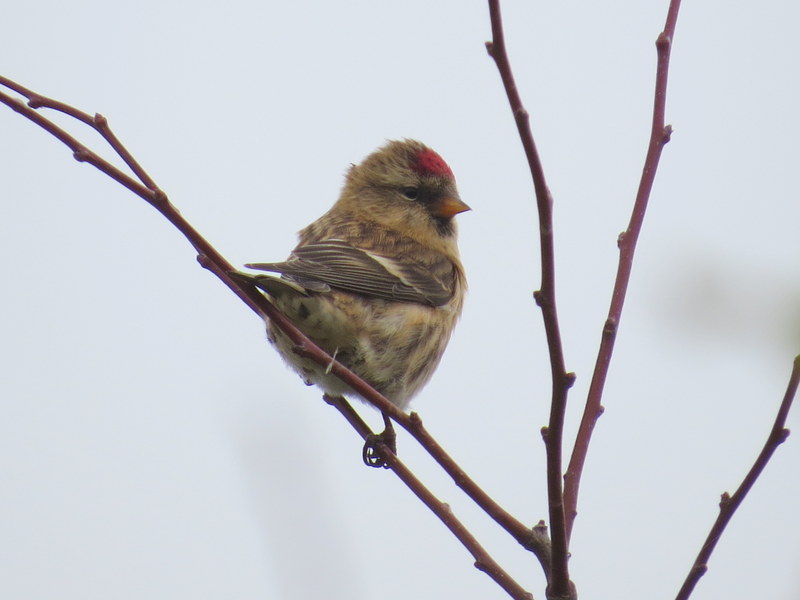 |
| Lesser Redpoll |
 |
| The male Stonechat |
Sunday, 11 October 2015
Sunday October 11
I'll begin this post by looking back to last Sunday. Dave was able to give me the full story of his Marsh Harrier sighting. After seeing it as soon as he arrived, he then relocated it over an hour later as he approached the flash field. It ended up over the nearest flash where it circled and then landed, apparently attracted by the corpse of a goose sp which had been shot the previous day. It then stood around for about 15 minutes while Dave tried to establish whether he could contact anyone with a camera. Eventually Mike set out from home, but before he got half way the bird took off and headed north. It must have been present at the patch for about an hour and a half in total.
Although I wasn't there, Dave's vivid description makes me wonder whether in ten years time I will think that I saw it! Dave also counted 75 Snipe and a Stonechat.
So back to this Sunday. Our most notable sighting occurred shortly after arriving, as nine late Swallows headed south. After that we decided to target tit flocks in the hope that this autumn's massive influx of Yellow-browed Warblers might be reflected here. It is a bit like looking for a needle in a thousand haystacks, and all we saw was a dozen Long-tailed Tits, two Marsh Tits, a Treecreeper, two Chiffchaffs, and four Goldcrests. Up to five Siskins, and three Lesser Redpolls were also present.
The flash field contained 56 Snipe, six Teal, four Green Sandpipers, and the dead goose. Considering I saw seven over Redditch as I headed for the paper shop this morning, I was surprised that not a single Redwing flew over all morning.
Here's a mystery raptor photograph for you.

The bird had careered across the ridge field before landing and allowing me to sneak up on it. Not too difficult, but give yourself a point if you said...
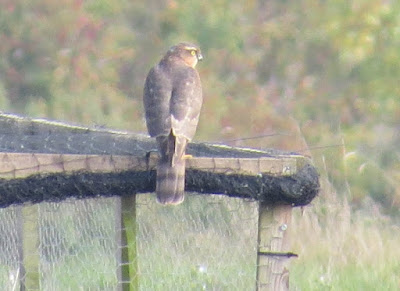
Sparrowhawk.
The final notable bird of the morning was a female Stonechat, which we discovered back at Netherstead.
Although I wasn't there, Dave's vivid description makes me wonder whether in ten years time I will think that I saw it! Dave also counted 75 Snipe and a Stonechat.
So back to this Sunday. Our most notable sighting occurred shortly after arriving, as nine late Swallows headed south. After that we decided to target tit flocks in the hope that this autumn's massive influx of Yellow-browed Warblers might be reflected here. It is a bit like looking for a needle in a thousand haystacks, and all we saw was a dozen Long-tailed Tits, two Marsh Tits, a Treecreeper, two Chiffchaffs, and four Goldcrests. Up to five Siskins, and three Lesser Redpolls were also present.
The flash field contained 56 Snipe, six Teal, four Green Sandpipers, and the dead goose. Considering I saw seven over Redditch as I headed for the paper shop this morning, I was surprised that not a single Redwing flew over all morning.
Here's a mystery raptor photograph for you.

The bird had careered across the ridge field before landing and allowing me to sneak up on it. Not too difficult, but give yourself a point if you said...

Sparrowhawk.
The final notable bird of the morning was a female Stonechat, which we discovered back at Netherstead.
Thursday, 8 October 2015
Thursday October 8
Our last full day dawned sunny for once. A light westerly, but I still decided to spend my last morning exploring the fields around the cottage.
Two hours later I was somewhat regretting the decision as very little noteworthy had come to my attention. In fact the best sighting was made as Lyn and I prepared to head for Scarborough for the non-birding part of the day, when a flock of 60 Pink-footed Geese flew noisily south.
Earlier I did at least manage to finally nail a photograph of one of the many Tree Sparrows which inhabit the hedgerows around here.
Other than that the bright sunshine was at least good for photography, and I was quite pleased with one of the local Robin singing in the garden.

My next post should be from back at Morton Bagot.
I can hardly wait.
Two hours later I was somewhat regretting the decision as very little noteworthy had come to my attention. In fact the best sighting was made as Lyn and I prepared to head for Scarborough for the non-birding part of the day, when a flock of 60 Pink-footed Geese flew noisily south.
Earlier I did at least manage to finally nail a photograph of one of the many Tree Sparrows which inhabit the hedgerows around here.
 |
| Tree Sparrow (if only it was at Morton Bagot) |

My next post should be from back at Morton Bagot.
I can hardly wait.
Subscribe to:
Posts (Atom)