Monday, 27 August 2018

Monday August 27

A mostly cloudy morning with a few very light showers and a light westerly wind.

This is one of my favourite times of the year for birding, but the weather and wind direction were a potential adverse factor.

After about an hour of not even seeing a passerine migrant, unless you count the 30 or so House Martins harvesting insects in the lee of the Netherstead plantation, I was beginning to think I was wasting my time.

I eventually reached the Flash field and counted an impressive 224 Greylag Geese and 38 Canada Geese. The nearest flash contained only four Green Sandpipers, four Snipe, 23 Teal, and 24 Black-headed Gulls. I decided a token bird photograph was in order.

Green Sandpiper and Pied Wagtail
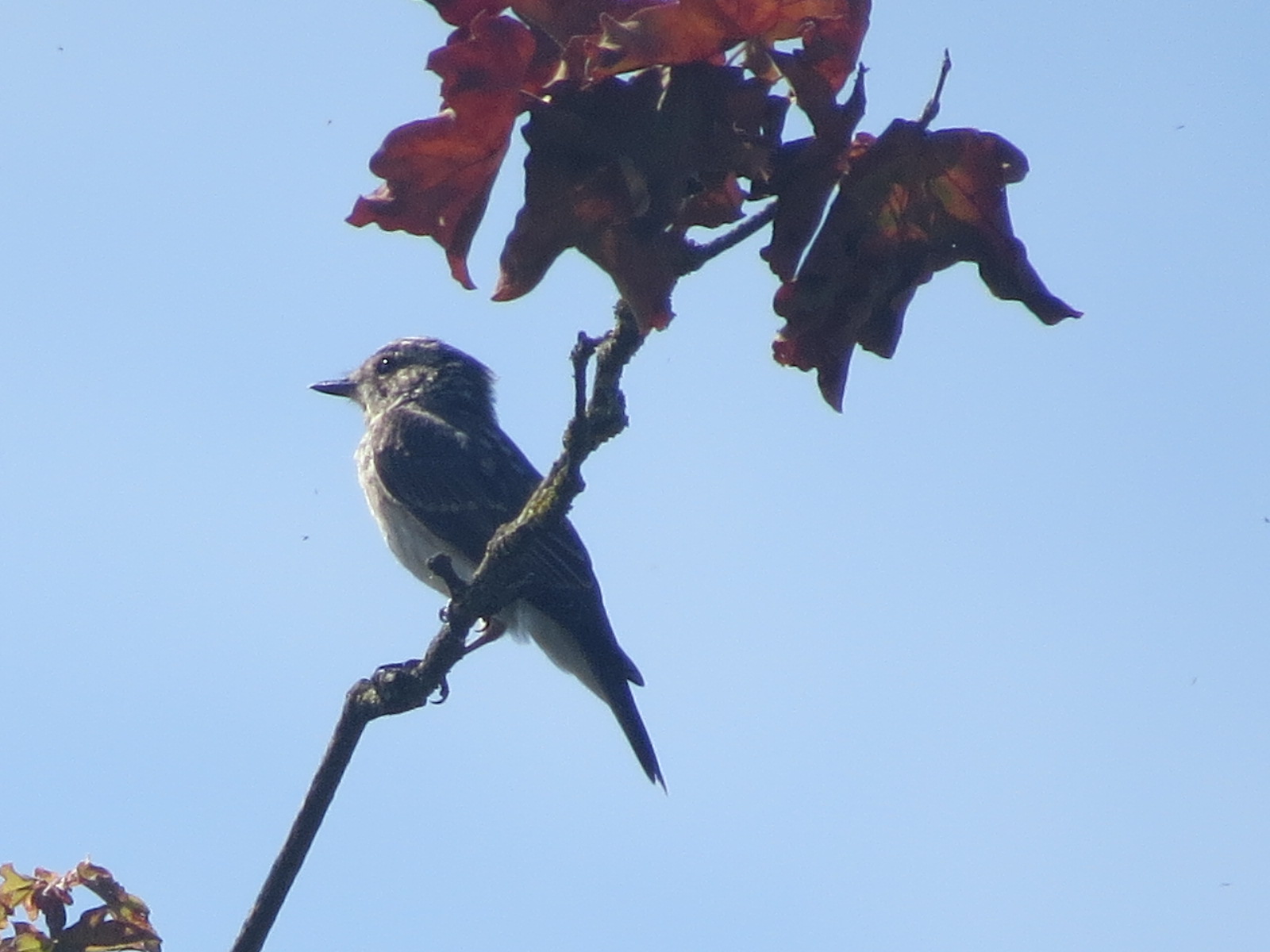
Fortunately my fortunes started to improve a little when I spotted a Sand Martin over the water, and then a few other migrants in the hedge. A Spotted Flycatcher was the pick of the bunch, which comprised two Blackcaps, two Chiffchaffs, and a Whitethroat.

Spotted Flycatcher
A Sparrowhawk stirred things up, and a Little Owl started calling.

On the walk back I turned my attention to insects, the highlight being several crickets of a species called Long-winged Conehead. This is a fairly recent colonist to the Midlands, and I only saw my first here last year.

Long-winged Conehead
Other creatures noted included at least a dozen Dark Bush Crickets, a Lesser Marsh Grasshopper, about six shieldbugs I took to be Dock Bugs, and one or two butterflies; two Small Coppers, a Small Heath, a few "whites", and three Speckled Woods.

Speckled Wood
Finally I noticed several strangely shaped growths on an Oak Tree. They were sticky to the touch, and after some very brief research I discovered they were Knopper Galls.


The Galls are produced by a tiny wasp Andricus quercuscalicis, which only reached the UK in the 1960s, but is now widespread. Apparently the Oaks manage to take these galls, which are the result of eggs laid in budding acorns, in their stride and the trees do not suffer unduly.

Sunday, 19 August 2018

Sunday August 19

Cloudy with a moderate westerly which eased during the morning.

Our initial impression was that there were not many migrants about, but managed to pull a Yellow Wagtail out of the hat as it flew from the pool and headed away, initially over the flash field, before veering away to the east.

The water level in both flashes looked ideal, and once again there were plenty of waders; three Lapwings, 10 Green Sandpipers, and 17 Snipe as well as 14 Teal and several Pied Wagtails. More significantly for us was the presence of an adult Ringed Plover.

Ringed Plover
This was the first this year, and the species is just less than annual. Not quite worth a fist pump, but definitely the sort of lift we needed.

The rest of the visit was a bit quiet. Insects were few; a Speckled Wood, a Small Heath, one or two "whites", a few Ruddy darters and hawkers, and a single Dark Bush Cricket.

Muntjac
Always nice to see a Muntjac, but this deer could arguably be considered a pest species because of the damage they do to the woodland understory.

Sunday, 12 August 2018

Sunday August 12

Following an encouraging overnight forecast I was a little dismayed to find that they had got it wrong and the morning was actually pretty wet. In fact, I decided to wait until after lunch in the expectation of drier weather. Not much drier as it turned out.

Although there were plenty of tits around Netherstead, and about 40 low flying House Martins across the site, there was precious little evidence of passerine migrants.

The only hope was the flash field. As usual it looked good but hosted only the usual suspects; six Green Sandpipers, 10 Teal, 12 Lapwings, and 18 Snipe (a considerable increase on last time).

Snipe
I was disappointed to see evidence that whoever farms the land beyond the Kingfisher Pool had grubbed out an Alder at one end of a hedge. I hope he stops there.


Sunday, 5 August 2018

Sunday August 5

A warm and mostly sunny morning with a very light southerly breeze.

Dave was able to join me and he soon spotted the first passerine migrant of the day, a Whinchat, near the Dragonfly Pools.

Whinchat
We continued to the pond in hedge, now bone dry, where we found a little flock of migrants. We followed them down the hedge and ended up with counts of 10 Common Whitethroats, five Lesser Whitethroats, several Chiffchaffs, a Willow Warbler, and a juvenile Spotted Flycatcher.

Willow Warbler
Spotted Flycatcher
Further evidence of migration came with a trickle of Swifts (nine in all) heading south.

The Flash field contained a lot of cattle. They were sheltering under an oak until they saw us and abandoned the shade for the thrill of getting as close as they could to us standing on the other side of the fence. To our amusement, the sheep in the field saw their chance and rushed to replace the cattle under the shady oak.

As for birds, we counted five Green Sandpipers, 37 Lapwings, a Snipe, and nine Teal. It was at this time we added a rather unsatisfactory year-tick. High up and off to the north we could hear a tern calling. We scanned the sky for at least a minute while the tern or terns called about a dozen more times. We couldn't see a thing. Given the time of year and the weather it was almost certainly a Common Tern as opposed to Arctic, but it would have been nice to actually see it.

Green Sandpiper

There were still plenty of insects about, more Small Heaths than recently, and still a few Common Blues and at least one Brown Argus. Dragonflies included the first Migrant Hawker of the year and at least 30 Small Red-eyed Damselflies.

A single Toad was sitting, covered in slime, watching the dragonflies with great interest.

Toad
By midday it was too hot to do anything further and we slouched off home.

Sunday, 29 July 2018

Sunday July 29

A foul morning of driving rain and a fresh southerly meant that I would be birding alone.

In these conditions there is really only one option. Head for the flash field and hope the weather has dropped something in.

Having not been here all week it is impossible to know whether the family party of five Shelducks had just arrived, but I suspect not.

Shelduck
As is typical with these late summer appearances they comprised four juveniles and an adult female.

If I had one banker I was hoping for in these conditions, it was Sand Martin. They didn't disappoint, and at least four birds were the only hirundines over the flash pool all morning. Seeing them is one thing, photographing them another.

Sand Martin
Three Snipe flew to the furthest flash, while at least five Green Sandpipers mingled with about 60 Lapwings and eight Teal. A flock of 60 Starlings gathered on wires beyond the flash field.

Lapwings
As the rain intensified I had a quick look at Kingfisher Pool and found it occupied by an adult and three well-grown, but un-fledged, Mute Swans. The fact that a pair of Mute Swans can breed here unnoticed doesn't say much for my thoroughness this year.

Not at all pleased to see me
The trudge back to the car into to the driving rain was an experience I wouldn't want to repeat too often.

Sunday, 22 July 2018

Sunday July 22

A cloudy start, but the sun soon burnt through and it became very warm again. A very slight westerly breeze. As expected, the pool is now well on the way to drying up.

From a birding point of view it felt as though all our eggs were firmly in the basket of hoping there would be something in the Flash field. There were some good signs; 62 Lapwings, a juvenile Little Ringed Plover, a Snipe, nine Green Sandpipers, and seven Teal. Nothing new though. Until Dave spotted a Sand Martin. Whoo hoo, a tick at last. The only problem was that he was some way from me and by the time I'd cottoned on, the bird had made a sharp exit. Never mind, there will be another...surely.

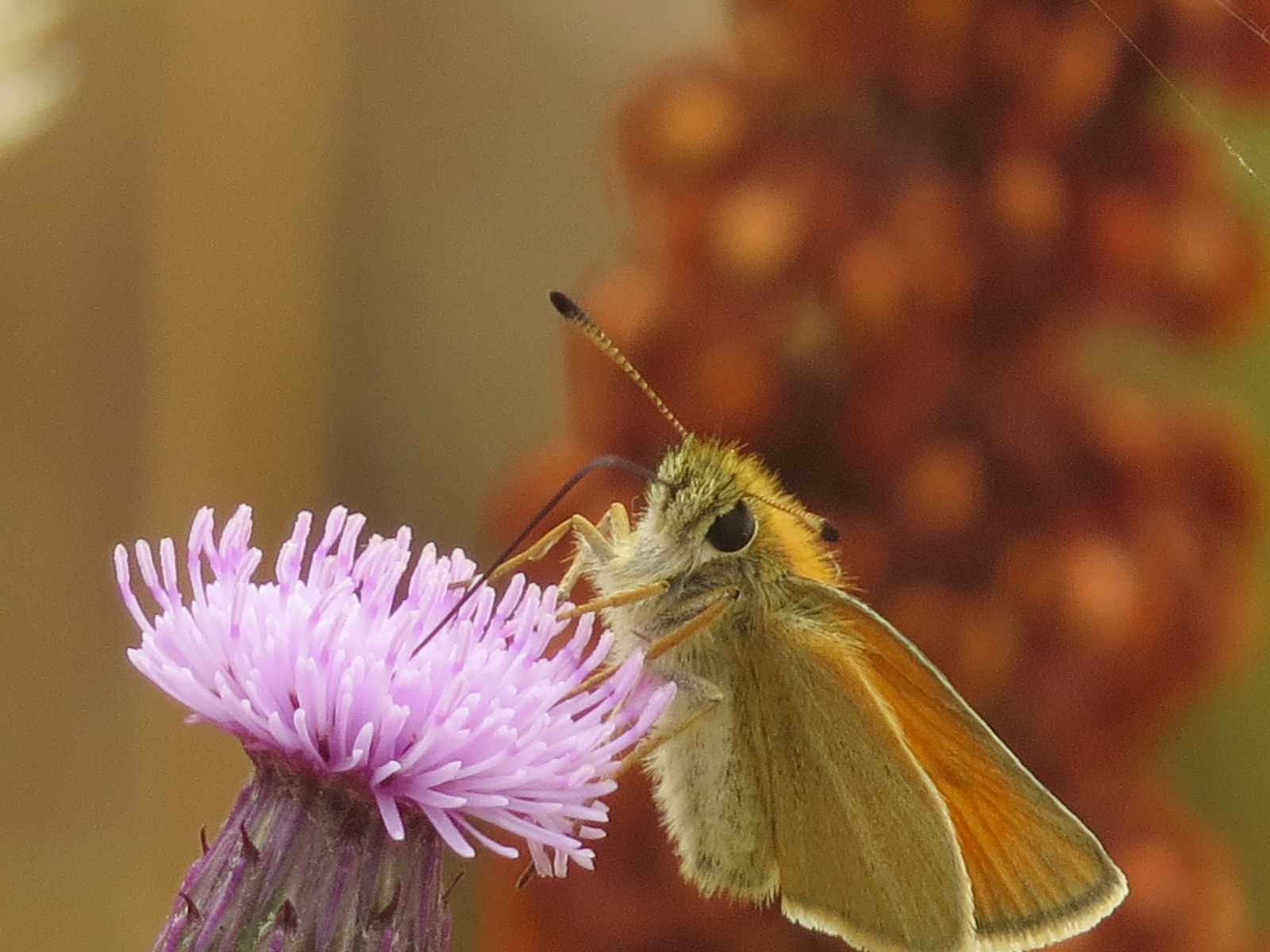
In the meantime, we reverted to looking at insects. It was noticeable that there were more Common Blue butterflies (almost double figures), and about a dozen Brown Arguses in the grass. The skippers we looked at were a mixture of Essex and Small, so I finally got a shot of the former.

Essex Skipper
We also saw at least three Small Coppers, an encouraging sign. Other butterflies included a very worn Red Admiral, and an absolutely pristine Painted Lady.

Small Copper
Fortunately for me, Dave had not given up trying to add birds to the year list. As we stood next to Kingfisher Pool, a movement in the hedge on the other side of the field led him to discover a male Redstart, and this time I managed to see it.

Redstart
A true record shot (distance, heat haze etc).

Painted Lady

Common Blue

Small Heath
By the time we got back to our cars, the heat was getting to us. We were flagging.

However, I was revived when I opened the car door and a moth flew in and landed on the upholstery of the passenger door.

Smoky Wainscot
I know that with my new found enthusiasm for moths I should be able to identify it. But I can't. It's a bit worn and is certainly one of three or four Wainscot species. Basically they all look the same.

PS: many thanks to John S who has suggested the above moth is a Smoky Wainscot.

Sunday, 15 July 2018

Sunday July 15

It's still scorchio and our visit to Morton Bagot this morning required extra kit (bottles of water). I was hoping this visit might start to shift the emphasis a notch back towards birds, but in truth it was all about insects again.

There were signs that the local Buzzards have bred, and we also heard juvenile Yellowhammers calling (a call which had us a little baffled at the time). A family of Lesser Whitethroats appeared in the hedgerow by the flash pool, but I only managed a photograph of one of the adults. The nearest flash has had its waterlevel adjusted so that it now looks pretty good again. The only waders we could see were two Green Sandpipers and about 20 Lapwings.

Common Buzzard

Lesser Whitethroat
As for insects, between us we recorded 23 species (including a late solo foray into Bannams Wood). I have since learnt that Mike Inskip was in Bannams Wood during the morning and that he saw some more White-letter Hairstreaks. So this would bump the total for the area up to 24 species. The only butterfly none of saw, but which was probably there somewhere, was Holly Blue.

New for the year at Morton Bagot were about six Brown Argus, and a single Small Copper. This formerly quite common species is now barely annual here.

Brown Argus
Small Copper
Possibly new for the year (I can't remember whether we have recorded them or not) were a Painted Lady and a Red Admiral.

Painted Lady
Dragonflies were also also well represented, 13 species, including a Southern Hawker and at least six Emperors.

After Dave left, I ventured into Bannam's Wood. Here I found at least 15 Silver-washed Fritilleries including a dull female of the Valezina form, something I have not seen before, and another Brown Argus.

Silver-washed Fritillary (form valezina)

Brown Argus

The full butterfly list was: c 30 Small White,  c 20 Large White (half of them in Bannam's), three Green-veined White, five Brimstone (all in Bannam's), sev White-letter Hairstreak (Mike in Bannams), one Purple Hairstreak, one Small Copper, eight Brown Argus, three Common Blue, c50 Small Skipper, one Essex Skipper, two Large Skipper (Bannam's), one Comma, one Red Admiral, one Peacock, one Small Tortoiseshell, one Painted Lady, c15 Silver-washed Fritillary (Bannams), six Marbled White, c50 Meadow Brown, c110 Gatekeeper, five Ringlet, one Small Heath (Dave at Morton Bagot), and three Speckled Wood.

Thank goodness there are still places like this where the excesses of agricultural intensification have been held in check.