Tuesday, 31 August 2021

Tuesday August 31 - Marsh Harrier again

 This morning Dave was able to join me and we headed to the flash field to see if the Marsh Harrier was still present. En route we met @Eskimoden and his wife who were making their first visit to Morton Bagot and were trying to work out where the flash field was.

We pointed them in the right direction and found Mark Clarke was already there. So that was a lot of photographic kit on show, all we needed was the bird. Actually Mark had already photographed it and pretty soon it showed reasonably well.

I took some pretty dull video in the hope I could work out how to make it viewable from a phone.


The URL is https://youtu.be/RyTEMS4MN74 but as you have probably worked out, I have no idea what I'm doing, so if it still can't be seen on a phone then I'm out of ideas.

Marsh Harrier

There seemed to be more or less the same numbers of birds present as on Sunday, which made it a bit annoying that I couldn't locate the Garganey. I wouldn't be surprised if its still here as only about three quarters of the Teal flock was available for scrutiny. 

Also present were six Snipe, four Green Sandpipers (Andy Owen had five on Monday), a Shoveler, and at least 57 Mallard. 

Snipe and Lapwings


Shortly after we left the others we spotted one of two Kingfishers recorded during the morning.

Kingfisher

It remained in view just long enough for this shot, but had moved on as I was about to backtrack to tell the others.

The strip of crops and bushes in the weedy field harboured five Whinchats and a couple of Whitethroats.  A Grey Wagtail (maybe two) flew over, but we only got the calls and didn't see it/them. Our last good bird came at Netherstead where a Hobby shot past at close range.

It's good that Morton Bagot is once again on the birding map in a small way.

PS Dennis Stinton has confirmed the continued presence of the Garganey with a brilliant in flight shot (plus cropped version) which I can share on this blog. He also took some excellent Marsh Harrier shots.

Teal and Garganey - per Dennis Stinton

The Garganey (cropped) - per Dennis S

Marsh Harrier - per Dennis Stinton

Marsh Harrier - per Dennis Stinton

Perhaps I need to invest in a bigger camera...and some training !

Monday, 30 August 2021

Monday August 30 - Harrier news

 I haven't been able to get down there myself today, but various sources assure me that the Marsh Harrier was still in residence this afternoon and is hunting enthusiastically.

It clearly knows a good place when it sees it.

Thanks for the updates guys.

Sunday, 29 August 2021

Sunday August 29 - Persistence pays off

 So another attempt to find something at Morton Bagot. The date is perfect, the conditions mostly cloudy with a light northerly again. 

For the first hour it was pleasant enough, I counted 11 Chiffchaffs, two Blackcaps, a Whitethroat, and a Whinchat. I was jumped up at and slobbered all over by a fifteen month old labrador called Arthur. Things could only get better.

When I reached the flash field they did. The pot-boiler was a Gadwall, the first this year, swimming with 27 Mallard on the nearest flash. I didn't exactly punch the sky, but a year tick is a year tick.

Gadwall

I could see the usual few Teal and Snipe, plus a Green Sandpiper and at least 11 Black-headed Gulls. Nothing to suggest what was about to happen.

I moved on to my other viewpoint under the trees. On arrival I noticed a bunch of Teal swimming in the middle of the flash. Odd, I thought. Then the reason became clear, a cream-crown Marsh Harrier was floating over the sedge. I lost it before even getting my binoculars on it, but I needn't have worried. It reappeared and went on to treat me to hours of enjoyment as it periodically hunted the terrified waterfowl.


It frequently landed in plain sight

The dark chocolate brown plumage, perfect fresh wing feathers, and limited amount of cream on the forewings all pointed to it being a juvenile bird.

I was even tempted to take some video clips. In the first one (see below) it is standing at the furthest flash and nothing seems to happen, but keep watching when the nearby Grey Heron starts to get curious. In the second, it's closer but listen for the sigh as it becomes obscured by a tree.


Anyway, one very useful result of having a Marsh Harrier hunting over the field is that birds you didn't know were there suddenly appear. I counted 67 Teal and 45 Lapwings before becoming preoccupied by the discovery of a Garganey among the Teal.

Garganey with Teal

If you're not sure which one it is, it's third from the right. The one with the hint of a little white eyebrow.  With the birds very unsettled I was tempted to take a quick bit of jerky video to give the impression of what it was like.


I started with the Lapwings, but then the Teal appeared. Once I got home it occurred to me that the Garganey should be in with them, and eventually I found it after scrolling through in slow motion. I'm not known for my ability with technology, so I am very proud of the fact I worked out how to take a zoomed in screenshot showing the Garganey in flight. Look for the one with the two white wing-bars.

Garganey in flight

I managed to send some texts before getting enough reception to call Mike Inskip. He turned up within the hour and I went back with him to see the bird again. I have since heard from Sam McVie that the Marsh Harrier was still present at 15.15. 

On my walk back to the car I discovered that at least three Whinchats were present.

I'll admit that I have been a bit disappointed by the lack of decent waders here this year (I eventually saw four Green Sandpipers and a few Snipe thanks to the Marsh Harrier), but when you get a day like this it really doesn't matter.


Friday, 27 August 2021

Friday August 27 - Another day another Whinchat

 A cloudy morning with a light northerly breeze. I tried parking at the church and coming in from that direction, but the result was pretty much the same.

At the flash field wader numbers are almost static; two Green Sandpipers, six Snipe, and at least 15 Lapwing (they were more hidden than usual). About 29 Teal, and 19 Mallard, but there may have been more out of view. The only real change was the presence of 26 Black-headed Gulls.

It's a balancing act

As for passerines, I teased out a Blackcap, a Goldcrest, and a couple of Whitethroats before spotting a rather co-operative Whinchat to remind me that passage migrants do still occur here. Shortly afterwards a Peregrine (which I nearly forgot to mention) flew over.

Whinchat

Its a good job its a nice place to walk around.

Still no Osprey on the dead tree

The moth trap goes out tonight. Finger's crossed.

Well it was ok, but quantity won over quality. The nearest to a first for the year was what may be the grey form of Orchard Ermine.

Bird-cherry Ermine 4,    Orchard Ermine 1 (nfy),    Yponomeuta ag 1,    Blastobasis adustella 1,    Cydia splendana 5,    Light Brown Apple Moth 1,    Phycita roborella 1,    Agriphila geniculea 4,    Mother of Pearl 1,    Garden Carpet 1,    Common Marbled Carpet 1,    Double-striped Pug 3,    Brimstone Moth 5,    Willow Beauty 1,    Canary-shouldered Thorn 1,    Dusky Thorn 1,    Copper Underwing 3,    Vine's Rustic 2,    Common Rustic ag 1,    Flame Shoulder 1,    Large Yellow Underwing 30,    Lesser Yellow Underwing 2,    Lesser Broad-bordered Yellow Underwing 3,    Square-spot Rustic 9.

Wednesday, 25 August 2021

Wednesday August 25 - More of the same

 What's supposed to happen at the back end of August is a constant turn over of birds as migrants wing their way south. This morning was cloudy, not ideal for the camera, with hardly a breath of wind. Good conditions for looking for passerines.

There were signs of movement, but you had to look hard. I counted 30 House Martins and 18 Swallows, the latter arguably on the move. The hedgerows contained warblers judging by the calls, but it took scoping the far hedge of the pool field to see most of them. I ended up with a respectable 12 Whitethroats, 5 Lesser Whitethroats, and 11 Chiffchaffs. Some of these were almost certainly on the move from elsewhere, but you'll never really know.

On the other hand three Whinchats was one more than at the weekend, and two more than Mike Inskip saw here yesterday. 

Down at the flash field the water level is still high so waders were restricted to at least 16 Lapwings, five Snipe, and a Green Sandpiper. On the other hand there were more ducks. 50 Mallard, 24 Teal, and four Shovelers was a marked improvement on the weekend.

One feature of this time of the year is the fruiting of Elderberry bushes. Birds love them, and most "tack" calls coming from them are usually made by Blackcaps.

A proper view

I found another grubbed out wasp nest, suggesting the local Badgers have been having a field day.

Back at Netherstead the Goldfinch flock is going from strength to strength and I counted 112 of them. There's probably more than that.

Its all very nice, but a bit of extra variety wouldn't go amiss.

Sunday, 22 August 2021

Sunday August 22 - The bar is raised a notch

In my birding calendar there are certain dates which spur me to extra effort, and higher expectations. For me, the three weeks after August 20 are when early autumn migration reaches a peak. The bar is raised and hope is high.

This morning Dave joined me as usual, and we started looking. Thunderstorms overnight may have forced migrants down, but the heavy rain will have raised the flash levels. There was plenty of bush-bashing (not literally) to do on the way, and a single Willow Warbler was subtly different from the numerous Chiffchaffs diving for cover.

Willow Warbler

We had met Mike Lane on his way to try to film Goldfinches from his photographic hide. Our own path took us to the old pool where Dave spotted two Hobbies streaking away from us towards the flash field.

The flash field revealed higher water levels as we had feared, but we still counted five Green Sandpipers, five Snipe, one Lapwing, 17 Teal, and 33 Mallard. It's still underperforming.

Apart from Whitethroats we were not finding many migrant passerines, so it was something of a relief to discover two Whinchats in the weedy strip where the Red-backed Shrike had been.

One of the Whinchats

As usual, they were difficult to approach. Walking back across the field Dave tripped over a hole in the ground. Peering into it we discovered the remains of a wasps nest. 

Wasp nest

We were a bit slow on the uptake, and it took a suggestion from Mike Lane before we realised that the nest had almost certainly been dug out by a Badger. I think you can see claw marks on the wall of the chasm.

Another feature of the morning was a constant stream of large gulls heading towards Redditch. We counted at least 51 Lesser Black-backed Gulls and a Herring Gull. The most likely explanation I can think of is that they were birds which had been loafing on a ploughed field somewhere. 

So not a bad visit, but the bar is now set higher, and I'm even harder to please.

I nearly forgot about the moths, a bit like last night when I was too captivated by the 100 Cricket Final on the television to remember to open the trap to allow them to escape. Lyn reminded me, but by then a thunderstorm was raging and I would guess they were not best pleased to have been kept waiting. Actually the trap is so leaky that most had already found a way out.

This all relates to Friday night when I had caught about 120 moths of 32 or so species. They were largely familiar ones, but did include a tiny Caloptilia semifascia which was new for the garden. This species of leaf-miner is sometimes given the name Maple leaf-borer, showing that it is another scarce maple chewing moth taking advantage of the Field Maples near the house.

Caloptilia semifascia

The full list was:

Yponomeuta ag 3,    Bird-cherry Ermine 8,    Caloptilia semifascia 1 (nfg),    Brown House Moth 1,    Chequered Fruit-tree Tortrix 3,    Light Brown Apple Moth 2,    Eudemis profundana 1,    Brimstone Moth 3,    Cydia splendana 2,    Phycita roborella 3,    Agriphila tristella 2,    Agriphila geniculea 16,    Pyrausta aurata 1,    Mother of Pearl 4,   Orange Swift 2 (nfy),    Riband Wave 1,    Yellow Shell 1,    Lime-speck Pug 1,    Willow Beauty 2,    September Thorn 2,    Dusky Thorn 2,    Straw Dot 2 (nfy),    Copper Underwing 6,    Vine's Rustic 2,    Common Rustic ag 2,    Flounced Rustic 12,    Flame Shoulder 2,    Shuttle-shaped Dart 2,    Large Yellow Underwing 35,    Lesser Yellow Underwing 2 (nfy),    Lesser Broad-bordered Yellow Underwing 10,    Square-spot Rustic 3

I also had to give up on several too worn to identify.

Thursday, 19 August 2021

Thursday August 19 - So much better

 You may have picked up on a rather negative vibe attached to my last post. Well today proves you've just got to forget the bad day and try again.

For a start the weather was better, sunny intervals and a light south-westerly. Admittedly I arrived to discover I'd forgotten my notebook, and as a compulsive note-taker this could have been an issue. But no, I soon found a hedgerow with plenty of warblers in it. They were mainly Whitethroats, plus a gorgeous Lesser Whitethroat. Enough to lift the spirits.

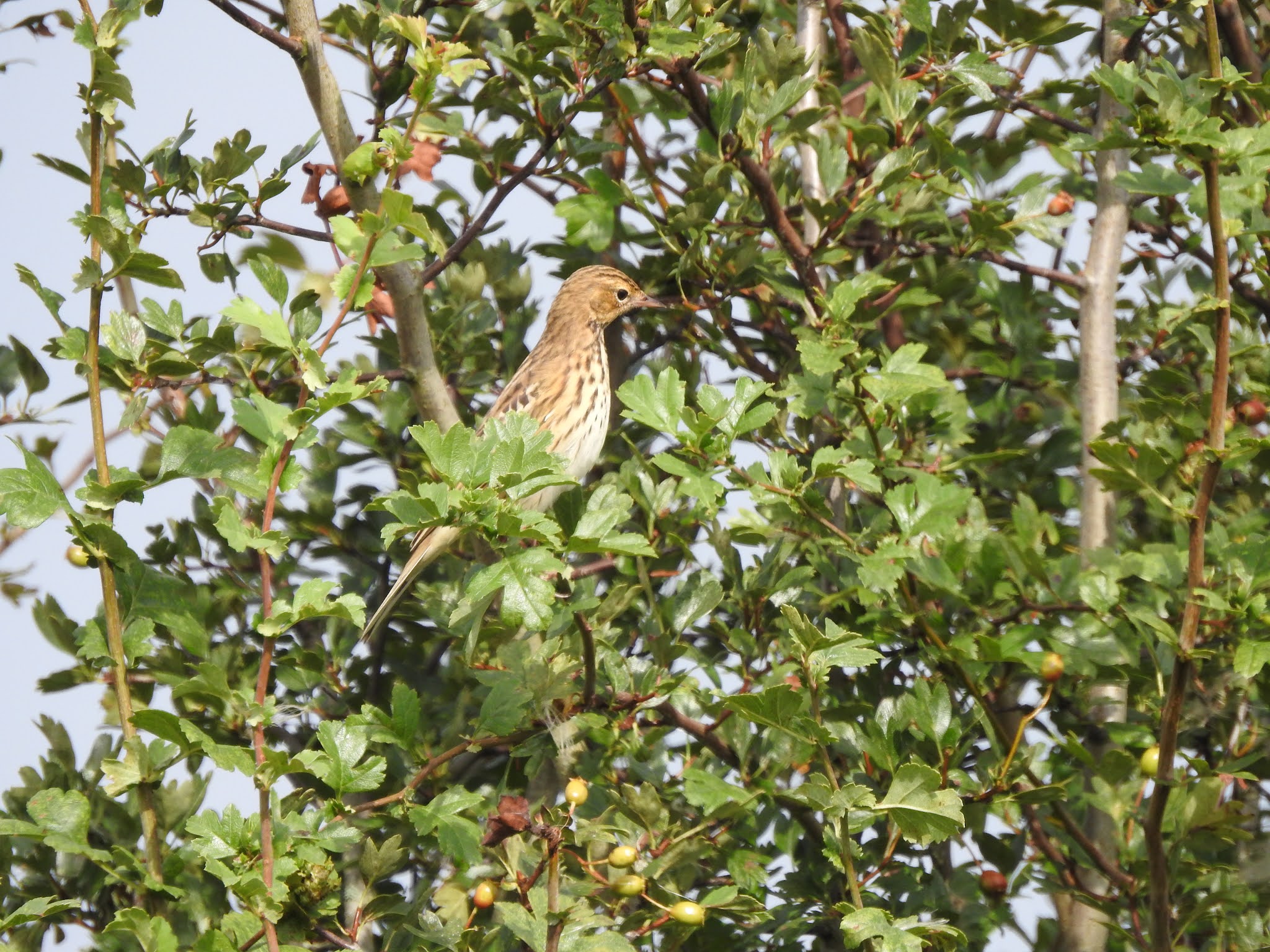
I reached the old pool field and soon spotted a distant Whinchat, the first of the autumn. I decided to walk on the pool side of the hedge in the hope of sneaking up on it. As it turned out, three quarters of the way along the hedge there was no sign of it. But scanning produced something better, a Tree Pipit, first of the year.

Tree Pipit

It was showing well, pumping its tail methodically. It was tempting to switch to video mode in the hope the bird would call. Shortly afterwards, a call was heard, but it was from a spot to my left. There was a second bird present.

The second Tree Pipit

Annoyingly, every time I stopped filming, one of the birds would call. Eventually I managed to film the second bird as it called. In the following clip the bird calls twice soon after the start, listen for a short "speez" call. I'm not sure what the other calls are. I have heard Tree Pipits making sort of conversational "seep" calls, but it could be a young Wren or something nearby.


I moved on to the flash field which was a little disappointing. The 41 Lapwings were still present, but there was only one Teal, one Green Sandpiper, and one Snipe. I flushed a Sparrowhawk as I approached and maybe that was the reason for the shortage of birds.

Back at Netherstead I counted 92 Goldfinches as they flew out of a birch tree.

It's nice to reflect that although this year's waterbirds have been uninspiring, I have seen just about all the passerine migrants that are likely in a year. There's no negativity here.