Saturday, 12 November 2022

Saturday November 12 - "Feeest"

 I was up early this morning to see whether the exceptionally mild weather had resulted in any unusual moths in my moth trap. The upshot was that I found 12 moths of eight species, three of them new for the year. 

The best species though, was a bird. At around 08.00 I had finished looking at moths and was about to go inside when a distant call stopped me in my tracks. A couple of seconds later, and much louder, I heard "feeest" and looked up to see a chunky pipit bounding westwards. It called again and I had no doubt at all that I was looking at either a Rock Pipit or a Water Pipit. Unfortunately the two calls are very similar, and although I thought it sound strong enough to be a Rock Pipit, I couldn't be completely certain it wasn't the rarer species. I certainly wanted it to be that. I tried playing some on line recordings, and some of them sounded indistinguishable from one another to me, so I am resigned to leaving it as either/or.

The three new for the year moths were a rather tatty Acleris sparsana, a splendid Feathered Thorn, and my first Sprawler since 2019.

Feathered Thorn

Sprawler

This morning I also planned to resume the exploring. I had identified a route from Bouts Lane, near Holberrow Green which took me eastwards to Cladswell and back. It was very sunny and mild day, and it turned out that the landscape was a mixture of horse and sheep pasture, with a couple of arable fields and a small scrubby wood.

Obviously I didn't see anything rare enough to rival the Rock/Water Pipit, but it had its moments. Redwings abounded in the hedgerows, with smaller numbers of Fieldfares. The proportion was 261 to 15. A party of 15 Linnets had found a small market garden by one of the farms to feed in. About 50 Rooks and a similar number of Jackdaws fed in the horse paddocks.

Redwing

Rooks

There were also a few minor surprises. A singing Chiffchaff near Cladswell, single Siskin and Redpoll flying over, and a pair of adult Herring Gulls which flew around me, calling loudly.

Herring Gull

The arable areas produced a handful of Skylarks, Meadow Pipits, and best of all up to four Yellowhammers.

Yellowhammer (backlit unfortunately)

Sadly this species looks to be following Tree Sparrow and Corn Bunting into local extinction.


Tuesday, 8 November 2022

Tuesday November 8 - Tardebigge Reservoir

This morning I abandoned my original plan which would have involved walking around virgin countryside (probably just fields) in favour of Tardebigge Reservoir. This was entirely because it was very windy overnight, and forecast to be just as windy through the day. I was thinking Great Northern Diver and Kittiwake. Dream on.

The water level at the reservoir had risen in response to the recent rain, but the bird life remained pretty similar. At least there were plenty of gulls to look through, with far more large gulls than I am used to seeing.

As it turned out they were Lesser Black-backed Gulls (82), Herring Gulls (14), and Black-headed Gulls (101). Oh well, next time maybe.

The usual suspects

Other waterfowl included 312 Canada Geese, one Greylag Goose, 62 Mallard, 15 Tufted Ducks, a Great Crested Grebe, and a Kingfisher.

The journey back along the canal was too windswept to produce anything noteworthy, but at least I was able to get the camera out.

A male Great Spotted Woodpecker

Part two of the morning's plan was largely foiled when I found Alvechurch Fishery had left their gates closed. A quick scan of Lower Bittell from the Mill Shrub causeway gave me no Pochards or Goldeneyes, and not enough else to be worth recording.


Sunday, 6 November 2022

Sunday November 6 - The pox has arrived

 This morning's visit to Morton Bagot began with fog and ended with rain, but the intervening period was pretty ideal for birding. We chose to walk along the road before heading down the footpath to the pool field, which is starting to look promising. The highlight here was the first Jack Snipe since January, but we chose not to disturb it again after accidentally flushing it. We also kicked up five Common Snipe, one of which was later showing on the flash field.

Common Snipe

We counted 17 Lapwings and six Teal there, and also noticed a dead goose. This possible sign of Avian Flu was compounded by the presence of a single Greylag Goose which crash-landed into the Kingfisher Pool where it proceeded to swim around, flicking its head repeatedly. I suppose it was inevitable that Bird Flu would get here eventually. Beyond asking DEFRA to collect the corpses (and I gather they need prodding by the land-owner to do so) there is not much to be done.

As it happened we met the owner of the Kingfisher Pool, Sally Walton from Castle Farm, and had a very interesting conversation with her. It seems that a much photographed Little Owl on her land has, like the Morton Bagot Little Owl, disappeared this year.

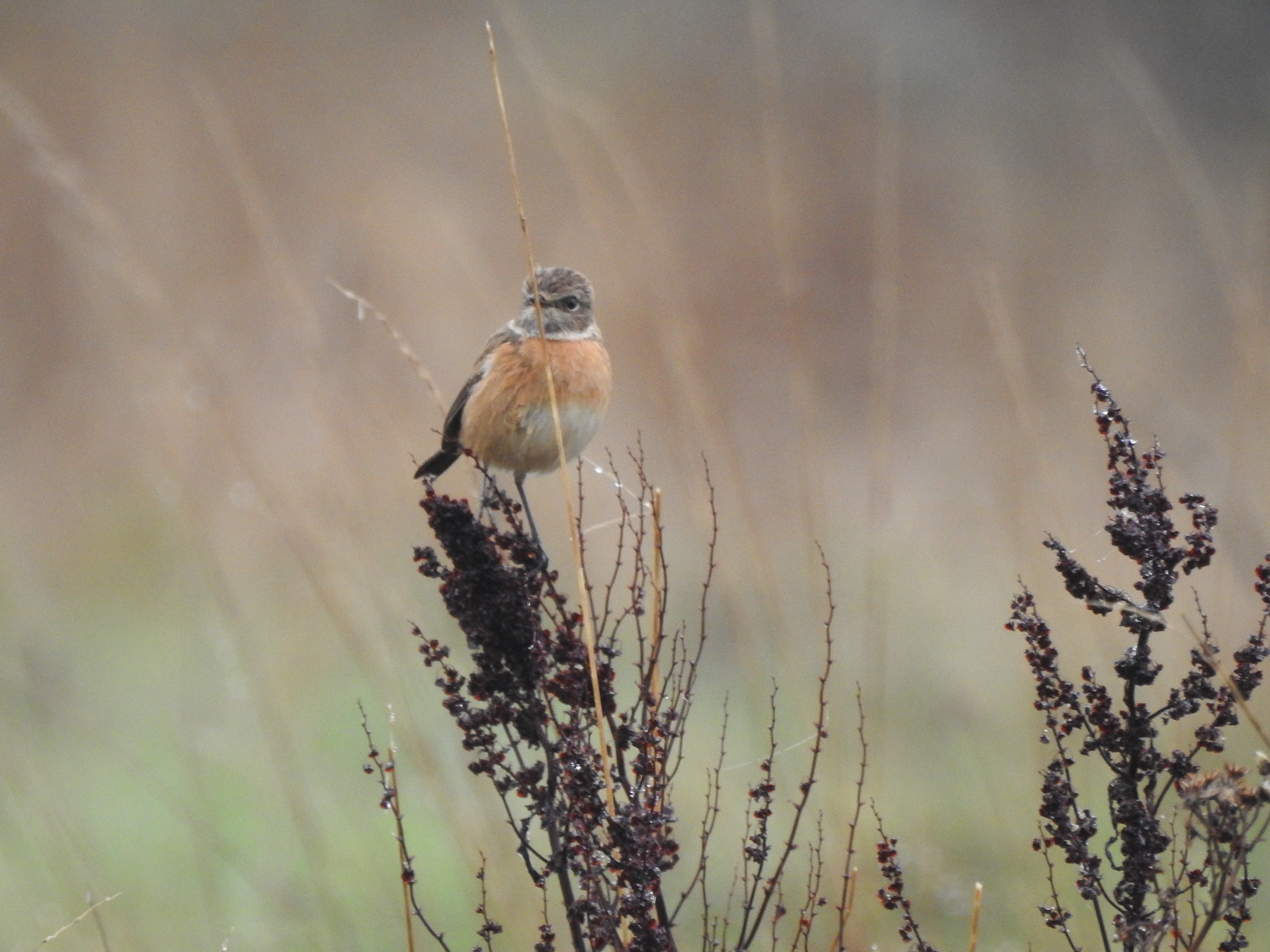
Other birds seen today included many thrushes, and a Stonechat. 

Stonechat with grass stem spoiling the shot

Finches remain thin on the ground, but we did notice about 30 Siskins and a dozen Goldfinches along the Morton Brook.

Goldfinch and Siskin

Pied Wagtail on the pool field scrapes

We didn't really count the Redwings and Fieldfares, but I would guess at about 100 of the former and 25 of the latter.

The highlight of the weekend though was Alvechurch beating League One Cheltenham Town 2 : 1. Up the 'church. In my teens I used to go to Lye Meadow to watch them play, and the village was where I was brought up. 

Nowadays wildlife takes precedent but I appreciate the team's fantastic achievement.


Friday, 4 November 2022

Friday November 4 - Back to exploring

 Now that November is here I have resumed my project of birding in far-flung and little visited parts of the Circle. Tuesday was very windy and my walk from Blunt's Green to Henley golf course and back was something of a non-event. I took no photographs and saw nothing which came close to being a highlight.

This morning was better. For a start it was sunny with a very light north-westerly breeze. At least I was certain I would take some photos. My route was a walk along Bushwood Lane from the A34 to Copt Green, looping back along even tinier lanes to my starting point.

Kestrel

Although I also saw a Kestrel near Blunt's Green, this morning's bird at Copt Green was much easier to photograph. The oddest sighting was a Kingfisher flying along a hedge, presumably heading to a small brook I later happened upon.

The only woodland on my route was a small patch opposite the entrance to Lapworth Park, but there was nothing to suggest it wasn't private so I contented myself with watching from the road. Several Goldcrests, and Coal Tits kept me entertained, and a Redpoll flew over.

A couple of Linnets were noteworthy near where the Kestrel had been perched. Over 100 Woodpigeons and a few Skylarks flew south during the course of the morning, and I gradually accumulated a list of other fairly common birds.

Long-tailed Tit

Treecreeper

Grey Wagtail

You might think that my tally of just 37 species with nothing very scarce, let alone rare, would be disappointing but that's not how I see it. I love exploring although I see from my Birdtrack records that I have been to both Copt Green and Blunt's Green before, during the BTO Atlas surveys fifteen or so years ago.

Before I sign off, I have some news about the Parakeets seen near Spernal a week or so ago. I'm very glad I didn't submit to the temptation to name them Ring-necked Parakeets because Neil Duggan tells me that some Parakeets seen in the Alcester area are thought to be escaped Alexandrine Parakeets. The males are a lot bigger than Ring-necked Parakeets, and there is a considerable male/female size difference, all of which ties in with the impression I got of the silhouetted birds I saw.

Sunday, 30 October 2022

Sunday October 30

 As the clocks went back I joined Dave for another bash around Morton Bagot. The weather continues unseasonably mild, and there was complete cloud cover for the whole morning along with a fresh southerly breeze.

There was some evidence of Woodpigeon movement first thing, and I counted 460 before the flocks dried up. The visit proved to be a bit of a damp squib. We saw two pairs of Stonechats, about 50 Redwings, and I glimpsed a probable Peregrine as it slipped off one of the masts. The flash field contained just 16 Teal, and 19 Lapwings, before we emerged from the hedge to find that even they had disappeared.

Lapwing flying in

Stonechat

Fortunately I had a plan B. It had been pointed out to me that the sailing from late morning at Upper Bittell sometimes disturbs the ducks there, causing them to head for Lower Bittell.

I arrived at the lower reservoir to find things much as I'd left them in the week. The Whooper Swan seems to have settled in, and there were small numbers of duck including 17 Gadwall, and 26 Tufted Duck. I hung around for an hour hoping for some arrivals, and there were a couple of encouraging signs. At one point an adult Yellow-legged Gull appeared and swooped at an adult Peregrine. Perhaps the falcon would spook the duck on Upper.

Whooper Swan

Yellow-legged Gull

The same Yellow-legged Gull

As the clouds rolled in, a party of eight duck flew around, but they appeared to be Wigeon. Shortly afterwards a roll of thunder persuaded me to head back, and as I reached the car the heavens opened and it bucketed down.

So Pochard remains off the list.

I put the trap out and caught eight moths of five species including three Merveille du Jours, two Rush-veneers, and a Red-line Quaker which was first of the year. While emptying the trap and subsequently going to the paper shop an impressive 556 Woodpigeons headed south in about 30 minutes.

Thursday, 27 October 2022

Thursday October 27 - Another jammy tick

Once the early morning rain had subsided I headed back to Lower Bittell Reservoir for another shot at the Pochard. It remains unseasonably mild, and the grey clouds largely dissuaded me from getting the camera out.

I reached the usual spot on the canal bank, strolling past a very tame drake Mandarin on the way, and started scanning the reservoir. The Whooper Swan was still present, in exactly the same spot. However, it soon became apparent that there were fewer ducks than on my last visit, and crucially no Pochard.

Passerines were flying over regularly, identified on call; Redpoll, a party of Siskins, 25 Fieldfares which were moving purposefully east, and a few Redwings. At some point I heard what I took to be another Redwing, and after delaying for a couple of seconds dragged myself away from the scope to look up. To my complete surprise the only bird I could see was a large chunky finch with a strongly undulating flight. There was a flick of white in the wings and I realised it was a Hawfinch. I quickly took in the short tail and swung my scope around to try to get onto it as it continued eastwards (in my tweet I said south, but since looking at a map I have realised the dam faces east/west). I couldn't relocate it though.

I cannot be 100% sure that the "seep" call I heard was made by the bird and not by a passing Redwing, but they do make a Redwing-like call, so it probably was. Although I wish I'd looked up a couple of seconds earlier, its incredibly lucky that I glanced up at all as I was fully expecting to see just a Redwing.

I set out to walk around the roads which circle most of Lower Bittell, and then decided to head up to the Upper reservoir, which is outside my circular "patch" with the intention of seeing the Tundra Bean Goose which I have been ignoring since it first turned up in August. 

I found two Bittell stalwarts, Chris T and Rob W, and large numbers of ducks and gulls. Eventually around 100 geese flew in, but the Bean Goose wasn't with them. Chris picked out an adult Yellow-legged Gull, and Rob drew my attention to that pesky Pochard feeding distantly and showing no signs of wanting to head to Lower Bittell. The female Pintail I saw on Tuesday was also present. It's clear that Upper Bittell is far superior to Lower Bittell for birds.

On the way back it started to drizzle a bit, and I thought I'd better get the camera out to make sure this wasn't an unillustrated post.

All the swans in this shot are Mutes

Anyway, the #LocalBigYear list has now advanced to 138 species, and I'm closing in on my target 140.

Tuesday, 25 October 2022

Tuesday October 25 - over thinking it

 My #LocalBigYear list making is starting to get a bit obsessive. Late yesterday afternoon I was tipped off that there was a Pochard at Lower Bittell. The part of me which was saying go there immediately was trumped by a little voice saying it's only a Pochard, there'll be another one.

I also had another plan in mind. A few days ago Dave Jackson recorded a Hawfinch flying over his garden in Redditch. Tardebigge church sometimes attracts Hawfinches, its half term (possibly), so the school there should be quiet. This could be the day to go.

The upshot was that I went to Tardebigge. School children were playing in the school, roofers were noisily roofing and my chances of finding a Hawfinch shrank from negligible to no chance. I did however locate a Chiffchaff as minor compensation. A flock of 40 Fieldfares heading west was the only evidence of visible migration.

I also walked to the reservoir which was fisherman free, and with the cats away, the mice were playing. In this case nine Goosanders (my first of the autumn) and 11 Cormorants. The Tufted Duck flock had expanded to 20 birds.

All nine

A closer look

I still had Lower Bittell up my sleeve, and so I went there next. It wasn't bad at all, but the Pochard was missing. As compensation I discovered that the Whooper Swan was still present, and also located a female Pintail which I didn't know was there. I've since found out it was seen at the weekend.

Whooper Swan

Pintail

Without official access its very difficult to watch Lower Bittell well enough to see everything. My Tufted Duck count rose from 15 (from the canal towpath) to 28 when I sneaked down the access drive to the gate. There are quite a few blind spots.

Other birds present included 10 Shovelers, eight Gadwall, 25 Mute Swans, four Wigeon, two Teal and 15 Little Grebes plus an unknown number of wildfowl which were out of view.

Further attempts to see this Pochard seem inevitable.