Sunday, 8 October 2023

Sunday October 8 - Too warm, too quiet

 The dream team was back today. Dave joined me for a traditional thrash round Morton Bagot. Being the dream team means we were dreaming of what birds we might see, and then asleep when they, potentially, presented themselves.

I won't go into the grisly details, but it was one of those frustrating mornings when very little was happening. To compound the issue whenever something that looked or sounded interesting flew over, we weren't on the ball enough to nail it.

The ringers were present, and keen to try out a new method of catching Stonechats. Sadly the birds in question would not take the bait, and not one was caught. Dave and I were at least seeing them, and we counted five all told.

Stonechat (unringed)

A few Meadow Pipits were heading south, as were Skylarks, Redpolls, and Siskins. We also saw at least three Chiffchaffs, a Marsh Tit and lots of butterflies, mostly Red Admirals

Nine Snipe came out of the marsh. A Green Sandpiper, 17 Lapwings, 34 Teal, and two Shovelers was standard fare at the flash pools.

Yesterday was no better. I tried my luck at Bittell Reservoirs where the locals were just as dispirited by the lack of anything new as you'd expect. Rob W told me that despite a generous edge, Upper Bittell had not seen a wader for a month. I was unable to assist, settling for counting the distant wildfowl. Plenty of Coots (206) on Upper, and Moorhens (40) on Lower. It didn't make me feel like shelling out £46 for an annual permit. I suppose I did see an adult Yellow-legged Gull flying over the lower res.

With all this warm weather you might think that moths would be worth trapping. Well I tried on Tuesday night I caught 22 of 11 species. This wasn't a bad result and did include two Beaded Chestnuts and a Brindled Green, both new for the year.

Beaded Chestnut

Brindled Green

Well I guess you can't catch a county first every time.

Stop Press: A Hummingbird Hawkmoth twice visited the Honeysuckle which rambles attractively over our garden shed (or messily straggles over our dilapidated eyesore...Lyn's point of view) this afternoon. 

Ringing results: The team caught a Stonechat using traditional methods on Wednesday:

1st winter female Stonechat
Great Spotted Woodpecker 1
Blue Tit 15
Great Tit 6
Stonechat 1
Song Thrush 2
Dunnock 2
Meadow Pipit 3

And today caught another 50 birds (plus two retraps)

Marsh Tit 1
Blue Tit 18
Great Tit 10
Long-tailed Tit 3
Chiffchaff 1
Wren 1
Dunnock 1
Meadow Pipit 9
Greenfinch 6
Linnet 1
Reed Bunting 1

Monday, 2 October 2023

Monday October 2 - Earlswood

 I fancied a bit of a change this morning and being aware that a couple of Ring-necked Parakeets had been seen there yesterday, Earlswood seemed to be the obvious place.

Within fifteen minutes of arrival a familiar squawk heralded a fly-by of one of the Parakeets, so that was the year tick in the bag. I could now relax and do some proper birding.

Normally when I go to Earlswood I miss out one of the lakes, so this time I was determined to walk around all three. It soon became clear it would be a quiet visit. There was hardly any overhead passage, just the odd Meadow Pipit, and a few distant Siskin calls which I suspected came from birds in the surrounding trees.

I took to photographing the close stuff.

A juvenile Great Crested Grebe

A juvenile Lesser Black-backed Gull

At Windmill Pool it was nice to confirm the continued presence of a Common Sandpiper and the Wigeon.  I saw the Parakeet again in flight, counted five Teal peeking out of the bistort, and picked up a small party of Swallows and House Martins. By now it was quite warm, and there were plenty of insects around to delay their departure. Nevertheless they were gone in minutes.

One curiosity was a strange noise near the stump at the end of Terry's Pool. It sounded a bit like someone trying and failing to fire up a distant chain saw. I wondered if it was some kind of amphibian, and after playing the calls of various likely suspects back home have concluded it was a Common Frog, although I'm surprised it would be calling at this time of the year.

Perhaps it was really was a guy with a chain saw.

Saturday, 30 September 2023

Friday and Saturday Sept 29/30 - Vizmigging

 It's that time of year again. Birds are winging their way southwards, and now it's possible to see them do it. Well it was today (Saturday), yesterday not so much. It's not that it wasn't happening yesterday, the breeze was a light westerly and the sun shone brightly. But therein lies the problem.

Sunny days are great for photographing stuff, but not so good for working out where in the sky that tiny bird that just went "tsip" is. So instead I wandered around, pointing my camera at anything near enough and counting the birds in the bushes.

Chiffchaff caught mid wing-quiver

Chiffchaff's took centre stage, and I counted 14 of them as I wandered round the patch. The one shown above was quivering its wings in display to another Chiffchaff. By contrast I only saw one Blackcap and no other warblers. 

Overnight rain has caused the water-level to rise, so there were no waders other than Snipe and Lapwing. On the plus side the route passed the Kingfisher Pool remains passable with care and even better, gave good views of a Kingfisher and a Grey Wagtail.

Kingfisher
Grey Wagtail

As for overhead migration, there was a steady trickle of Meadow Pipits and a substantial flock of hirundines, mainly Swallows with a few House Martins.

This morning the wind had swung round to a light southerly. I was due to join the ringers (Tony and John today) so this meant an earlier start, 08.00. I had decided to vizmig (visual migration) properly, which meant standing still for two hours and looking skywards.

The early start is one reason I don't do much vizmigging, and it really is a key factor. In the first hour I counted 157 Meadow Pipits and 95 Swallows heading south. The second hour saw Swallow numbers dip to 25 south, although Meadow Pipits were no less frequent. 

My tally after two hours was 312 Meadow Pipits, 120 Swallows, 18 Siskins, eight Lesser Redpolls, two Chaffinches, seven Alba (probably Pied) Wagtails, and a Grey Wagtail. There were also small parties of Skylarks, Linnets, and Goldfinches which may have been migrating, and I heard a Mistle Thrush, the first for ages.

The ringers were having a good morning too, but I was concentrating too much to be good company. That's another thing about vizmigging, when the birds are moving you have to be fully switched on. The camera is pretty much an irrelevance (well mine is anyway), with no chance of getting a recognisable image of anything because they are all too high up. However, some high cloud was extremely helpful because its a lot easier to count the dots against a whiteish background.

Nevertheless I did notice one bird of worth in the hedge behind me. A male Yellowhammer appeared and unlike with the one a few days ago it was not backlit.

Yellowhammer

It didn't find its way into the nets either.

After two hours, normal birding activity was resumed. I headed towards the flash pools spotting three Stonechats on the way, and once there, saw pretty much the same birds as yesterday, counting 50 Teal, 27 Lapwings, five Snipe and three Shovelers

I couldn't help noticing that Meadow Pipits were still moving, and I had an additional party of nine Lesser Redpolls going over. But the Swallow tap had been switched off and I added just two more.

As next month progresses there should be further opportunities for vizmigging, but the cast will gradually change to thrushes and their ilk. There probably won't be anything rare on offer, but the visual spectacle can, on a good day, more than make up for that.

PS: The ringing totals were:

Blue Tit 7
Great Tit 3
Blackcap 1
Song Thrush 1
Robin 1
Meadow Pipit 48
Chaffinch 1
Goldfinch 1

Tuesday, 26 September 2023

Monday September 25 - A county first (moth)

 I have to admit that my enthusiasm for moth-trapping has been waning lately. Several promising nights have been ignored and three weeks have passed since I last counted a batch of the same old moths. 

But after an enjoyable day's birding at Morton Bagot logging Swallows (82) and House Martins (22) heading south, the warmth of the afternoon encouraged me to give it another go. I'm glad I did.

Among the catch of 31 moths were an expected selection of new ones for the year: Snout, Lunar Underwing (14), Black Rustic (2), and Brown-spot Pinion (only my second), and a couple of moths which looked different. One was a bit like a Pale Mottled Willow, but not really. Intrigued, I tried Obsidentify on it and it came up with an uncertain identification of Clancy's Rustic. I checked the books and discovered that a) it did look like one, and b) there has never been a Warwickshire or Worcestershire record.

In better light this morning (Tuesday) an internet search still suggested it was Clancy's Rustic, so I ran it past the ever reliable @MOTHIDUK who confirmed the identification.

Clancy's Rustic

This species is supposed to be a south coast specialist, although there have been a few turning up as far north as Norfolk since 2018. I suspect that more will be found in the Midlands before long.

In the meantime the moth has been twitched by a few birders/moth-ers as it rests in a pot prior to release. One of these, Steve W on being shown my other good moth, a Deep-brown Dart, told me that recent genetic studies have discovered that all the British ones are actually a race of Northern Deep-brown Dart (the Deep-brown Dart being a European species). It's a tick for me whatever it is.

Northern Deep-brown Dart (the species formerly known as Deep-brown Dart)


Less controversial were the birds at Morton Bagot. Tony has continued to catch brand new Blackcaps and Chiffchaffs, and was particularly pleased to catch a Skylark. Meanwhile my best bird was a Yellowhammer, my first there since the first day of the year. Unfortunately the only shot I got was heavily silhouetted, so instead I'll share one of 12 Chiffchaffs, and my only Whinchat which was accompanied by a bumper six Stonechats.

Chiffchaff

Whinchat

My last blog post was banging on about invisible migration. This time the emphasis has switched to the visible kind. As well as the Swallows and House Martins mentioned earlier I recorded 16 Meadow Pipits, 11 Siskins, and 11 Lesser Redpolls heading south.

I'm sure if I'd spent the morning standing in one place as you are supposed to when vizmigging I would have seen a lot more.

The only damper on the day was the work going on at the Kingfisher Pool. The edge has been scraped back almost to the hedge so I might have to revert to the original way of looking at the nearest flash as access is getting tricky. Time will tell.

Thursday, 21 September 2023

Thursday September 21 - Twitching the local stuff

 Yesterday was a bit of a day. Temptations were everywhere, and one of these was a juvenile Ruff discovered at Earlswood late in the afternoon. I was tempted to go immediately, but played it cool and went this morning.

I joined Joe and John on the causeway. The Ruff was on the only patch of shore on Windmill Pool and was very easy to see.

Ruff

We were joined by Ken (KL) who just had time to get an eyeful before two thoughtless fishermen (without rods) felt it was appropriate to walk onto the shore loudly discussing the presence of "twitchers" and even noticing the Ruff as it attempted to land after they had flushed it. We watched it circle the reservoir before leaving to the north-east.

Other birds seen were three Common Sandpipers, four Ravens, numerous hirundines (Joe later saw all three common species) and a constant movement of Meadow Pipits which I didn't log. I just missed a Hobby, but saw a Sparrowhawk.

Common Sandpiper

After this excellent start I had to decide whether to birdwatch at Earlswood properly or try another site in the hope of finding another refugee of the storm. 

I opted for Bittell Reservoirs, having not been there since early June. Parking at Alvechurch Fisheries, I discovered two Common Sandpipers there. Scoping from the dam at Lower Bittell I counted the small number of waterbirds in view. These included 16 Little Grebes, two Little Egrets, and a Green Sandpiper. A flock of large gulls circled from the direction of Upper Bittell, but if they were mobbing anything I couldn't see it.

I decided to step out of my self-imposed Circle (patch), and visit Upper Bittell. The sight that greeted me was a very large number of dabbling duck, Geese, and Coots. These I diligently counted from the dam, but without a permit I could not see many more birds which were screened from view in the north-west corner. At least I finally saw the presumed escapee Tundra Bean Goose for a belated Bittell tick, just over a year since it was found. That is playing it cool. Other dodgy wildfowl were a drake Mandarin, and a Bar-headed Goose.

What I couldn't find was any waders at all. Not even a Lapwing. Stacks of shoreline and lots of wildfowl and Gulls on it. A major drawback was my distance from the action. Even with a scope it was hard to locate and count the Teal (96 at least). I have recently been contemplating the unthinkable (adjusting my Circle border to include Upper Bittell), but after today I'm still undecided.


Wednesday, 20 September 2023

Wednesday September 20 - Wet 'n windy

The last few days have been blighted by grey skies, rain, and strong south-westerlies. Particularly today. Most of the warblers have gone south, and we're just down to Chiffchaffs and Blackcaps. So why don't I just stay indoors and wait for proper autumn?

It is a temptation, but it's the last thing I should be doing. On Sunday I gave Earlswood a look for a change. It was grey, but probably not windy enough. I only walked around Windmill Pool so didn't see the Mandarin which was still on Terry's. About 15 House Martins and a few Swallows appeared to remind me that they are still about. I saw a couple of Teal, and gather that ten of them later emerged from the Bistort jungle along the west shore. The little gravel island is showing on Engine Pool. A Common Sandpiper flew over it, and the presence of several large gulls may have put it off.

I decided this was a second calendar year Herring Gull

Two days later the wind was blowing strongly from the south, and I decided Morton Bagot should be checked. As it turned out I should have waited until the afternoon when the wind dropped a little. Instead I found myself counting Teal on the nearest flash which was now a sheet of shallow water. There was no sign of the Garganey and after a cursory scope of the furthest flash revealed that all the ducks and geese were sheltering or sleeping I gave up and went home. I should have tried harder.

In the afternoon Mark Clarke decided to pay a visit and innocently recorded 12 Gadwall before retiring to write his notes onto the BTO's Birdtrack site. 

So this morning I was very impressed to see the record. There have been no Gadwalls at Morton Bagot this year, and the count of 12 was double the previous all-time highest count there. 

It was raining like hell all morning, but by mid afternoon the wind had died down and it was drying up. So while intrepid midland twitchers were heading to either Bodymoor Heath (Pectoral Sandpiper) or Dartmouth Park in West Bromwich (Grey Phalarope), I was twitching a flock of Gadwall which it turned out were no longer there.

But I'm not down-hearted because the rain did deliver a bird to Morton Bagot. Not exactly a rarity, but the second this year, so worth the effort. My initial view was of a small wader with a white rear end disappearing behind the dratted rushes. I waited half an hour, scoping about a dozen Snipe, a Green Sandpiper, and several Pied Wagtails hoping that I wasn't wasting my time on a poor view of one of them. My faith proved justified when I spotted the culprit, a rather long-billed Dunlin at the back of the flash. 

Hard to believe, but there are four species in this shot (answers at the end)

Dunlin (magnification cranked up to maximum)

Also present were the usual Teal and Mallard and a flock of about a dozen Swallows. A few Chiffchaffs were chasing each other around as I walked back, while a buck Roe Deer gave me a proper photo opportunity.

Nice and close


As for the birds in the long shot. They are Lapwing, Snipe, Dunlin, and hardest of all to see a Pied Wagtail. Award yourself a pat on the back if you spotted them.

Saturday, 16 September 2023

Saturday September 16 - Migration at Morton Bagot

 Migration sometimes seems invisible at Morton Bagot, and this is particularly the case with warblers. This is where the bird ringers are a valuable asset to any patch. Consider last weekend's figures. They caught 31 Blackcaps, 16 Chiffchaffs and four Whitethroats all bar one (a Chiffchaff) new birds. On Friday they were back, and caught another 13 Blackcaps, 10 Chiffchaffs, and one Whitethroat with not a single retrap. They also caught the first Lesser Redpoll of the autumn.

Lesser Redpoll - Tony and Leigh Kelly

My own efforts were restricted to Wednesday when I saw eight Chiffchaffs, five Whitethroats, and eight Blackcaps, and again today with a further 15 Chiffchaffs, and three Blackcaps (including one unringed bird sadly found dead). In addition on Wednesday there were two Whinchats and a Wheatear.

Whitethroat

Blackcap

Whinchat

So that's a minimum of 55 Blackcaps, 48 Chiffchaffs, and 10 Whitethroats moving through one tiny part of Warwickshire in the course of a week. And those are just the ones that get captured or seen. The scale of invisible migration across Britain at this time of year is mind-boggling. Who needs rarities?

Well me actually. Bird migration fires my imagination, but its always nice to find something unexpected, that little blob of jam on top of the cream scone. Today was cloudy, the wind light but distinctly northerly. A trickle of Meadow Pipits headed south overhead (visible migration), and at least 11 House Martins continued to hunt insects high above.

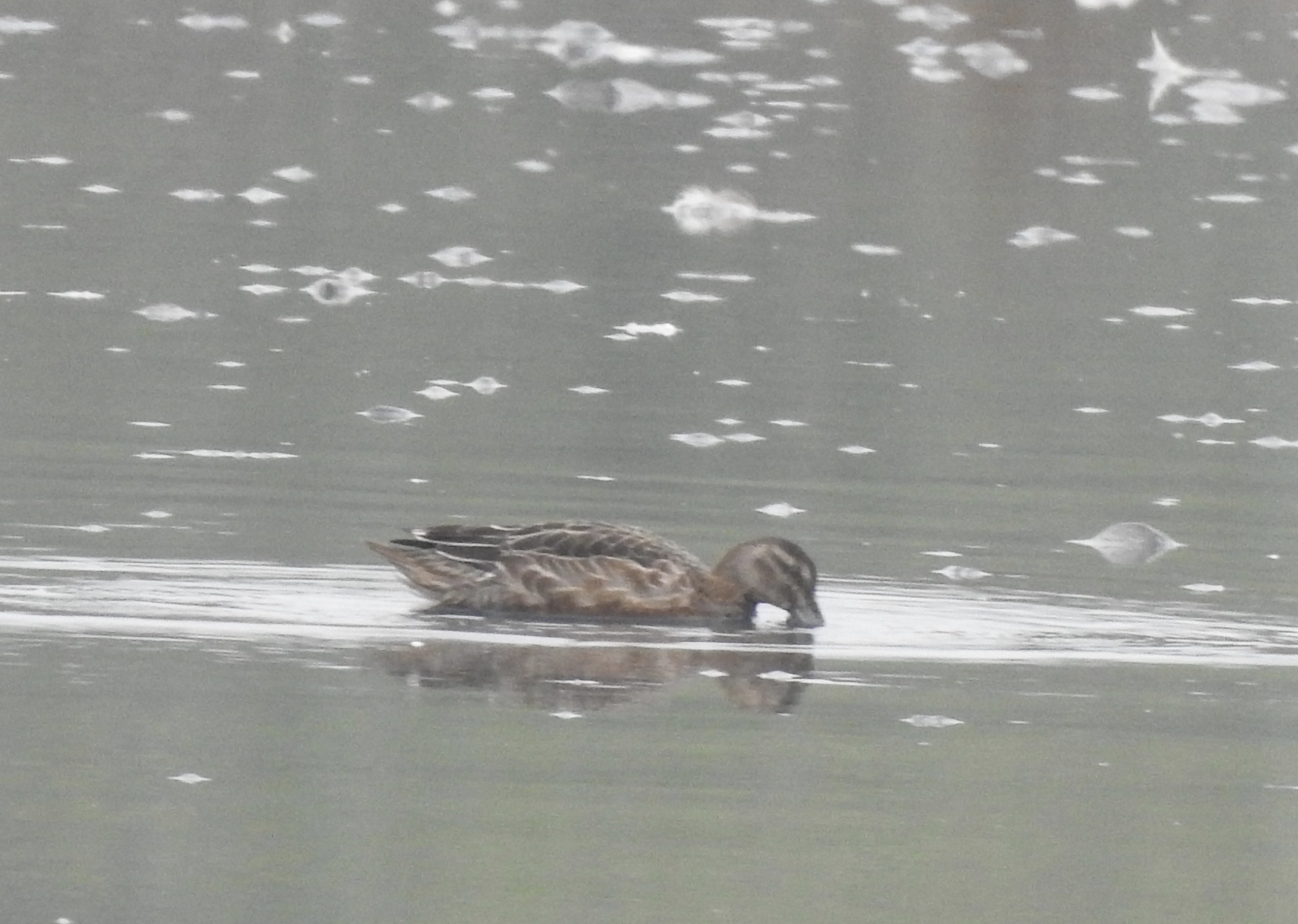
The flash field was going to have to be the provider. For once, I took my scope and that allowed me to discover five Shoveler with the usual species on the furthest flash. Meanwhile the nearest flash remains in good shape. The Ringed Plover was still here, as were at least four Green Sandpipers. There seemed to be more Teal present so I started counting them. I'd got to seven, eight, nine?....number nine looked interesting. The count stopped and I switched to my scope to confirm my suspicions. Yep, my first Garganey of the year was hiding in plain sight.

Garganey

Definitely not annual here, I can think of maybe six previous records in the last fifteen years. So definitely jammy.

I went on to count 43 Teal, and accumulated a modest 14 Meadow Pipits heading south. The lack of any Whitethroats today was also a clear sign that the first phase of autumn is drawing to a close. Summer is over and winter beckons. A whole new set of birds will be darkening the skies and filling the bushes by the end of next month.

I can hardly wait.