Wednesday, 30 April 2025

Wednesday April 30

 This morning's pre-breakfast dash was to Morton Bagot. It's the last day of April and maybe the best part of spring is over. I spent yesterday exploring, but was keen to give the patch one last try. It paid off.

Three Grasshopper Warblers were singing in the Netherstead area, I even briefly saw one of them, but my focus was on another species. Cuckoos have been seen here, and at Morgrove Coppice, and at Studley, but not by me. This morning I was delighted to put that right. As I approached the flash field I could hear one calling in the distance. I didn't expect to see it, let alone film it or photograph it, but I put that right too.


Obviously the shot won't be winning any awards, but I was just pleased to see it. This is the Cuckoo

Other than that the flash field was pretty disappointing, just a few Lapwings and Mallard were present. The Whimbrel seems to have gone. No surprise there.

I don't normally bother with Pheasants, there is a strong argument that regular releases into the countryside for shooting has upset the equilibrium of nature, but when I blundered into one which was standing on a gate at Netherstead, well it was irresistible.


As for yesterday, I visited some farmland at Oldberrow Hill first thing. This is actually closer to home than Morton Bagot and a bit of a gem.


Birds seen or heard included Lesser Whitethroat, several Whitethroats, Skylarks and best of all at least one pair of Yellowhammers.


After breakfast I headed down to the southern edge of my circular patch to visit farmland around Aston Cantlow. 

This produced more Yellowhammers and Skylarks in an area which as far as I can tell hasn't been losing them. The river meadows look good for warblers, and I saw BlackcapsWhitethroat, and Lesser Whitethroat there.


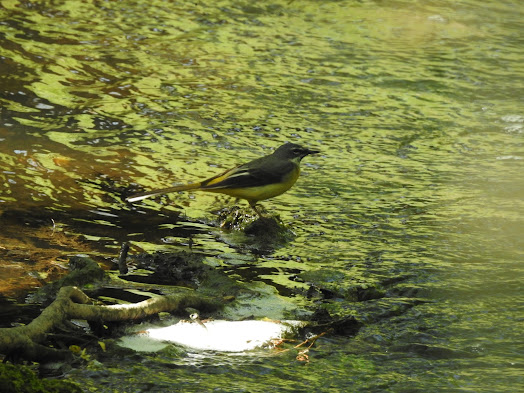
While the fast flowing river added a pair of Grey Wagtails to the day.


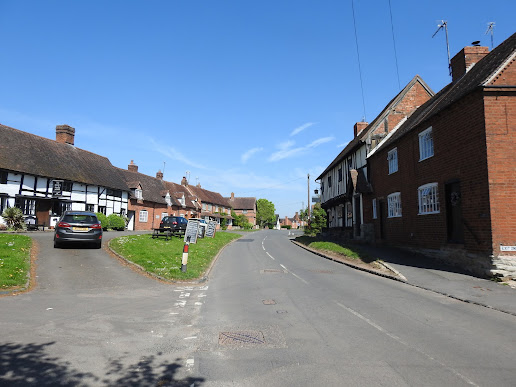
Finally, the village itself was quite productive with breeding Starlings, House Sparrows, Collared Doves, and House Martins. It's easy to forget that villages have different birds than the surrounding farmland.


Moths: I decided to bring forward the Garden Moth night to Wednesday evening because I plan to be up early on Saturday morning for the annual Spring all-dayer (I'm joining the Earlswood team again) and reckoned I would need a break from two early starts on the trot.

As it happened this coincided with the warmest weather of the year, so I was expecting lots of moths. And I'm pleased to say that's just what I got. My final haul was 46 moths of 28 species which included 14 new for the year, and two new for the garden.

It's such a thrill when your eyes alight on an unfamiliar moth and my first one was certainly that. Grey Birch is apparently widespread and fairly common, but as the name suggests, it's caterpillars require birch to feed on. I know of no birch trees in the immediate vicinity so that's probably why I had not caught one before.

The other new one was a micro, so there wasn't quite the excitement. In fact I didn't realise it was something different until I started my on-line research. The penny quickly dropped that this was Dark-barred Tortrix Syndemis musculana, a common enough moth which I probably should have caught in the eight years I've been mothing.


Grey Birch

Dark-barred Tortrix Syndemis musculana


Sunday, 27 April 2025

Whimbrel at Morton Bagot April 2025

I was up with the lark this morning, arriving at Morton Bagot at 06.15. This paid off as expected when I heard at least three Grasshopper Warblers and two Lesser Whitethroats singing along with stacks of Whitethroats, several Sedge Warblers, and a Willow Warbler.

The only disappointment was that the Cuckoo which John Chidwick had heard on Thursday appeared to have left.

I had to return home after a couple of hours, but was back in the field by 09.30 and made my way slowly to the flash field which had been shrouded in fog on my early visit. This time I got really lucky as a Whimbrel was striding around the field between the two flashes.


Also present was a Little Ringed Plover and a flock of Lesser Black-backed Gulls.


Before finding the Whimbrel I had spotted Martin Wheeler in the distance so I knew he was somewhere on site, and fortunately I managed to contact him before he drove off. The only other person who got down to see it before I had to leave was Mike Inskip.

The Grasshopper Warblers were no longer singing by the time of my second visit and were invisible on my early morning jaunt, so I can only post footage of a singing bush.


A nice boost to the year list.

Friday, 25 April 2025

Friday April 25 - still exploring

 The best I can say about this week is that I've been sticking to the plan. Ignoring the increasing flood of migrants arriving in prime habitat, I've gone sub-prime.

On Tuesday I walked around a small patch of farmland surrounding a hamlet called Heath Green, about halfway between Branson's Cross and the motorway. At least I remembered to take a habitat photo this time.


This bridleway was the most promising area but in all honesty I didn't see much. A Great Spotted Woodpecker was drumming, a Mistle Thrush and a Sparrowhawk appeared, while migrants were restricted to the usual Chiffchaffs, Blackcaps, and Swallows. It was a nice walk though.

Today was potentially even worse. I picked a small area in the north of my circle between Tidbury Green and Whitlock's End. Once again there was a bit of roadside woodland to look at and some scrubby bits which harboured the best discovery; a Common Whitethroat.


The only way to approach this, I concluded, was to imagine a bird which could conceivably pause here on passage; maybe a Pied Flycatcher or a Wood Warbler. As expected the birds weren't playing.

As I was close to Earlswood Lakes I decided to call in on my way home. Disappointingly the little shingle island which I noticed was diminished on my last visit, is now very small indeed. It still supported some of the eight Common Terns which were wheeling around Engine Pool, and interestingly two at least had colour rings. In one case I was only able to note the colour of the ring (green) and not read the lettering. However a second tern did have a readable ring.


This one was C51, and I am grateful to John Oates who did the research when he saw it yesterday. It turned out to have been ringed at Marsh Lane GP on 22 June 2022, and to have subsequently been sighted at Seaforth (Merseyside) in June 2024, then back at Marsh Lane GP in May 2023 and April 2024, followed by Formby Point (Merseyside) in August 2024, before appearing at Earlswood yesterday and today.

The only other noteworthy event was that I somehow lost my notebook there, so had to remember what birds I'd seen when inputting the data onto Birdtrack. Sometimes there are advantages to seeing hardly anything.

Sunday, 20 April 2025

Sunday April 20

 The last couple of days have been pretty decent, with the opportunity to twitch someone else's find and to turn up a few things at Morton Bagot.

But before I get to all that I'll take you back to Friday morning which I spent exploring the Bank's Green area just west of Redditch. Rather belatedly in the walk it occurred to me I should post a landscape shot to set the scene. By then it was drizzling and I didn't have many options.


I'll try to do better next time. Birdwise the highlights were a handful of Swallows and a daytime hooting Tawny Owl.

Fortunately, the following evening I got a Whatsapp message from Earlswood. Matt Griffiths had just found a male Ring Ouzel in a field along Umberslade Road. I exited the house at speed and in no time at all joined Matt and Peter who were still watching the bird.


It's difficult to beat a male Ring Ouzel found in a random field on its way to the high peaks of the Cairngorms or wherever. 

This morning I was back at Morton Bagot, ever hopeful of turning up something decent. Dave was with me, which was fortunate because it was he who found the bird of the day. The sun had come out and squinting into it he spotted a Chat on a distant bush. When it flew he noticed the tell tale white feathers on either side of the base of the bird's tail which could only mean it was a Whinchat. And so it proved, a beautiful male.


Not quite the rarity of Ring Ouzel, but gorgeous nonetheless. Earlier we had heard my first Sedge Warbler of the year, had estimated at least 14 Whitethroats on site, and had spotted the first Peregrine here this year.


The flash field still has a pair of Avocets, a couple of Green Sandpipers and four Teal, plus an unusually large flock of 19 Lesser Black-backed Gulls.

There are still no Lesser Whitethroats, Cuckoos, or Grasshopper Warblers, but hopefully it won't be too long.

Wednesday, 16 April 2025

A strange Tern of events

 Shortly after completing my last post, the Whatsapp pinged with news of eight Arctic Terns at Earlswood. They'd been reported on the Warwickshire Whatsapp Group (of which I am not a member) but then reposted on Earlswood Whatsapp by Matt.

I decided to go to see them and arrived 15 minutes later to the sight of a flock of terns wheeling about over Engine Pool. However, I couldn't pick out any Arctics among them. I carried on towards the causeway and discovered a group of terns sitting on the shingle island. I quickly decided they were Common Terns, and shortly afterwards Mick D-L appeared and said he now thought they were a mixture. He pointed out a particular tern among the flock as an Arctic. I photographed the flock and noticed that the bird in question seemed to have a dark red bill with an extensive black tip, so I jumped to the conclusion that it was a Common. 

Then I noticed a single Arctic Tern flying around, and we all agreed that that at least was an Arctic. I tried to get some flight shots of it, with limited success. The main flock then took off and the job became even harder, particularly as I kept thinking I was on the Arctic, only to find it was dark-billed. What was going on?

Sorry about the poor quality, but this is my best shot of the undisputed Arctic

On later reviewing my shots at home I changed my mind about the dark-billed tern. It's legs were noticeably short which surely made it an Arctic Tern notwithstanding the anomalous bill colour. This supports Mick's initial impression. 


While it was flying around, although I was still calling it a Common Tern, I tried to get some shots of it. My best effort, such as it is, I think supports the re-identification as an Arctic Tern.


As a relief from all this tern stuff I located a Yellow Wagtail on the shingle island, and eventually managed to photograph that. Also another year-tick appeared, a first-summer Common Gull.


Common Gull

Also present were at least three White Wagtails as well as numerous Pied Wags, at least two Common Sandpipers, and three Little Ringed Plovers.

As a postscript I should add that Matt Griffiths arrived after I had left and confirmed at least one Arctic Tern was present, but was also happy, based on field views, that the nine others he saw were all Commons. I understand that all but two Commons then left to the north-east.

PPS: The case for the prosecution:

I've been mulling over this dark-billed "Arctic" Tern for some days, and have been reading everything I could get my hands on hoping for something that will support my re-identification of the tern as an Arctic. And I haven't really come up with anything.

It is generally agreed that occasionally Common Terns can appear in Spring in summer plumage with a largely dark bill, but the nearest reference I can find which says Arctic Terns can also do that comes from BWP (Birds of the Western Palearctic) which says that very rarely Arctic Terns can retain their dark winter bill in summer. It suggests this occurs where birds are in poor physical condition. It doesn't say what the rest of the bird looks like, and my guess would be that it refers to birds which retain winter plumage in summer.

I've also had another look at my photographs, and in particular one which I considered to contain eight Common Terns. I had assumed the "Arctic" was out of shot or had flown off, but on looking more closely I think I can see it, and it no longer looks short-legged.

Second from left, looking straight at me

If this is the bird, it's a bit of a nail in the coffin of my re-identification. 

I also have to admit that my photo of the flying bird isn't very good. There is an obvious problem with photographing one bird from a flock of terns. You spot the bird with the bins, and then have to find it in the camera and shoot. It's all too easy to get the wrong bird. My photograph is not very sharp and maybe over-exposed. It could thus give a false impression, or even be of the actual Arctic Tern which was definitely present at the time.

Tony P, who was shooting at the flock from the other side of the lake, managed a much better photograph of what appears to be the dark-billed Tern. Assuming he has photographed the right bird, it also looks more like a Common than an Arctic as is shows more greyness on the upper wing than my shot does. It may also show the moult contrast between the inner and outer primaries which is the best way of separating Commons from Arctics. I will post Tony's photo if I get his permission to use it.

The upshot of all this mulling is that I think maybe there really were eight Common Terns and only one Arctic Tern present. Photography can be very useful, but it can also mislead. I tend to use my camera as a replacement scope, it has the advantage that you have a permanent record and its less hard on my ageing back, but maybe it pays to go with your birding instincts and not over-rely on it. 

I'd like to say a lesson learnt....but I've said that before.

Wednesday April 16

I was trying to think of a word to describe the experience of April for me, and I think I've come up with one; frenetic. In the past if I'd been asked for my favourite month I'd always have said May. Not any more. April is definitely the new May, but it passes so quickly.

Already I'm starting to worry that it's too late to see some species locally. Ring Ouzels have surely gone through, Curlews too. Actually they are pretty much lost as a local breeder.

On Monday I "picked" Broad Green as the venue for my latest wander. It didn't seem to have a lot going for it, but at least it had altitude. One the higher areas within the 10k Circle around Redditch, I was pleased to find lots of recently sown crop fields. Within thirty minutes of leaving the car my constant scanning of these paid off as I at last added Wheatear to the year-list.


A nice male, maybe bound for Iceland or Greenland rather than Scotland. The dark brown flight feathers at least suggested this was a bird which was making its first return to its breeding grounds.

This turned out to be the only addition to my list, but I did also see a Red Kite, and singing Linnet to pad out the notebook with a little quality.

The following day I was back to my routine of pre-breakfast dashes. This time it was to Earlswood where the shingle island hosted one of four Common Terns, a couple of White Wagtails, three Little Ringed Plovers, a Common Sandpiper, and an Oystercatcher. The latter had been visiting fairly frequently during the last few days, but never when I'd been there.


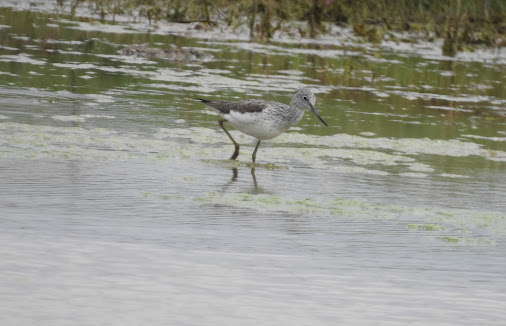
The previous day Lyn and I had been at the cinema when Mark C was down at Haselor watching a Greenshank. By the time I saw the message, it had been followed by negative news so I thought my chance had gone. Scroll forward to Tuesday afternoon, and it was visible once more. I had to go. This is generally more of an autumn species than a spring one, but I had still only seen one bird in each of the previous two years.

Thankfully it was still there, and showing pretty well.


The reason I called it an autumn bird is that three or four times as many make the return trip as their numbers are swelled by newly hatched juveniles. Although for all birds there are a lot more of them in autumn, this doesn't necessarily mean they are easier to see at that time.

The fact is that for a lot of migrants, spring is your best chance. Bird want to be seen in Spring, not by humans but by other birds. So they arrive in striking plumage, or they sing loudly, or they just strut about in the middle of fields instead of skulking in hedgerows.

If you want to see a Cuckoo or a Grasshopper Warbler, or hope to get lucky with a Wood Warbler or Pied Flycatcher spring is by far your best bet.

This morning I pre-breakfasted at Morton Bagot. It was cold and windy, and I saw almost nothing. A pair of Little Ringed Plovers was at least new for the site for the year.

But tomorrow could be different, you just never know.

Sunday, 13 April 2025

Sunday April 13

 To continue the story from last time, I duly visited Lakeside on Thursday and although the healthy wooded margins favoured by the Redditch town planners produced plenty of singing Blackcaps and Chiffchaffs, I didn't find anything unexpected.

As I was close to Arrow Valley Lake I called in for a quick look and saw that the Egretry contained at least nine Little Egrets.

Moth-trapping in the garden on Friday night added six species to the year list, but my twenty moths of eleven species contained no great surprises.

This morning I joined Dave at Morton Bagot, and my expectations were high. Perhaps too high. We found at least four Whitethroats singing from bramble patches and hedges in various places, but only glimpsed one of them. An apparent singing Sedge Warbler was eventually considered to be a Blackcap which added a remarkably accurate rendition of Sedge Warbler song to its normal song. I've heard mimicry in Blackcaps before, but never of Sedge Warbler.

This was from the hedge overlooking the flash field. There, the water level continues to look excellent for waders, but contained only a pair of Avocets, at least four Lapwings, three Snipe and three Green Sandpipers. Also present was at least 31 Teal, and best of all a squealing Water Rail, which we even (very briefly and distantly) saw. One or two Swallows and Sand Martins appeared sporadically while we were there, but try as we might we could not find any Wheatears, Redstarts or other passage migrants.

During the afternoon I decided it was high time I went to Earlswood to see the White Wagtails which have been present all week (apart from the early morning hour I spent there on Wednesday). This time they were very easy to see, exactly where you'd want them to be, on the shingle island off the causeway.

Female White Wagtail

Male White Wagtail


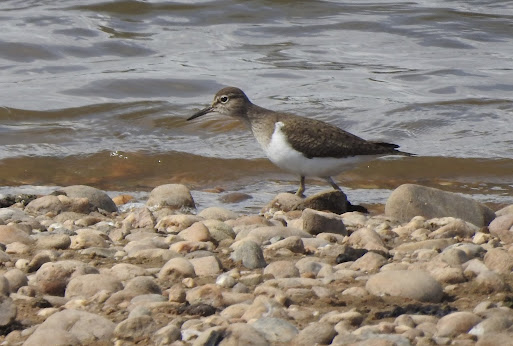
Also present, and new for the year for me, was at least one, probably two, Common Sandpipers and a Common Tern, plus the usual Little Ringed Plovers and an awful lot of people.

Common Sandpiper

Common Tern