Saturday, 22 August 2020

Late summer moths

 My garden trap contained about 73 moths this morning, several of which were so worn that I released them without attempting an identification. There were also quite a lot of wasps again and I'm afraid one moth, a Dusky Thorn I think from the wings that were left, was eaten by them.

Most of the survivors were Large Yellow Underwings (27), and the next three in order of abundance were Agriphila geniculea (nine), Vine's Rustic (six), and Lesser Broad-bordered Yellow Underwing (four).

There was just one moth which was new for the garden, a small micro which unfortunately cannot be identified to species level without the recorder becoming involved. However I believe it to be either Caloptilia alchimiella or Caloptilia robustella. The recorder later confirmed it was C robustella which is the commoner of the two.

Caloptilia robustella

The only other moth which was new for the year was a Six-striped Rustic, although an Orange Swift was unusual in being a female rather than a male, and is therefore sort of new for the garden.

Six-striped Rustic
The female Orange Swift

It looks as though I'm going to be stuck with the annoying wasps for the duration of the autumn as my neighbour hasn't noticed (I assume) the nest entrance in the corner of his garage. I keep having to remind myself that they are good for the garden ecosystem.

Friday, 21 August 2020

The Pits - 21 August

The title of this post is a reflection of where I went today, not necessarily how dire it was. With a howling gale and the prospect of no exposed mud at Morton Bagot, a trip to Salford Priors seemed a good plan.

 I paid a visit here in May when there was hardly any gravel poking up from the water surface. Today that island has expanded and looked suitable for waders. And indeed there were a couple, but just a Common Sandpiper, and a juvenile Ringed Plover. Yes these were the species which made my day at Morton Bagot last week, but here they were pretty much the staple diet.

On arrival I was pleased to see a couple of Swifts, my first this month and probably my last of the year unless I spread my wings again. A Sedge Warbler had dived into the hedge by the road, but it wasn't really a day for passerines. On the other hand, I had heard some interesting calls as I arrived and it wasn't long before I was able to confirm my impression that they were indeed Yellow Wagtails. At least two were present on the island. I'm ashamed to say that these were my first for a couple of years.

Yellow Wagtail (and Coot)

Its very likely that this species breeds in the agricultural land around here, but its another declining farmland bird so any I see are much appreciated.

Juvenile Ringed Plover

Another birder then joined me. It was nice to see Chris Lane again, and we spent the next half hour chatting. We also kept an eye open for anything which might turn up, but a juvenile Common Gull which joined the 50 or so Black-headed Gulls was the best we could manage.

I normally enjoy counting birds but only tallied 18 Little Grebes, at least three Gadwall, and a Teal before I lost interest in the numerous Mallards, Tufted Ducks, Coots, and Geese present.

I went across to the other pool, but was disappointed to find that it had no muddy edge. One thing it did contain was a Greylag Goose closely following a Mute Swan around.

Parent and child ?

This seems to be evidence of egg dumping where a Greylag Goose has laid in the Swan's nest. Perhaps the Swan's clutch has failed to hatch or has been predated, while the gosling has imprinted on the first bird it sees and the Mute Swan is quite happy to accept its strange "cygnet".

Tuesday, 18 August 2020

Tuesday August 18 - An early start reaps rewards

 I was up early this morning, not stupidly so, but it meant that I arrived on the patch about an hour earlier than normal. Had I not done so, I would not have heard the "skeez" call of a Tree Pipit as I was putting on my wellies. New for the year, and not recorded every year, this was a great start.

The weather was fresher than on my last visit, a moderate south-westerly. Sunny intervals which could be handy if I need to photograph anything. And it wasn't long before I found a nice sunny corner near the beehives where Blackcap, Chiffchaffs, and best of all three young Lesser Whitethroats were darting in and out of the foliage.

Lesser Whitethroat
Lesser Whitethroat

I could tell that these were young birds because their ear-coverts were a fraction darker than those of an adult and the plumage looked splendidly sharp and clean. One of my favourite birds.

I reached the pool field and noticed that the deep end actually contained some water. This would mean, yep, the nearest flash was now a sheet of water. It must have been Sunday afternoon's deluge.

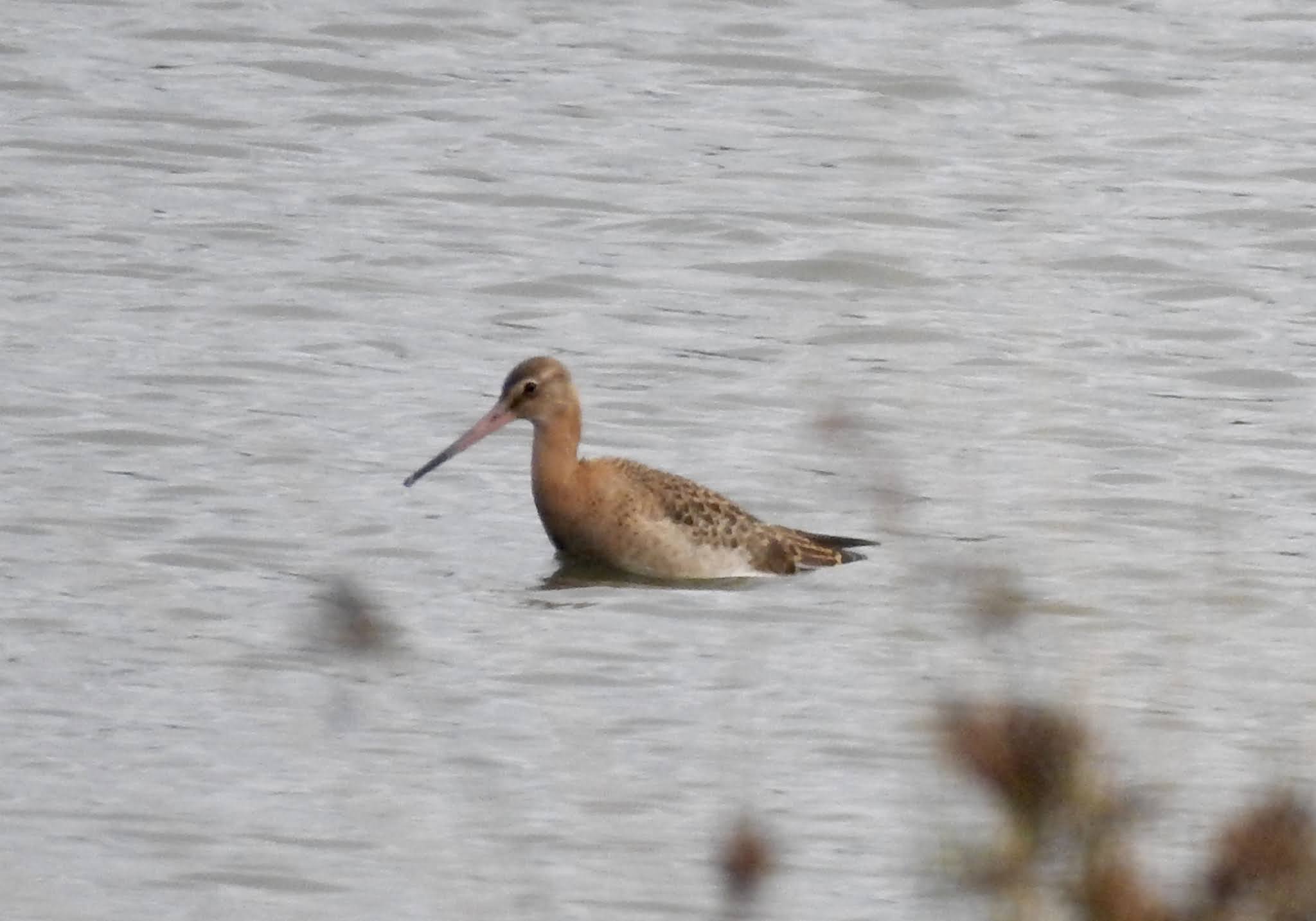
So there'd be no waders then. Unless of course it was a wader with very long legs, like a Black-tailed Godwit. Excellent.

Black-tailed Godwit

Although it appears quite orange, don't be fooled. The neatly edged wing feathers confirmed that this was actually a juvenile. It was feeding enthusiastically, and a couple of my shots suggested that the prey was a species of Water-snail.

A water-snail dangling from its bill-tip

Anyway, apart from the Godwit, I was right about the habitat. In the course of a fortnight we've gone from not enough water, through just right, to too much water. No good for Common Sandpipers and Ringed Plovers, and I could only see two Green Sandpipers and two Snipe. The Teal were quite happy, and even the Lapwings were still present. I counted 24 of the former and 44 of the latter. There has also been an influx of Mallard, now 89 feeding happily.

A Hobby appeared and created mayhem, the unsettled ducks swimming out to the middle where they could be counted. Cheers Mr Hobby. Unfortunately the raptor promptly disappeared and I was again unable to get a shot.

It sometimes strikes me that birding is slipping back to Victorian times, when the gun was king. What's hit is history, what's missed is mystery, or so the saying went. Now guns have been replaced by cameras, and the days of field notes and reputation are receding. Perhaps one day all our pre-digital field note based observations will be reviewed out of existence. I hope not, but there's no doubt that cameras are a massive help.

The walk back to the car was a quiet affair, but I did manage to sneak up on a Silver-Y moth, and saw several. Perhaps it will be a good year for this migratory species.

Silver-Y

The Silver Y has a nicely appropriate English name, its upside down Y mark obvious in the middle of its forewing. It has quite a nice latin name too, Autographa gamma. I'll let you do the translation.

This brings me on to a micro caught in our bathroom last night, Carcina quercana. For most micros the books don't give an English name.

Carcina quercana

I am guessing that quercana refers to the Oak quercus which may be the caterpillar's food plant. Many people are put off by latin names, and I agree they do take a bit of getting used to. This micro, despite being featured on the cover of A Field Guide to the Micro Moths of Great Britain and Ireland by Sterling and Parsons, is not given an English name in that book. However, a more recent publication has put forward English names for the commoner micros like this one. It now has the name Long-horned Flat-body

I think I prefer Carcina quercana.


Sunday, 16 August 2020

Sunday August 16 - migrants on the move

 This was the kind of morning which reminds me why I keep coming here. All the elements were there; a warm muggy overcast feel with the odd shower and some sunshine. Wader migration season - mid August, perfect. No other people (apart from Dave, who doesn't count), ideal.

All we needed were the birds. After a steady first hour with all the usual warblers, we reached the pool field and quickly located two Whinchats

Whinchat

A bit of a Morton Bagot autumn speciality, not particularly rare but scarce enough to make any day. There is still no main pool in the pool field, but you can't have everything.

Better was to follow. 

We got to the flash field where the nearest flash now looks in excellent condition. It soon became clear that the birds thought so too. Numbers had more than doubled since my last visit, 23 Teal, 10 Snipe, 12 Green Sandpipers, and best of all a Common Sandpiper. Yes I know, just a Common Sandpiper. But this species is barely annual here. We're always knee-deep in Green Sands, but Common isn't common.

Common Sandpiper

For those uncertain of the difference, Common is distinctly smaller and its white belly rises up almost to its shoulder. On Green Sandpiper the white belly meets its grey breast with no sign of extending upwards. The next shot shows the two species together.

Common and Green Sandpipers

Unlike at certain other Midland sites, Black-headed Gulls remain at manageable levels, i.e. hardly any, and although I like a gull as much as the next man, their absence makes the place much more peaceful. Noisy buggers, gulls.

Green Sandpiper, Teal, and Black-headed Gull

As you can see in the above photograph, it soon started to rain. Luckily, we were under the trees overlooking the flash at the time, the nearest thing to a hide at Morton Bagot.

Rain often drops waders in - is a mantra popular with birders. It is certainly true of big reservoirs and well-watched (pre-covid) sites like Upton Warren. It never happens here though. Well almost never. We were just about to start yet another attempt to upgrade our Green Sandpiper count, when a wader called and something shot across my line of vision. Seconds later we got onto them, two Ringed Plovers, an adult and a juvenile. Fantastic. Similar in status to Common Sandpiper here, and two of them. Make that three. Just as we were preparing to leave Dave astutely observed that he was now looking at two adults.

The adult Ringed Plovers

The juvenile, which I do have a blurred image of from when it stood behind some sedge, then decided it was time to go. It flew around calling, landing for seconds before taking off again. I just couldn't get a shot of all three together, and after thirty minutes the shower abated and they all circled ever higher to continue their journey from the Arctic (or maybe just Scotland) to West Africa or wherever. 

Migration in action is absolutely thrilling to witness.

We weren't finished. The journey back along the Morton Brook took us past a discarded walking stick (if anyone's lost one we can tell you where it is) to Stapenhill Wood. Here, first one, and then another Spotted Flycatchers flew up into a stunted tree, pausing just long enough for me to get a couple of shots.

Spotted Flycatcher

A bit more convincing than the dot on a hedge I thought might be this species on Tuesday. They quickly disappeared behind the wood and we did not see them again.

Instead we reached the edge of the ridge field where at least 137 finches were counted on the wires. About a hundred of them were Goldfinches, the rest being Linnets plus a solitary Reed Bunting.

Insects didn't get much of a look in today, but I did notice a Silver Y moth, which I mention because, like the birds featured in this post, its a migrant.

Saturday, 15 August 2020

Back in moth world

 Last night's temperature dropped no lower than 15 degrees, but it was a bit breezy and didn't feel very warm this morning.

I caught 70 moths (and about 30 Common Wasps), and after encouraging the wasps to fly off I got down to business. It was actually slightly disappointing, the nearest I came to a new moth was a micro which I tentatively identified as Bryotropha domestica, which it may well be. However, SMW texted to suggest I bear in mind the possibility of Bryotropha basaltinella which has recently colonised Worcestershire. I no longer have the moth in question and my photos aren't very good either.

Bryotropha ag

There were several that were new for the year, the best in terms of looks and the number of years since my last one in the garden was Angle Shades.

Angle Shades

My excitement at seeing this moth was somewhat tempered by the fact that it was easily the commonest macro moth attracted to the discs on the side of Selfridges when I used to work in Birmingham City Centre. But it was still the first for the garden since pre-moth trap days when one entered the bathroom on 21 Sept 2015.

Another one new for this year was the pyralid Acrobasis adustella, of which I caught two.

Acrobasis adustella

Arguably better was a Straw Underwing which was the second for the garden, the other being last year. A rather smart noctuid moth.

Straw Underwing

I also caught my first five Flounced Rustics, and my first two Agriphila geniculea of the year. Both very common moths.

Flounced Rustic


Agriphila geniculea

The total number of species caught was 35. In addition to those already mentioned the most notable were a Swallow Prominent (first since the spring, so a new generation), a Setaceous Hebrew Character (also the first of the new generation), a Bright-line Brown-eye (first since the spring), an Orange Swift, a Marbled Beauty, three Common Carpets, and a Garden Carpet.

The top four in numbers were Large Yellow Underwing (nine), Common Rustic ag (five), Flounced Rustic (five), and Vine's Rustic (five).

Thursday, 13 August 2020

Thursday August 13 - good signs

After some spectacular rain through the evening I was keen to see whether this would prompt the arrival of migrants, and also how the flash might look.  The morning dawned grey with a little hazy sunshine and a light north-easterly.

I headed straight for the flash field and was soon recording migrants, or rather not recording them. The first bird on offer flew over me giving a single call. Was that a Yellow Wagtail? This species normally gives a very distinctive call, but can also present you with a slightly different call. I wasn't sure. Either way I didn't see it and the doubts remained. Let it go.

Fortunately the next offering was a little more co-operative. A small passerine flew along the hedge line on the far side of the pool field, and I could see a white patch on either side of its tail. This meant that by the time it perched I was pretty certain it would be a Whinchat.

Whinchat

I've noticed that several Midland sites have been getting this species in the last few weeks, so it was nice to come to the party.

I got to the flash field and was relieved to see plenty of shallow water, and indeed it was occupied by 11 Teal. By the time I had moved on to the best spot something had flushed most of them, but the site was back to how it should look.

The water is back

Scanning around I started to see waders, and eventually counted 27 Lapwings, five Green Sandpipers, and five Snipe. I looked again and spotted something on the mud, but it wasn't a wader. The first Wheatear of the year (due to Covid wiping out the opportunity to cash in on the normally strong Spring passage) was very encouraging.

Wheatear

The walk back produced a big flock of at least 120 Goldfinches and a few Linnets.
I had been fighting my camera a bit all morning, and the reason became clear when I investigated further. I had forgotten to change the setting since photographing some moths this morning.

Orange Swift

Oegoconia quadripuncta ag
Agriphila tristella

What a twit. With the setting changed away from "close up" a Kestrel gave me the chance to see what I had been missing.

Kestrel

It'll be back to moths on Friday night, and hopefully I'll remember to put the camera on the right setting.

Tuesday, 11 August 2020

Tuesday 11 August - too hot

Actually, despite the title of this post, for the first hour of my visit to the patch the conditions were great. A very light easterly and humid overcast skies. The problem was that my first hour didn't start until after 09.00. By late morning the sun was out and things started to go wrong.

So lets start with the best bit. Warblers abounded at Netherstead, and I soon logged Lesser Whitethroats, Whitethroats, Blackcaps, a Willow Warbler, and Chiffchaffs. It was all very nice.

Common Whitethroat
Lesser Whitethroat

In fact the highlight was a moth, you'll be surprised to hear. I occasionally check posts and tree trunks for moths without ever finding any. Today I checked a telegraph pole and bingo, a Knot Grass

Knot Grass

I do get this species occasionally in my garden trap, but I don't think I've seen one at Morton Bagot before.

Moving on, I reached the flash field, the scene of Sunday's triumph. The situation did not look good. Evaporation has removed almost all of the water in just the last two days. Apparently thunder storms are on their way, and boy does the flash need them.

Scarcely a drop left

Apart from 33 Lapwings the only waders were two Snipe, and a single Green Sandpiper.

Earlier in the morning I had seen about 80 hirundines reacting in panic without seeing the culprit, although I did later spot the Peregrine on the pylons. But now, as I left the flash field I had the annoying experience of flushing a Hobby from a dead tree. I know I shouldn't have been annoyed, a Hobby is still a Hobby, but if I'd been a little more alert to the possibilities it could have been a great photo.

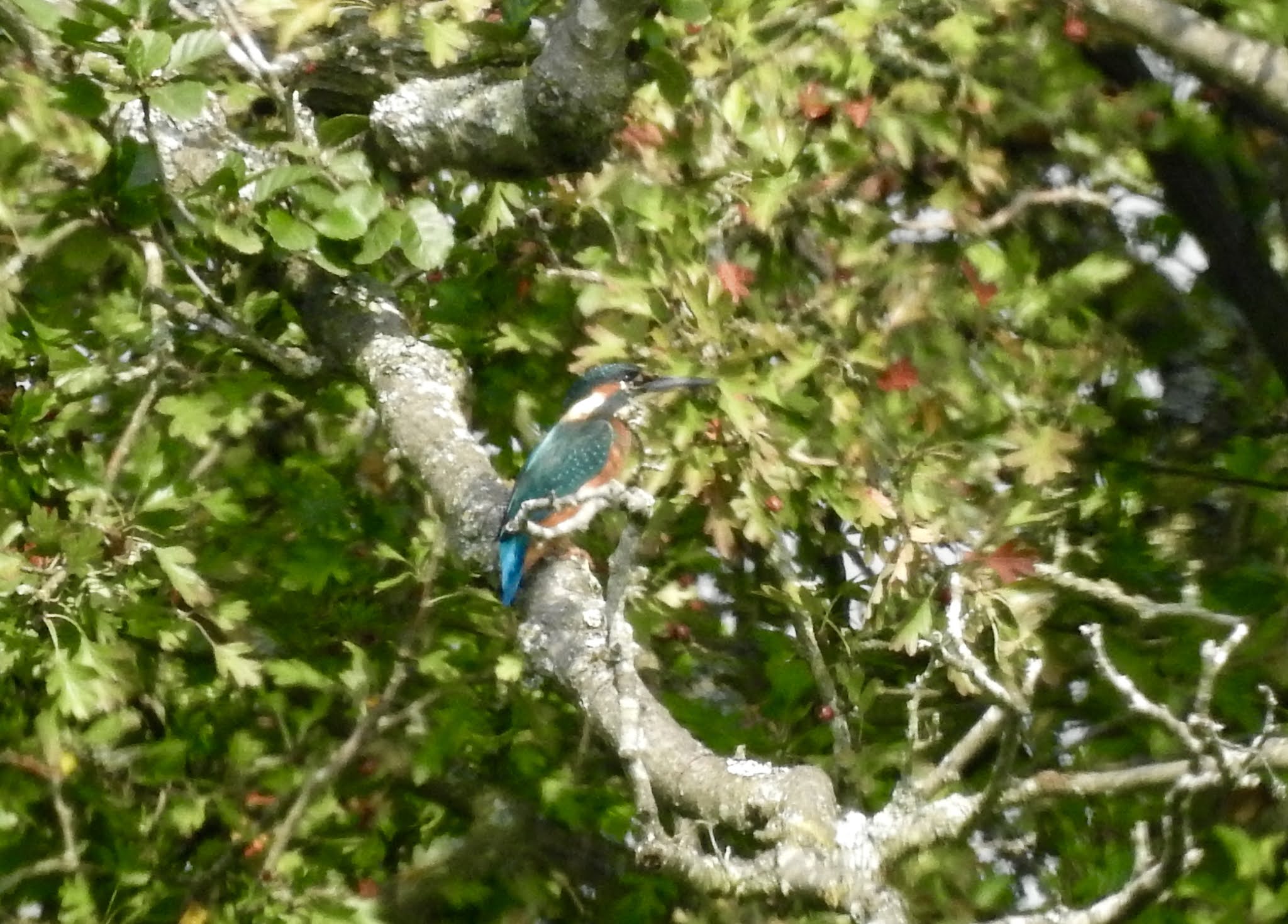
At the far end of the Kingfisher Pool I crept through the bramble strewn pathway to find no sign of the Kingfisher or anything else. Fortunately I lingered, and ten minutes later it appeared, saw me, and hurried off across the field where it perched on a distant hawthorn. Thus a rather incongruous sight of a Kingfisher perched about 100 metres from the nearest water.

Kingfisher

I headed on, and no doubt it breathed a sigh of relief and resumed its intended journey to the pool.

The bird of the day was also the miss of the day. Far away on the top of a hedge stood a small bird. It suddenly took to the air and returned to its perch. Surely a Spotted Flycatcher. The problem was, when I said far away I wasn't kidding.

Spot the spot fly?

I tried my scope, and got on it again. It looked even better, but it was still a silhouette. I decided to head to the ridge field to try to get closer and have the sun behind me. 

I never saw it again. The one that got away.

By now I thought sun stroke was a very real possibility so I staggered back to the car without really looking at anything else.