Sunday, 29 September 2019

Sunday September 29

A cloudy but mild morning with a moderate south-westerly wind sandwiched between an overnight deluge and heavy showers through the afternoon.

I would be lying if I said that on every visit I wasn't hoping to see a special bird, but this morning proved that Morton Bagot can be fantastic without rarities on show. The key is passage migration, and boy did we get it today.

An early omen was a single Yellowhammer which flew over Netherstead shortly after I arrived. Dave joined me and we noticed wagtails and pipits in the part flooded horse paddocks. We headed down there and soon counted around 60 Meadow Pipits, 12 Pied Wagtails, and two Stonechats.

One of the Meadow Pipits
Soon after we resumed our normal circuit we realised that hirundines were moving. A sudden rush of House Martins heading purposefully south-west started us logging them. With them were more Meadow Pipits, and a few Swallows.

Its hard to express how thrilling it was to see these birds whizzing past us in waves, we surely missed far more than we counted but our record breaking final totals were 650 House Martins, 150 Meadow Pipits, and 40 Swallows.

One of the House Martins
My bridge camera is not up to the task of documenting the movement, but I couldn't resist trying.

Slightly less captivating were the numbers of downed migrants in the hedgerows. Although we felt there were a lot of birds about; Reed Buntings, Goldfinches, Linnets etc, there were few definite migrants. The best we could muster was 11 Chiffchaffs and six Stonechats.

The main pool is a pool once more, but will no doubt drain away. The flash field is now a mixture of grass and water. 46 Lapwings flew off as we appeared, but there were no other waders. Teal numbers were barely more than a dozen, but Shovelers did try to impress. The count of 14 was a new site record for a species that usually shuns us.

Some of the Shovelers
Eventually the hirundine passage reduced, and the only other fly-over to mention was a Siskin (heard not seen as usual).

A memorable day.

Friday, 27 September 2019

National Moth Night - Winyates East

National Moth Night is an event spanning three nights (it used to be just one). Originally organised by the magazine Atropos, and now jointly run with Butterfly Conservation, it shifts its position each year to take advantage of the various short flight seasons of the over a thousand species occurring in the UK.

I have never felt knowledgable enough to take part, until this year. The arbitrary selection of the date has led to many wash-outs in previous years, it almost seems part of a tradition. This year is no exception; cool wet and windy. They were hyping it as an opportunity to target the Holy Grail of moths, a rapidly spreading former rarity called Clifden Nonpareil. I managed to catch one a fortnight ago, so was astonished to find another clinging to the side of the house this morning.

Clifden Nonpareil showing a bit of its blue underwing

Clifden Nonpareil
My total catch was 28 moths of 12 species as follows: 1 Ruddy Streak, 3 Common Marbled Carpets, 1 Light Brown Apple Moth, 1 Clifden Nonpareil, 3 Brindled Greens, 9 Large Yellow Underwings, 5 Lunar Underwings, 1 Light Emerald, 1 Flounced Rustic, 1 Lesser Yellow Underwing, 1 Square-spot Rustic, and 1 very worn Copper Underwing ag.

All of the above have turned up in the garden before, but the Brindled Greens were new for the year.

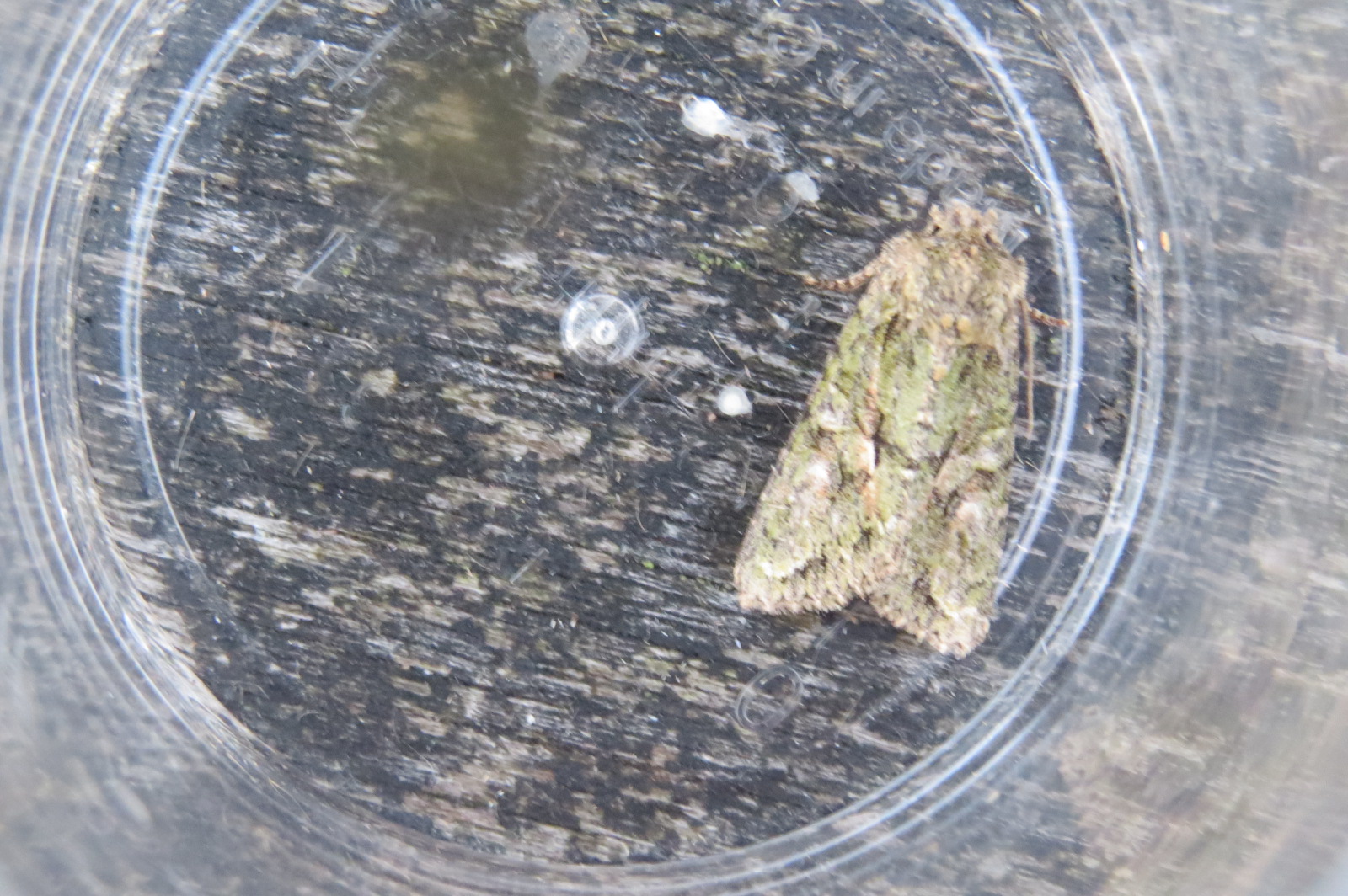
Brindled Green
I'm pleased to feel I have made a contribution to the survey at last.

Wednesday, 25 September 2019

Wednesday Sept 25

A grey morning with a very light northerly. Recent heavy rain has raised all the waterlevels, and the pool is briefly restored.

It was a fairly quiet visit. A party of 10 House Martins headed south, while four Swallows also drifted over. I couldn't see the Garganey, but it could still be present. The main interest at the flash field was an influx of Shoveler, the number now standing at 12. A single adult Peregrine powered over, and I later spotted it on a pylon.

Jay
Peregrine
A single Cormorant was the first of the year.

Today's frustrating experience was a ticking Bunting which flew out of the hedge and away into the distance. I suppose it could have been a Yellowhammer, but if I got on the right bird it looked Reed Bunting-like.

Bloody birding!

Sunday, 22 September 2019

Sunday September 22

A mostly cloudy humid morning with the faintest southerly breeze. The forecast rain arrived at 11.00am, but by then we'd done rather well.

Dave was back from his hols, so the team was at full strength.  A flock of about 200 finches on wires towards Stapenhill Wood looked worth a look, but we decided to head for the flash field first in case there was something there. On the way we noticed 27 Lapwings and 21 Snipe flying around, and the reason became clear when we arrived. Overnight rain had brought the water-level up and mud was in short supply. On the other hand there were a lot of visible ducks.

Three Shovelers were on the near flash with 84 Mallard and 130 Greylag Geese. The furthest flash contained nearly all of the 48 Teal. I was going through them hoping for a Garganey when I found.... a Garganey.

Garganey
I think this is the first since 2016, and it was also the first to be found in September.

We strolled back, seeing very few summer migrants; ten Swallows, and about four Chiffchaffs, until we reached the raptor watch point, where the finches had been. The flock seemed to have dispersed, or was in the linseed crop. We saw a few Goldfinches, Linnets, and Greenfinches before we flushed a warbler sp. It was quite small and had no white in the tail, so I guessed at Chiffchaff. Dave waded in, and to my surprise, and his, found himself looking at a Grasshopper Warbler.  I joined him, but was only able to see a bird sp slip through the stems. As we edged forward we were distracted by a calling  Raven. I looked round to see that it was mobbing a Red Kite.

Red Kite and Raven
Red Kite
This was the first Red Kite since the spring, and like the Garganey, the first September record.

By this time the skies were darkening worryingly, so we abandoned our attempt to relocate the Grasshopper Warbler and headed for the cars.

Thursday, 19 September 2019

Thursday Sept 19

A sunny morning with a very light northerly.

A curtailed visit for personal reasons, but the birdlife seems to be enjoying the balmy early autumn temperatures.

Highlights were a Hobby, a Sedge Warbler, a Whitethroat, and three Stonechats.

Stonechat
At least three Shovelers remain at the flash pools, and most of the twenty or so Lapwings were lying on the sun-baked mud.

A single Siskin flew over unseen, but calling, as a reminder that winter is coming!


Sunday, 15 September 2019

Sunday September 15

A sunny morning with a very light westerly.

Birding was to prove a very frustrating experience this morning. The TV people are still camped at Netherstead, so I parked at the church.

A few Chiffchaffs and Meadow Pipits suggested passage was still taking place, and one Grey Wagtail went over, and I flushed a Whitethroat. The defining moment came when I spotted an "interesting" Buzzard flying over the former pool. Did I see a longish tail with a roundish tail tip? Was its head a little small? I was sufficiently interested to take some shots as it headed away towards Morton Wood.


My camera currently has a fault which means I can't check the shots in the back screen, so all I could do was head for the flash and scope the wood in the hope that whatever it was was perched up. It wasn't.

The Lapwings and Black-headed Gulls were rather restless, and the cause turned out to be a Peregrine which I saw flying away into the distance.

The flash pools contained four Shovelers, and just the usual ducks and waders. I decided to head home to see if the shots added anything.

All I would say is that the raptor's level winged glide is illustrated well, but I can't see anything else which supports an identification as Honey Buzzard, so I guess it was just a Common Buzzard.

Meanwhile, some ringing news. The team switched to Saturday this week and also tried their luck along the hedge west of the former pool in the hope of catching some buntings and pipits. They were very happy with their final haul of 119 birds, which included lots of Meadow Pipits and the first Linnets caught on Heart of England Forest land.

The full totals (re-traps in brackets) are as follows:

Blue Tit 45 (6)
Great Tit 15 (3)
Chiffchaff 3
Blackcap 1
Whitethroat 1
Lesser Whitethroat 1
Wren 2
Dunnock 1
Meadow Pipit 22
Greenfinch 7
Linnet 2
Goldfinch 2
Reed Bunting 17

Saturday, 14 September 2019

Clifden Nonpareil

I put the garden trap out last night, and the first 15 moths pulled out of the trap this morning were all common and unexciting looking ones.

The sixteenth moth, clinging to the fence, was something completely different. A Clifden Nonpareil. This is a stunning moth and until a few years ago was a rarity in Britain, let alone the Midlands. It does seem to be undergoing a status change, global warming no doubt, and is turning up occasionally in local moth traps this year.

Clifden Nonpareil


Its the first I have ever seen, and is the equivalent of finding a Hoopoe in your garden.

Superb.