Sunday, 9 August 2020

Friday August 9 - a rare bird at last

This morning dawned cloudy with a light easterly. Always a good start.

Dave joined me and we started our usual circuit, searching for something unusual. The fields were full of Goldfinches, with a smattering of Whitethroats, Reed Buntings, and Linnets, but still no Chats yet.

We reached the flash field and noticed that the water level was even lower. At least six Green Sandpipers and 26 Lapwings had been joined by another wader. Its a nice bird, but it was still just a Common Snipe.

Common Snipe
 

Oh well, at least it was something different. A little further down the hedge a Willow Warbler burst into song, and then we heard the Kingfisher calling. As we approached our viewing point beneath the trees bordering the nearest flash there was a commotion of wader calls. A Sparrowhawk took off and flew towards us.

We were left to scan the flash and consider which of the preceding species qualified as the "best bird" today. Then it turned up.

Dave was in the "gallery" from where he could see the mud of the flash, while I was moving further down the bank. I looked up to see a dark shape fly across the flash well above tree-top level. Marsh Harrier I yelled, as I glimpsed its cream coloured crown and throat. In an instant I lost it behind an oak tree. Meanwhile Dave, whose view was restricted by the overhanging hedge, had seen nothing and was scrambling to join me. I dashed a few yards and scanned the field to the east of the oak tree where the bird would surely reappear. Surely. It seemed an age, but eventually I picked it up again, still heading east. I managed a few record shots as Dave joined me and had his first view of the bird.

Marsh Harrier
Marsh Harrier
Heading away

Between us, Dave and I have seen four Marsh Harriers here, but this was the first time we had seen one together. My two were in 2011 and 2013 (the latter on Aug 10) so this one was timely and I'm tempted to say punctual. Dave's were in October 2015 (when I was in Whitby) and last July (when I chose to stay in to watch the cricket world cup final).

For the rest of the walk we had a rather self-congratulatory air, which is probably why we didn't see any other birds of any significance. But who cares.

Here's a moth, in case you've been missing them.

Shaded Broad-bar

We see this species here most years, but it remains missing from my garden list. Perhaps they are reluctant to wander.


Saturday, 8 August 2020

Epic moth session part 2 - The best of the rest

 Right, so here we go again. The really good stuff caught last night is written up in the previous post, but the remainder was not too shabby.

I'll start with a couple of moths which deserve to be moved to the front of the queue for several reasons. They both look great, and they were nearly garden ticks. The first is a moth I saw in our bathroom in 2015, and is therefore on my "wildlife of the garden" list from before I bought a moth trap. Small Phoenix has kept me waiting since then to qualify for this blog.

Small Phoenix

This species can vary a bit in the pattern of its markings. The 2015 was a classic pattern, but last night's moth looked much more similar to a moth called Phoenix, an example of which I caught in 2018. Fortunately the Small Phoenix was erm...smaller than a Phoenix would be.

The second moth to elbow its way to the front was a species I see regularly at Morton Bagot, but have only seen once in the garden (2018), and on that occasion it evaded my camera. The Blood-vein is also an especially pretty beast.

Blood-vein

So having dealt with those two, I'll list the rest in the order in which I found them. 

I can rarely resist checking the moths which are attracted to the light of the utility room and kitchen once the trap is switched on, and one of the first to appear cut a distinctive shape. I did not catch an Oak Hook-tip last year, so that made it particularly special.

Oak Hook-tip

The second moth I detained was a Mouse Moth. This is a rather unassuming species, and in fact the one caught was rather worn, so I'm showing the second (which I found in the trap during the morning).

Mouse Moth

Actually, this very fresh individual looked a bit odd , as they normally show two tiny black dots on the outer wing, not a single heart shaped one. However, I couldn't find anything else in the book which matched my photo, so I decided it was just natural variation. I may get it checked.

The third "new for the year" moth from the evening was a Lesser Broad-bodied Yellow Underwing. This is a pretty common species, and I should catch plenty more before the end of the month. Unfortunately, by morning it was determined to fly off and was quivering its wings as I took the photo.

Lesser Broad-bordered Yellow Underwing


Cut to this morning and the excitement of turning over egg-boxes to see what I'd caught. New for the year were: Rhyacionia pinicolana (one previous record - last year), Chequered Fruit-tree Tortrix, Lime-speck Pug (second record - first was last year), and finally Common Carpet (only previously recorded in 2018).

Rhyacionia pincolana (a rather faded one)


Chequered Fruit-tree Tortrix


Lime-speck Pug


Common Carpet


So lets talk about numbers. Way out in front (as intimated in Part 1) was Water Veneer with 62 examples. The next six were:

Crassa unitella - nine, 

Eudonia lacustrata - seven

Large Yellow Underwing - seven

Dusky Thorn - seven

Shuttle-shaped Dart - seven

Flame Shoulder - six

Also well represented were Cloaked Minor - five, Garden Grass Veneer (just four), and Light Brown Apple Moth - four.

Out of the remainder of the grand total of 54 species of moths recorded, Limnaecia phragmitella was only the second record, and one of two Knot Grass was unexpectedly large.

I tend not to mention other insects caught, but one beetle was so enormous that I can't resist showing it.

Thanks to Lloyd Evans for putting a name to it.

A female Lesser Stag Beetle


PS: During the evening I found the moth identified without my glasses in the bathroom last night as a Mother of Pearl was actually a Willow Beauty. Another trip to Specsavers could be required. Also in the bathroom was a micro Ypsolopha scabrella. Its probably pushing it to suggest that that too had been there since the night before.

Ypsolopha scabrella

Also, I had left the trap out overnight to allow the last two moths to escape, but was concerned to see one still in it this morning. The reason soon became clear, it had died. One upside (though not from the moth's point of view) was that it was a Common Rustic ag (either Common Rustic or Lesser Common Rustic), this means I can arrange to have it examined under a microscope so that at least one of this aggregated species will have been identified for certain.

Lesser Common Rustic

Update: The recorder has confirmed the deceased moth's identity as a Lesser Common Rustic. This species is less common, but equally widespread, as the Common Rustic. Ironically I have never had a Common Rustic die unexpectedly, so although most of my Common Rustic ags are probably Common Rustics, I cannot prove that is the case.

This was the first Lesser Common Rustic to have been confirmed for SP06.


Warmest night of the year brings an epic moth session

It was always going to be a good one, and within an hour the trap was full of insects. A lot of them were the doomed backswimmers (Water-boatmen I suppose), and seeing their plight always makes me feel a bit sick if I'm honest. The same can be said for the micro Water Veneer. Its strategy of a massive emergence of males on a warm night is no doubt very effective, but 62 of them found their way into my trap, and they were all dead by morning. Perhaps, like the May-fly, they are only programmed to survive one night as an adult.

Fortunately the remaining moths survive well, and my total as I write stands at 180 moths of 54 species. These included six that were new for the garden, and a further nine which were new for the year.

Two of the new ones were macros; a Pine Carpet and an Olive. The former is scarcer in Warwickshire than its relative the Grey Pine Carpet, and I was glad to receive confirmation that it was indeed that species.

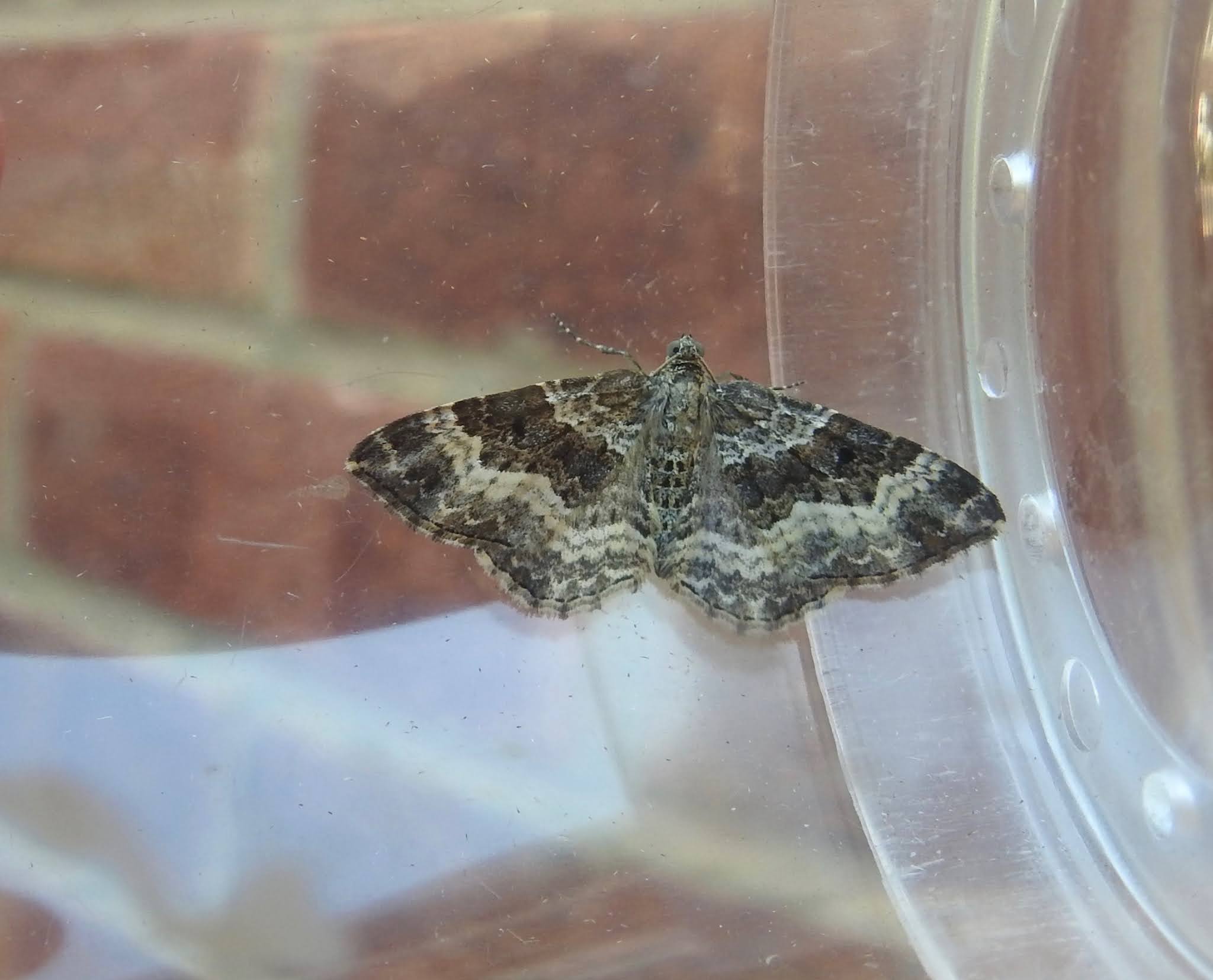
Pine Carpet

The key feature is the V shaped indentation along the top (inner) edge of the darker orange band across its wings. Grey Pine Carpet does not show that.

The Olive is a fairly distinctive moth, but I still only realised it was something new as I reviewed my photographs. Its food plants include Poplars, so it shouldn't be too big a surprise.

Olive

It seems to be a rather worn individual.

The four micros included the best looking moth of the night; Ypsolopha sequella, (its an absolute stunner, but only 9mm long). However, it was a giant compared to two of the other three. A pair of Apple Leaf Miners were making babies on the window pane, and the female is no doubt now preparing to lay her eggs into one of the leaves of our huge apple tree. I almost didn't realise they were moths at first glance as they measure a dinky 4mm in length. 

Ypsolopha sequella
Apple Leaf Miner


The third tiny moth was a member of the Gracillariidae family, most of which are characterised by super long front legs which give them a perching position rather like a miniature rocket due to be launched skywards. At around 6 mm long I was afraid it might be unidentifiable, but I came up with the name Aspilapteryx tringipennella and my on-line expert confirmed it.

Aspilapteryx tringipennella


Last, and also least, of the new ones was a grass moth called Agriphila inquinatella. As micros go, we are back in the land of the giants; 12mm. I initially thought it was something else (Agriphila geniculea), but it looked subtly different. 

Agriphila inquinatella


Actually I wasn't at all sure about it, but my phone a friend concurred. This moth is supposed to be fairly common, so I wouldn't be at all surprised if I've been overlooking them.

I was going to carry on about all the other moths caught but that would make this post too long, so it will be a case of .....to be continued.

Tuesday, 4 August 2020

Tuesday August 4

Cloudy with a very light westerly and a heavy shower which fortunately occurred when I was sheltering under trees overlooking the flash field.

I quite like this time of year. Although its three weeks too early for dreams of scarce migrant passerines to be realistic, the numbers of regular migrants and residents are swelled fourfold by recently fledged juveniles. So there's plenty to look at.

There were double figure counts of Whitethroats and Chiffchaffs, the latter associated with a marauding band of tits.

Twenty years ago the sight of an approaching egret would have made the day,  a Little Egret was rare event. Nowadays, with three egret species currently present in the West Midlands, the only question was could it be something better? 

Little Egret

As usual it was "just" a Little Egret, but maybe one day it'll be one of the yellow billed species.

The nearest flash continues to tease. After seeing a single Green Sandpiper heading south from the dragonfly pools, I found a further six on the flash. Four Teal were also visible, but only six Lapwings. The whole scene reminds me of the early eighties at Upton Warren, an impression reinforced by an impressive count of 19 Moorhens, and just one Black-headed Gull.

The walk back was enlivened by a sizeable flock of Goldfinches. This is another species which has changed its status since the olden days. They were never rare, but always played second fiddle to Chaffinches and Greenfinches. Today I counted at least 110, mostly juveniles, excitedly feeding on thistles and Knapweed heads. Most of them ended up on telephone wires where counting was easier. 

Goldfinches


By contrast I saw just two Chaffinches, two Linnets, and no Greenfinches although there were no doubt a few around.

So no big jaw-dropping moments todays, just plenty of reminders of how quickly times change.

PS: Since my first visit to the patch (Feb 2007) I have been keeping a record of the highest counts of birds I have made here. Some relate to flocks of birds like Woodpigeons, Fieldfares, or Meadow Pipits and some to scarcer birds like Ruffs or Water Pipits. Others can easily slip under the radar. Such a species is Moorhen. Today's count of 19 was my largest count here. It beat my previous highest by one. Woohoo!

Sunday, 2 August 2020

Sunday August 2

A mixture of high cloud and sunny intervals with a light westerly breeze.

Dave and I strolled around with the sense of heightened optimism that comes with the beginning of August. In fact Dave had already scored before I arrived, watching a Peregrine at close range above Bannam's Wood as he drove to Netherstead. He picked the bird up again shortly after I joined him and we watched it vanish into the distance.

Warblers were seen, but all rather briefly. To continue with this theme, we disturbed a Kingfisher from Kingfisher Pool, twice. This was the first of the autumn here, but not a year-tick because we recorded one here in March.

We got into position at the nearest flash, which I commented was "crying out for a wader". Obviously I didn't mean the 34 Lapwings and six Green Sandpipers which are currently enjoying its falling water-levels. I meant a "good" wader, the kind we so rarely get.

If only there was a wader here ! Not you in the foreground.

As I took the above photograph I noticed the Lapwing shown suddenly crouch in alarm. The reason became clear when Dave drew my attention to a Hobby flying towards us.

We retreated to the Kingfisher Pool where we found the Hobby again. This was point at which my camera's battery decided it had had enough, and with a sad little bleep it bowed out. Drat! I also discovered I had forgotten to change the setting from "close focus" to "birdwatching" mode. What a pro.

The remainder of the visit passed pleasantly enough. We had crippling views of a Sedge Warbler, and fleeting views of a lot of Whitethroats

Next time I'll try to be better prepared.


Saturday, 1 August 2020

A warm night brings a stack of moths

I've given the moths a break this week, although we did spot a Bat sp on Monday night, so they've not had it all their own way. As the nights have become increasingly warm, so a number of moths have made it into the bathroom, including the first two Blastobasis adustella of the year on the evening of 30 July.

Blastobasis adustella

So last night there was every reason to hope for a lot of moths, and it didn't disappoint. There may still be a few lurking in the utility room, but the count stands at 95 moths of 46 species. About half were micros, and it was those that provided the most reward (and difficulty).

Two which were definitely new for the garden were Ptycholomoides aeriferana and Cochylis atricapitana. What I don't know is the current status of these two in Warwickshire.

Ptycholomoides aeriferana

Cochylis atricapitana

Not knowing the status of these micro moths is a disadvantage, and can lead to errors. A case in point came with two other small tortrix moths I found in the trap. They reminded me of Eudemis profundana, one of which I caught last time. I therefore recorded them as such, but had the photos checked by UKmothID. After I had released them I learned that they looked sufficiently similar to Eudemis porphyrana, which it turns out is a scarce moth, to make it worth contacting the County Recorder. Too late I'm afraid....or maybe not. Nigel has seen the images and regards the original identification as E profundana as correct, so its as you were.

Eudemis profundana

Moving on to moths which were new for the year, the pendulum swung back to macro-moths, which should be easier.

An Iron Prominent in the trap was certainly straightforward, my only regret being that I chose to wake it up to get it into a pot before photographing it. As a result it was rather agitated and wasn't sitting in a natural position.

Iron Prominent

Also now regarded as "easy" was a Copper Underwing, but I did check its underwing to make sure.

Copper Underwing

The last one was so easy that I messed it up ! My excuse was that it was resting awkwardly in the pot and was earlier than I had expected to see a Square-spot Rustic. Mind you they are very common, so I'm grasping at straws.

Square-spot Rustic

The last year-tick was even more humble. The micro Bryotropha domestica is presumably associated with human habitation, so not a very exciting moth.

Bryotropha domestica

The commonest moths last night were the usual suspects: 13 Large Yellow Underwings, and 10 Garden Grass veneers. No other species got near to double figures.

There are always plenty of other insects attracted. Several Common Wasps meant that progress was cautious, and a Cricket was assumed to be Oak Bush-cricket. Weirdest of all was a strange leafhopper, which I have seen in the garden once before.

Oak Bush-cricket

Ledra aurita


Wednesday, 29 July 2020

Morgrove Coppice

This afternoon the temperature was not too cold and not too hot. Ideal for coaxing Lyn to give the accessible path at Morgrove Coppice a try.

Success. Lyn loved it. We made our way around the entire route, Lyn even spotting the star butterfly before I did. This was a Silver-washed Fritillery. By the time I had got my camera out etc etc, you know the drill, it had gone. Never mind, I assured her, we would see another one. We didn't.

There were still loads of Gatekeepers, and several Speckled Woods, Large Whites, and a Peacock to see. 

Predictably, most birds were keeping a low profile as it was a late July afternoon, but there were several Blackcaps, Chiffchaffs, Whitethroats, and a couple of Marsh Tits on offer if you were quick enough.

A male Dark Bush Cricket stood impressively on the path in front of us.

Dark Bush-cricket

The flora was marvellous too. I really must get a smart phone, because after I get it I'll be able to download an App, and the App will be able to save me the bother of ploughing through three books and various wildflower sites before eventually googling tall pink flowers to identify Verbena bonariensis, a garden escape.

Argentinian Vervain

On seeing it Lyn had said "it looks just like the one's you see in Hillers". Hah, what does she know, I thought.

L K B. (Lyn knows best).