Sunday, 24 June 2018

Sunday June 24

Warm and sunny from the start. Given the time of year this post was never going to be about birds, so I can quickly get them out of the way. There were two Reed Warblers singing, one at the pond and one at the dragonfly pools. Meanwhile at the Flashes the water level is receding fast and the only waders were 20 Lapwings and two Green Sandpipers. We also flushed a Little Owl from the boundary hedge.

Much more interesting were insects, with butterflies taking centre stage when Dave drew my attention to a first for Morton Bagot. He had spotted a tiny butterfly at the top of a young elm in the hedgerow along the footpath west of the flash field. It was a White-letter Hairstreak. I had long hoped that one of these would be found here, but it still came as a pleasant surprise.

White-letter Hairstreak in shadow
White-letter Hairstreak with the sun shining on it
Slightly frustratingly I couldn't get a clear shot of it except when it was in partial silhouette. There may have been at least one more present, but after considerable neck straining we eventually decided to try again another day.

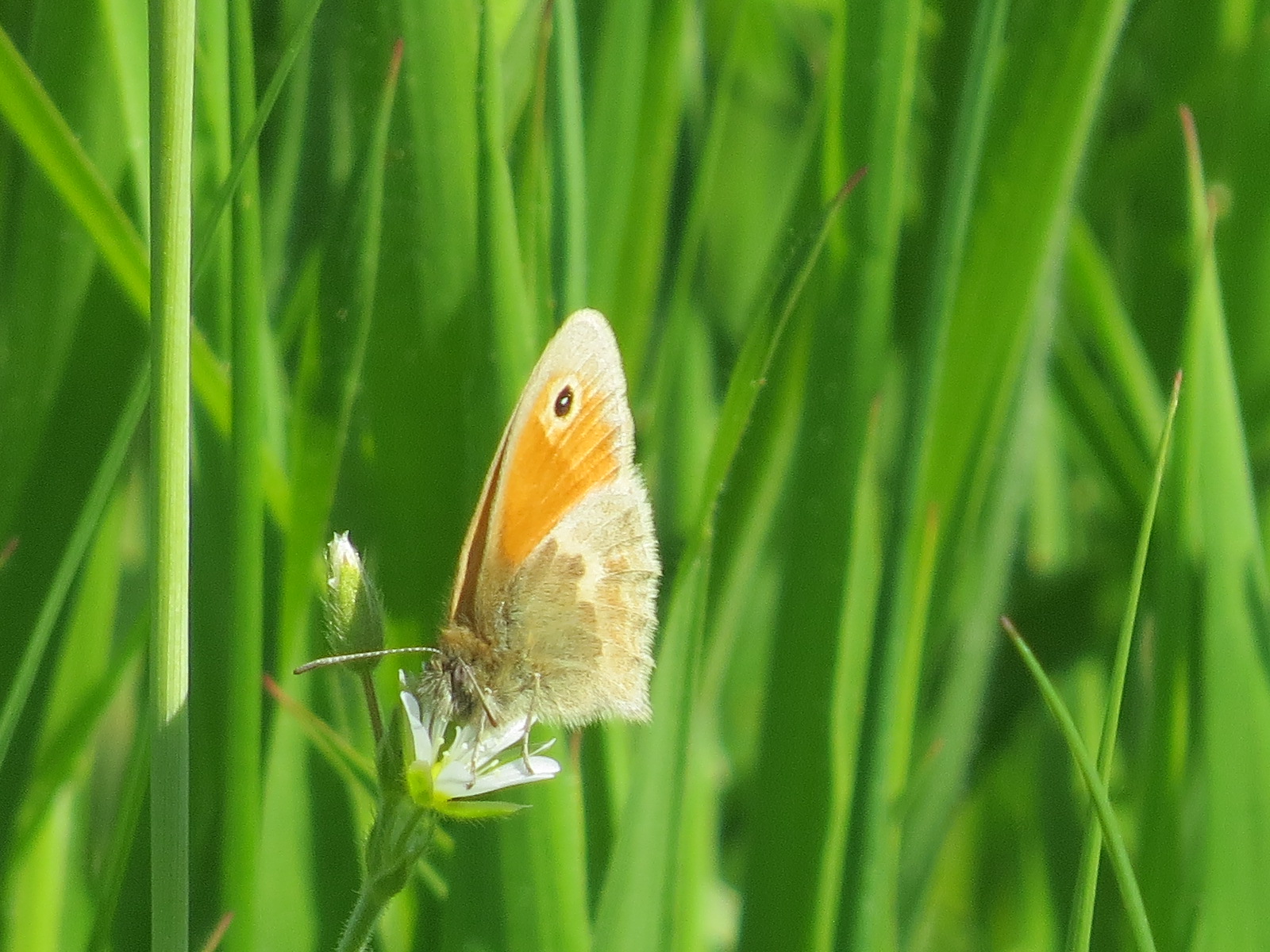
It was actually party time for butterflies until then, with 52 newly emerged Marbled Whites and at least 20 Small Skippers on view for the first time this year. The grassland butterflies were flying in big numbers; 200 Meadow Browns, 180 Ringlets, 40 Large Skippers, five Small Tortoiseshells, eight Large Whites, 20 Small Heaths, and one Small White.

Marbled White
Small Skippers
The small Skippers require careful consideration here because two near identical species, Small and Essex, both occur here. We always see a few we are not sure about.

Probably Small Skipper
Usually Essex Skippers emerge later than Small, but from mid-July you should be seeing both.

Continuing with the debatable insects theme, we saw lots of dragonflies too. I photographed what I thought might be a male White-legged Damselfly. However, on reflection it is probably a mature female Common Blue (I think). In fact it turned out to be a female Azure Damselfly (thanks to Peter Reeves for pointing out that the black lines on the sides of the thorax ruled out Common Blue).

Female Azure Damselfly
We have also been looking at darters and decided they were all Ruddy Darters.

Ruddy Darter
However, one of them was actually a Common Darter.

Common Darter
We finally reached the dragonfly pools where several red-eyed damselflies were too distant for satisfactory shots. But despite the rather early date and level stance, the pattern of blue on the final three segments of the abdomen suggests they were Small Red-eyed Damselflies and not the species we had been hoping for.

Small Red-eyed Damselfly
I also noticed an interesting looking bumblebee. It probably just a Common Carder Bee, but its pale haired thorax did make me wonder if it was something rarer.

Carder Bee sp
As for beetles, all I can say is that we saw an impressive one.

Possibly Strawberry Seed Beetle - Harpalus rufipes
I have come up with a tentative identification (see caption) but I'll try submitting it to the irecord website in the hope someone either verifies it or tells me what it actually is.

Sunday, 17 June 2018

Sunday June 17

A rather cloudy morning with a moderate south-westerly breeze. Its the time of year when everything is settled and breeding. We saw the first brood of Tufted Ducks on the pond at Clowse Farm and plenty of evidence of recently fledged passerines.

In fact readers of a nervous disposition should be advised that this post contains scenes of a sexual nature which some may find upsetting.

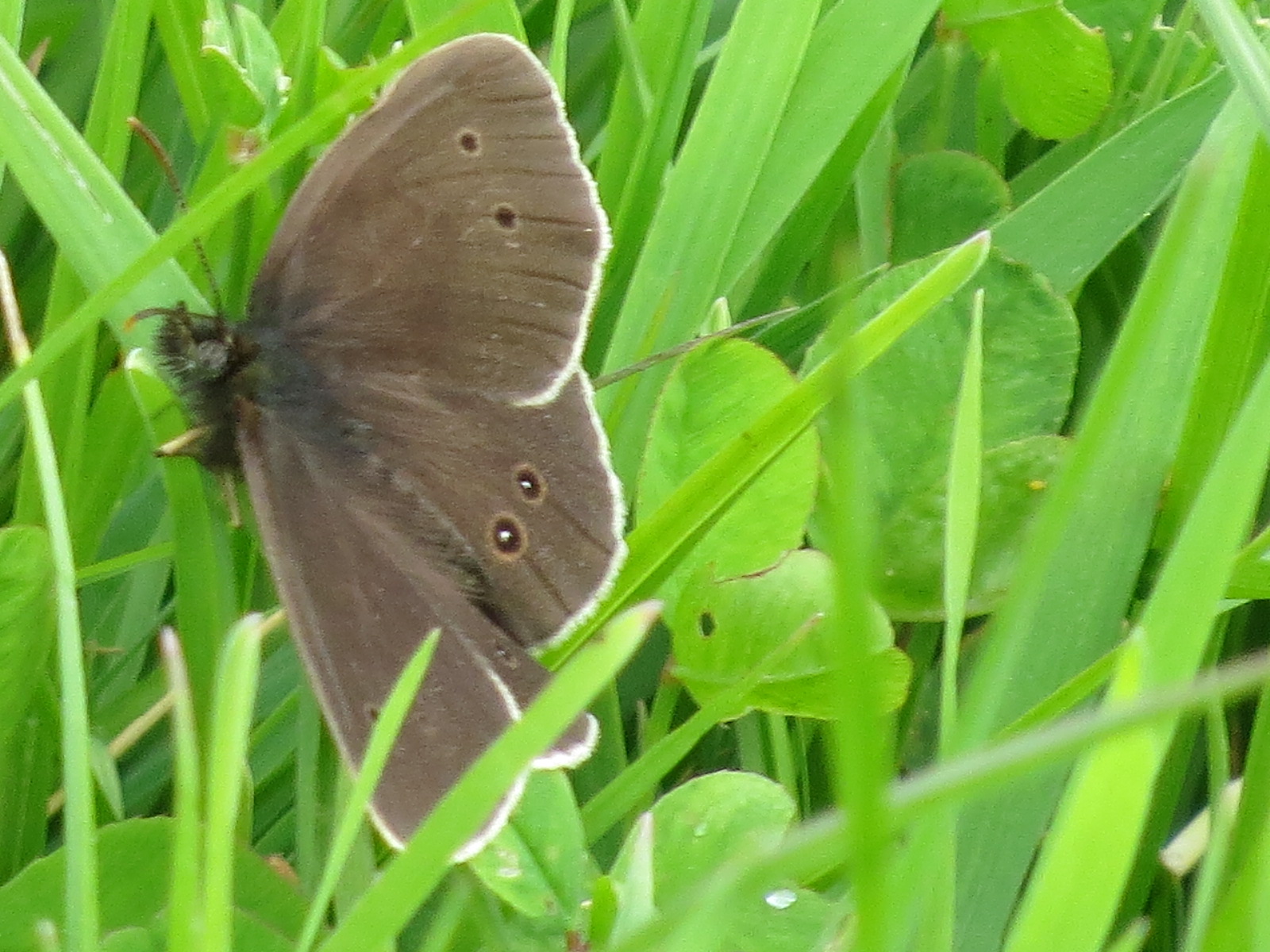
Before we get to that, the emphasis was on trying to find new insects for the year. As far as butterflies are concerned only about six Ringlets were new. The skippers were all Large Skippers (about 20), the browns all Meadow Browns (about 20), Small Heaths (about eight), and one or two Speckled Woods.

Ringlet
As for dragonflies, it was a similar story. The best was a single Brown Hawker which, due to the cool weather and probably it's recent emergence, was very easy to photograph.

Brown Hawker
We also saw about 12 darters (all Ruddy Darters) and numerous damselflies including about 30 Common Emeralds, about 20 Azures, a few Commons, a Beautiful Demoiselle and two Banded Demoiselles.

Now for some very brazen mammals.

Brown Hares
The field behind the pool was full of frisky Brown Hares, and we also disturbed a Roe Deer calf and a Muntjac.

Another feature of the day was hundreds of amphibians, almost all tiny Common Toads, crawling through the grass. There was also at least one Common Frog.

Toadlet
There was at least some evidence of bird migration to keep us birders happy. Two Green Sandpipers at the Flashes were the first  of the "autumn" and a pair of Little Ringed Plovers have reappeared now that the water-level is receding there.

Sunday, 10 June 2018

Sunday June 10

Following a hiatus caused by an ongoing family crisis, it was a relief to get down to the patch again. A cloudy morning meant that insects were hard to spot, but once seen, easy to photograph. Later in the morning the sun broke through and the temperature rose.

This is a hopeless time of the year for finding unusual birds, but Dave and I did see a Red Kite and hear a Reed Warbler. A single drake Teal remains on the flash field, and it appears that two Lapwing broods have fledged. Both Canada and Greylag Geese have goslings.

Red Kite
In just two weeks the grass has shot up, and new butterflies are now on the wing.

Large Skipper
Speckled Wood

Meadow Brown
As well as several of all the above, we saw one Common Blue, and about 20 Small Heaths. Since getting myself a garden moth trap I have become interested in the day-flying moths here. I didn't trouble myself with the grass moths but noticed many Timothy Tortrixes (another micro) and several macro moths.

Timothy Tortrix

Blood-vein

Cinnabar

Silver Y

Straw Dot
As for dragonflies, there were several new species on the wing while some of those already seen this year posed nicely. The Darters are in immature colours at this time of year which makes them tricky to identify. The first one shown below has black legs, while the second shows a moustachial droop on either side of the frons. These are features I associate with Ruddy Darter.

Ruddy Darter

Ruddy Darter
Both demoiselle damselflies were on show, and also both Broad-bodied and Four-spotted Chasers.

Beautiful Demoiselle

Banded Demoiselle
Broad-bodied Chaser

Four-spotted Chaser
The last of these was photographed in sunshine at the dragonfly ponds. The warmer late morning meant that none of the four Emperors settled long enough for me to get a decent shot. Instead I had to settle for the ever obliging Emerald Damselflies to round the visit off.

Emerald Damselfly
We also saw a hatch of tiny Toads, one or two young crickets, plenty of biting flies, and an interesting looking insect which I have not seen before and cannot identify.

Some kind of caddisfly perhaps

Sunday, 27 May 2018

Sunday May 27

Overnight thunderstorms looked set to continue if you believed the weather forecast. Dave did, and duly baled out. As it turned out, the morning was warm and fairly sunny with not a hint of rain.

Barely a sniff of any decent birds either though. The only discernible change being the presence of two drake Teal on the nearest flash.

Teal
Apart from that, at least two of the Lapwing chicks look virtually fledged. There may have been others in the field. A Treecreeper and a Lesser Whitethroat were singing, and the Little Grebe is still here.

In the absence of ornithological interest I turned to odonata (that's dragonflies if you don't like posh latin names). New for the year was a freshly emerged black-tailed Skimmer, and evidence of further emergences was provided by some exuviae (the cases of the larval forms left by the dragonflies as they crawl out of the water). These may have been of Emperor Dragonfly and Four-spotted or Broad-bodied Chaser, but I am not sure.

Black-tailed Skimmer

Possibly Emperor Dragonfly exuvia
Possible Broad-bodied Chaser exuvia
The rest were mainly damselflies; about 20 each of Large Red and Azure, five Beautiful Demoiselles, and three or four Common Blues. I did also see one Four-spotted Chaser.

My invigorated interest in moths was pandered to by sightings of several Silver-ground Carpets, a Mother Shipton, and a tiny micro on a buttercup which turned out to be a Cocksfoot Moth Glyphipterix simpliciella. 


Cocksfoot Moth
Mother Shipton
Finally, there were relatively few butterflies on the wing, apart from lots of Small Heaths. However, I did see my first Common Blue of the year.

Common Blue
As far as birds are concerned it looks like a long wait for autumn ..... July.

Sunday, 20 May 2018

Sunday May 20

Another warm sunny day, this time the very light breeze being southerly.

Dave joined me and quickly proved his worth. While I was watching a circling Sparrowhawk, Dave got onto a pair of Swifts among the hirundines seeing it off. This is the latest first date for Swift since I have been coming here.

We set off on the usual circuit and as we reached the pond we were greeted by the song of a Reed Warbler coming from the bulrushes at the back of the pond. Not exactly ideal breeding habitat, this could be a late arrival unable to find a place in more traditional reed habitat. We stood around trying to see it, and although I eventually did, the views were too brief for a photograph. A singing Blackbird on the other hand, couldn't have been more co-operative.

Blackbird
A few metres further on Dave located the adult Tawny Owl close to where we had seen it last week. The next tree contained, as I had hoped, two fluffy fledglings.

Tawny Owl chicks
We continued towards the flash field, taking in several Small Tortoiseshells on the way. They may have had a slightly better winter.

Small Tortoiseshell
The flash field contained virtually the same as on Friday; two Shelducks, a Gadwall, two broods of Lapwings, a brood of Coots, and three broods of Mallard. A party of 17 Canada Geese were charged by the herd of frisky bullocks now occupying the field. They waddled away in alarm.

The walk back along the tall hedgerow is always great for insects, and today was no exception. We saw two moths; Mother Shipton and Silver-ground Carpet, and numerous Large Red Damselflies, Beautiful Demoiselles, and Azure Damselflies, with a single Broad-bodied Chaser.

Silver-ground Carpet
Azure Damselfly
Also we saw the most extraordinarily colourful fly (at least I think it was a fly). In fact it wasn't too hard to discover it was actually a wasp of a group called Ruby-tailed Wasps, Chrysis spp. I also found out that they are pretty much unidentifiable to species level without detailed examination.

Ruby-tailed Wasp spp

Shortly afterwards birds came back into focus. There must have been a lot of flying ants because about 20 Lesser black-backed Gulls, 10 Black-headed Gulls, and two distant Hobbies were helping themselves. Then Dave spotted a female Whinchat perched on birch saplings in the young forest now gaining a foothold in the ridge field.

Whinchat
We ended the morning at the dragonfly pools where several blue damselflies defied identification by refusing to settle, but a male Broad-bodied Chaser and a Four-spotted Chaser were more obliging.

Four-spotted Chaser
I had almost forgotten to mention butterflies. As well as several Small Tortoiseshells, we saw four Brimstones, an Orange-tip, a Green-veined White, and about 15 Small Heaths.

Small Heath
The three new birds for the year represent the last hurrah of spring I should think. Summer is just around the corner, so its time for Springwatch!


Friday, 18 May 2018

Thursday May 18

It's always nice, indeed a relief, when you take someone around the patch and are able to see something good. It is probably over a year since both Richards joined me, and we certainly picked the weather, it being a beautifully sunny morning.

My friends are excellent companions in that they are happy to walk around and see a few Hares.

Brown Hare
So when a Fox appeared in the pool field and starts hunting the Brown Hares, they are left very happy indeed.

Fox
The hares definitely had the measure of the fox which never came close to a successful kill. It eventually got wind of us and ran off.

Then things got really good. A pair of Hobbies appeared and after initially simply circling, they started to treat us to what can only describe as horseplay as one occasionally picked up speed and dived spectacularly towards the other.

Hobby
I even noticed a white butterfly fluttering dangerously close to them, and was not too surprised when the nearest bird plucked it out of the sky and started consuming it on the wing.

At the flash field all was pretty much the same, a drake Gadwall and a pair of Shelducks standing out. The highlight though was finding that the two broods of Lapwings were still intact, with a total of five chicks, three of which were large enough to be practicing a bit of wing flapping.

The stroll back produced plenty of interesting insects.

Hoverfly which mimics a bee, Volucella bombylans
possibly Grey-patched Mining Bee
Beautiful Demoiselle - male

Beautiful Demoiselle - female
We counted about six Beautiful Demoiselles without trying especially hard, probably the best emergence I have seen here. We also saw several Large Red Damselflies and an Azure Damselfly.


And the hawthorn hedgerows just look fantastic at this time of the year. You can't beat it.