 |
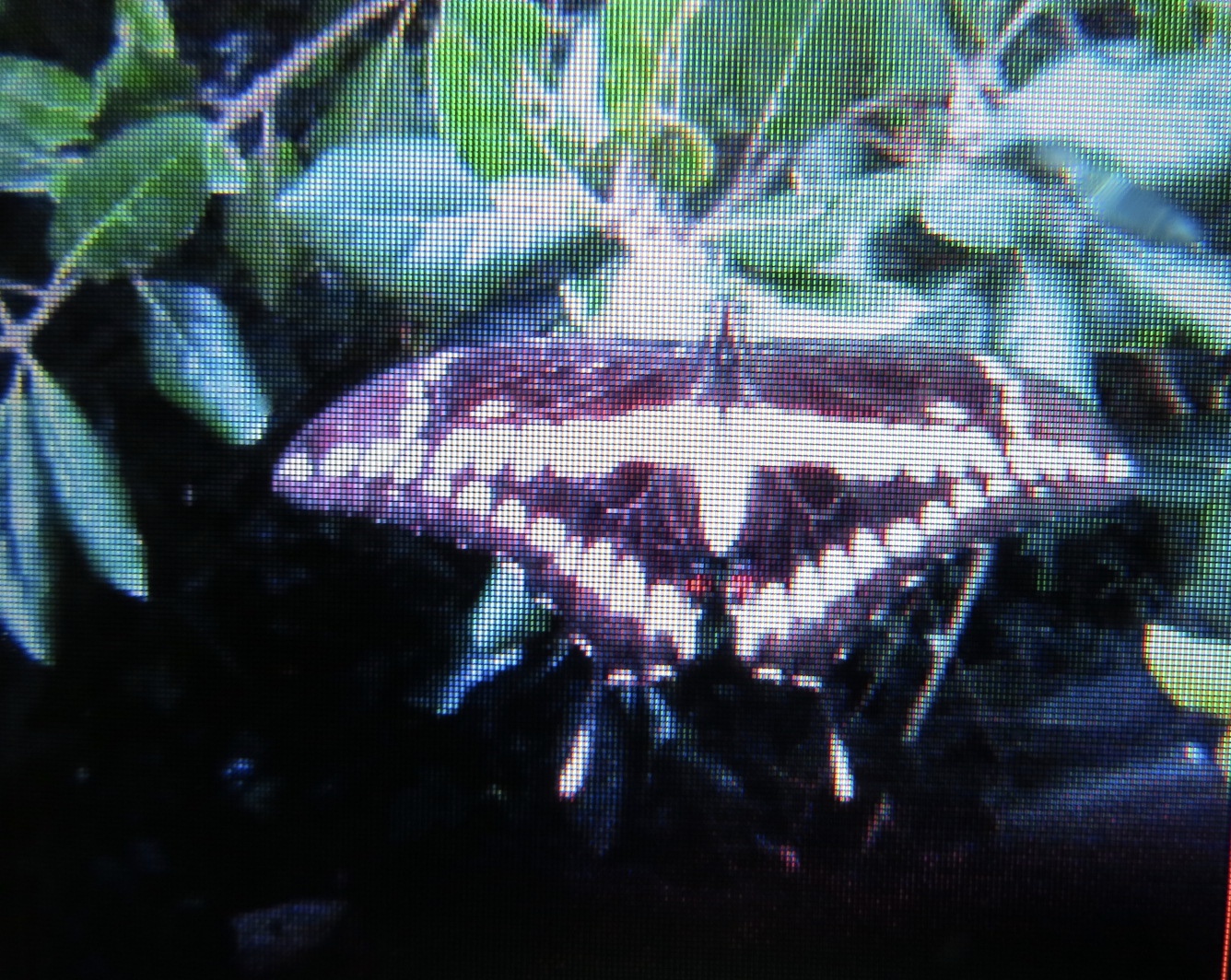
| Giant Swallowtail |
Thursday, 21 July 2016
Weird butterfly photographed at Stratford
This afternoon, strolling around Stratford with friends, we came across this astonishing butterfly. Unfortunately only a mobile phone was available for the shot.
A North American species, but the proximity of Stratford Butterfly Farm is certainly of relevance to the record.

Sunday, 17 July 2016
Sunday July 17
A very warm, humid morning.
I have recently rejoined Butterfly Conservation and decided to take part in the Big Butterfly Count having read that it has been a very bad season nationally. My 15 minutes produced the following:
Marbled White - 9
Meadow Brown - 31
Small/Essex Skipper - 13
Large White - 3
Ringlet - 3
Large Skipper - 2
Gatekeeper - 1
The reason I was cautious regarding the Skippers was that most were seen in flight, and later examination showed that both species are now present.
Outside the allotted period we saw many more butterflies including a couple of Common Blues, three Small Tortoiseshells, and several Small Whites.
As it got hotter, it became increasingly difficult to photograph insects as they became extremely unwilling to settle. Dragonflies were especially difficult, and although we saw at least four Brown Hawkers, new for the year, there was no chance of a photograph.
You may have noticed that I haven't mentioned birds yet. In fact it wasn't terrible for them, but it was frustrating. A Reed Warbler was singing, but remained hidden, and I got the impression that there were additional birds calling, so perhaps they have bred.
An unusual feature was the presence of a flock of House Martins perching on a hawthorn hedge.
They may have had a good breeding season. I also noticed a single Sand Martin flying with them at one stage.
A single female Tufted Duck at the pool may have been the bird I saw with two ducklings at the Dragonfly Pools on Friday. It would seem that the ducklings haven't lasted too long. The Flashes were a bit disappointing, just six Green Sandpipers and 23 Lapwings.
The bird of the day was an escape (but a pretty good one). Dave spotted a yellow and black bird perched with Goldfinches in the hedge by Kingfisher Pool. With brief thoughts of Golden Oriole floating through my mind I got the scope up and shifted to a position where I could see what the bird was. Right colours, wrong size, it was in fact an adult male Yellow-crowned Weaver (aka Yellow-crowned Bishop). It was a stunningly attractive bird, but as my camera came out the bird decided it was time to fly off. It actually circled the entire field before disappearing into the distance.
This may be the bird which we saw in 2014, when it was a more dowdy immature, but I suppose it could be a completely new one. Continuing the theme of missed opportunities, Dave rounded the
corner of the hedge at Kingfisher Pool before I did and walked straight into a perched Kingfisher. I saw only the perch!
Back to insects, the first Grasshoppers are now showing, but not stridulating yet, and we noticed a small moth which I reckon is a Yellow Shell.
The Swifts are down to single figures. Autumn beckons.
I have recently rejoined Butterfly Conservation and decided to take part in the Big Butterfly Count having read that it has been a very bad season nationally. My 15 minutes produced the following:
Marbled White - 9
Meadow Brown - 31
Small/Essex Skipper - 13
Large White - 3
Ringlet - 3
Large Skipper - 2
Gatekeeper - 1
The reason I was cautious regarding the Skippers was that most were seen in flight, and later examination showed that both species are now present.
 |
| A female Essex Skipper |
 |
| Gatekeeper |
You may have noticed that I haven't mentioned birds yet. In fact it wasn't terrible for them, but it was frustrating. A Reed Warbler was singing, but remained hidden, and I got the impression that there were additional birds calling, so perhaps they have bred.
An unusual feature was the presence of a flock of House Martins perching on a hawthorn hedge.
 |
| House Martins |
A single female Tufted Duck at the pool may have been the bird I saw with two ducklings at the Dragonfly Pools on Friday. It would seem that the ducklings haven't lasted too long. The Flashes were a bit disappointing, just six Green Sandpipers and 23 Lapwings.
The bird of the day was an escape (but a pretty good one). Dave spotted a yellow and black bird perched with Goldfinches in the hedge by Kingfisher Pool. With brief thoughts of Golden Oriole floating through my mind I got the scope up and shifted to a position where I could see what the bird was. Right colours, wrong size, it was in fact an adult male Yellow-crowned Weaver (aka Yellow-crowned Bishop). It was a stunningly attractive bird, but as my camera came out the bird decided it was time to fly off. It actually circled the entire field before disappearing into the distance.
This may be the bird which we saw in 2014, when it was a more dowdy immature, but I suppose it could be a completely new one. Continuing the theme of missed opportunities, Dave rounded the
corner of the hedge at Kingfisher Pool before I did and walked straight into a perched Kingfisher. I saw only the perch!
Back to insects, the first Grasshoppers are now showing, but not stridulating yet, and we noticed a small moth which I reckon is a Yellow Shell.
 |
| Yellow Shell |
Friday, 15 July 2016
Friday July 15
A cool, cloudy morning with a light north-westerly breeze.
I was joined by two friends, both also called Richard, who were keen to be shown some wildlife. To begin with they were kept on their toes by a succession of little brown jobs; Whitethroats, Reed Buntings, Linnets, and the like.
In fact, the best discovery on the outward journey was a patch tick for me, albeit deceased and not a bird.
I was aware that Moles occur here, the occasional molehill giving their presence away, but it was interesting to see an example of the actual species.
The pool produced an adult and two juvenile Little Grebes, while the flash field served up two newly arrived juvenile Little Ringed Plovers and a handful of Green Sandpipers and Lapwings.
At the Kingfisher Pool we were startled by the call and flash of blue of the first Kingfisher of the year to arrive (and depart). About 30 Swifts were still careering over the unsprayed field, while employees of the Heart of England Forest Project got on with spraying the ridge field.
Our last notable discovery was a female Tufted Duck with two ducklings on the Dragonfly Pool.
I was joined by two friends, both also called Richard, who were keen to be shown some wildlife. To begin with they were kept on their toes by a succession of little brown jobs; Whitethroats, Reed Buntings, Linnets, and the like.
 |
| Linnet |
 |
| An ex-Mole |
The pool produced an adult and two juvenile Little Grebes, while the flash field served up two newly arrived juvenile Little Ringed Plovers and a handful of Green Sandpipers and Lapwings.
At the Kingfisher Pool we were startled by the call and flash of blue of the first Kingfisher of the year to arrive (and depart). About 30 Swifts were still careering over the unsprayed field, while employees of the Heart of England Forest Project got on with spraying the ridge field.
Our last notable discovery was a female Tufted Duck with two ducklings on the Dragonfly Pool.
Sunday, 10 July 2016
Sunday July 10
Mostly cloudy with a fresh south-westerly breeze, but also quite warm.
At last, some bird migration to report. Dave and I had reached the Chat Field, and he was scanning across it when he noticed a potential Stonechat. Any Chat in the field seemed unexpected in July so I got the scope up and was able to see that it was actually an adult male Whinchat, and a bit of a stonker at that. Some stalking was required to get an acceptable image of it.
I would have been reasonably happy if that had been our only good find of the morning, but no, year-ticks were lining themselves up at the Flash field.
At least one Little Grebe was showing on the pool, but much more interesting was the sight of a muddy edge around the nearest flash. I quickly spotted a Greenshank wading through the shallow water, and we were later to find that two were present. Unfortunately they never approached one another, so I can only depict this first bird.
Also present were six Green Sandpipers, a Little Ringed Plover, three Teal, and a Common Sandpiper, which was another year-tick. It remained on the shore at the back of the flash, so only a terrible record shot was possible.
We continued along the hedge, and just beyond the Kingfisher Pool we flushed a flock of Ravens off what turned out to be the carcass of a sheep. They quickly scattered, and we eventually counted 11 individuals, which I would imagine was made up of two family groups. This beats my previous record count, which was on the same date in 2011, by one.
Scanning to the west we picked up a Buzzard carrying prey, which appeared to be a Crow. Proof, if it were needed, of another successful Buzzard's nest.
Finally, the Ravens flew up in the distance before heading back to their lunch.
So I have managed to go a whole visit without mentioning insects. Well ok I did see a Comma butterfly, which I think was a first for the year.
At last, some bird migration to report. Dave and I had reached the Chat Field, and he was scanning across it when he noticed a potential Stonechat. Any Chat in the field seemed unexpected in July so I got the scope up and was able to see that it was actually an adult male Whinchat, and a bit of a stonker at that. Some stalking was required to get an acceptable image of it.
 |
| The Whinchat |
At least one Little Grebe was showing on the pool, but much more interesting was the sight of a muddy edge around the nearest flash. I quickly spotted a Greenshank wading through the shallow water, and we were later to find that two were present. Unfortunately they never approached one another, so I can only depict this first bird.
 |
| Greenshank |
 |
| Common Sandpiper |
 |
| Raven |
 |
| Buzzard carrying a Crow |
 |
| Only 10 Ravens in this shot! |
Friday, 8 July 2016
Friday July 8
Sunny intervals and rather too breezy, but reasonably warm.
I headed for the flash field where I was pleasantly surprised to see a few more waders than of late, although the long grass still makes them hard work. The counts were 21 Lapwings, eight Green Sandpipers, a Little Ringed Plover, and a juvenile Redshank.
The presence of the Redshank is intriguing. It could fly, so was probably not home grown, but given the difficulty of watching the flash pools it is tempting to wonder whether it could have been hatched here and eluded me before it learnt to fly.
At least three Teal were also present, while I counted/estimated 105 Swifts which continue to dash back and forth over the unsprayed field. At one stage they went into mobbing mode, but the target of their anxiety turned out to be a Cormorant.
However, just after I had packed my camera away I noticed a Red Kite flying through the Swifts (which were ignoring it!) I still had time to get the camera out and get a terrible record shot before I lost the kite behind trees.
The wind was by now blowing the grass stems about, so photographing insects was hard work, but I still managed some decent shots.
There were good numbers of dragonflies about, and these included a probable Ruddy Darter.
I intend to try to check these Fly identifications with experts eventually.
I headed for the flash field where I was pleasantly surprised to see a few more waders than of late, although the long grass still makes them hard work. The counts were 21 Lapwings, eight Green Sandpipers, a Little Ringed Plover, and a juvenile Redshank.
 |
| Three Lapwings with the juvenile Redshank |
At least three Teal were also present, while I counted/estimated 105 Swifts which continue to dash back and forth over the unsprayed field. At one stage they went into mobbing mode, but the target of their anxiety turned out to be a Cormorant.
However, just after I had packed my camera away I noticed a Red Kite flying through the Swifts (which were ignoring it!) I still had time to get the camera out and get a terrible record shot before I lost the kite behind trees.
 |
| Red Kite |
 |
| Green-veined White |
 |
| Bluebottle sp, probably Calliphona vicina |
 |
| Noon Fly - Mesembrina meridiana |
 |
| Greenbottle sp, probably Lucilia sericata |
 |
| Drone Flies, possibly Tapered Drone Flies - Eristalis pertinax |
Sunday, 3 July 2016
Sunday July 3
A sunny morning with only a very light south-westerly. Dave joined me and quickly picked up an adult Hobby as it flew over the Netherstead dragonfly ponds.
As far as birds are concerned we never quite beat this sighting, although the Swift gathering continues to impress. The largest count we got raised the site record to 145. An adult Little Grebe was on the pool and I may have had a brief view of a juvenile before it disappeared. At the flash pools there were at least five Green Sandpipers and a Little Ringed Plover.
New insects for the year were several Small Skippers, while Marbled Whites are now flying in good numbers, Dave logging 28 as we walked round.
There were also loads of dragonflies on the wing, with increases in numbers of Emperors, Four-spotted Chasers, and Black-tailed Skimmers.
I flushed a small moth and tried to photograph it. The trouble with moths in the daytime is that they only ever want to be on the shady side of the leaf/grass stem. So you end up with photos like this one.

After considerable time I managed a fuzzy photograph which at least enabled me to identify it.
Dead common apparently.
Just dead.
As far as birds are concerned we never quite beat this sighting, although the Swift gathering continues to impress. The largest count we got raised the site record to 145. An adult Little Grebe was on the pool and I may have had a brief view of a juvenile before it disappeared. At the flash pools there were at least five Green Sandpipers and a Little Ringed Plover.
 |
| Green Sandpipers and Pied Wagtails keeping their feet dry |
 |
| Small Skipper |
 |
| A female Black-tailed Skimmer |
 |
| A male Black-tailed Skimmer |
 |
| Four-spotted Chaser |

After considerable time I managed a fuzzy photograph which at least enabled me to identify it.
 |
| Udea lutealis |
 |
| Fox cub |
Saturday, 2 July 2016
Saturday July 2
Disappointing news.
Despite leaving the lawn alone to facilitate a trouble free fledging of the Robins in our garden.

I woke up to find that the nest hole was no longer facing the kitchen window. Further investigations have confirmed my worst fears. The nest has been robbed, probably by a cat, and the adult Robins have had to abandon their attempt about four days after the chicks hatched.
Worse still, I'll have to cut the grass.
Despite leaving the lawn alone to facilitate a trouble free fledging of the Robins in our garden.

I woke up to find that the nest hole was no longer facing the kitchen window. Further investigations have confirmed my worst fears. The nest has been robbed, probably by a cat, and the adult Robins have had to abandon their attempt about four days after the chicks hatched.
Worse still, I'll have to cut the grass.
Subscribe to:
Posts (Atom)