Sunday, 28 June 2015

Sunday June 28

After a disconcerting amount of early morning rainfall, I arrived to find it pepping up. It showed no sign of abating when Dave arrived. So we had a bit of a soggy start.

One possible consequence of the rain was the sudden appearance of a large (for Morton Bagot) flock of Swifts, 62 in total, which headed south-west. We were not sure whether they were actually migrating or just reacting to the conditions. One bird which hasn't migrated, surprisingly, is the male Cuckoo which could be heard calling from woods to the south.

As well as the Sedge Warbler singing in the reed-bed, the reverend Reed Warbler decided to give up his oath and also started singing on this Sunday. He can consider himself defrocked.

By the time we reached the pool, the rain had stopped. The water level looked lower than ever, and the pool eventually contained three Green Sandpipers, three Little Ringed Plovers, and a Redshank. The Little Grebes seemed to be absent.

Green Sandpiper
With dull, slightly chilly, conditions persisting there were few insects on the wing and the visit rather petered out. A Hobby put in a brief appearance, and a Coot tried to hide under the algae on the dragonfly pool.

Up periscope!
Instead of heading home early, I suggested we check out a small conifer wood I now know to be called Morgrove Coppice. The Crossbills had headed south last week, and I was wondering if they had gone there. Well we didn't see any, but I was very impressed by the place. It's only 100 metres south-west of my self imposed patch boundary and consists of a stand of Scots pines and a few Larch trees. It also contained a very substantial tit flock which kept us entertained for much of the time we were there. I'm not sure who owns it, but its probably part of the Dorsington Estate land. A public footpath skirts its northern boundary and the rest can be seen from the road.

I am very tempted to extend my patch to include it.


Thursday, 25 June 2015

Thursday June 25

A warm, sultry day. I had decided to take my sketchbook with the aim of drawing Herons. Unfortunately none were present, so I had to consider my fall back plan, which was Buzzards. A possible reason for the lack of Herons was the continuing drop in water levels, which has left the nearest flash almost dry, and a substantial muddy edge to the main pool.

An early surprise came as I headed for the pool. I looked up to see a Common Tern flying over (talk about buses, seven years without a tern and then two in a week). In fact, there were probably two as once one had disappeared I spotted another heading away. I also took a photo of it which looks less like a gnat and more like a bird.

Common Tern
Trying to formulate a theory for why Common Terns are starting to appear, it could be that the dry summer is causing pools to dry up, or even fish deaths, forcing birds to travel further afield in search of new areas to feed. At the pool I counted three Little Ringed Plovers, all adults.

female Little Ringed Plover
Despite the Flash being reduced to a puddle, it contained two Green Sandpipers. The pool beyond the hedge contained a pair of Tufted Ducks, the male being ringed. As I had the scope I had a stab at reading the ring, and came up with 0662 but I 'm not sure that will be enough to establish where it might have been ringed.

Where did you come from?
The walk back was very pleasant. The long grass, now waist high, contained all sorts of insects and flowers to look at. On reaching the ridge I thought I had better start looking for Buzzards. They were not performing very well today, and I failed to find any perched. But after half an hour I had a few sketches in the bag.

Buzzards
Among the birds I saw on the way back were two Nuthatches checking out woodpecker holes.

Nuthatch
Insects including several infestations of black aphids, all on thistles. Yuck.

Aphid sp
I have seen very few dragonflies this year, so I was pleased to add a female Emperor, and a female type Black-tailed Skimmer.

Black-tailed Skimmer
The soft mud at the dragonfly pools contained fresh tracks.

Badger tracks?
Butterflies on the wing included my first Marbled Whites of the year (which all refused to alight, so no photo), plenty of Large Skippers, Small Heaths, Meadow Browns, and a Ringlet.

Meadow Brown
Ringlet
All in all another worthwhile visit.

Sunday, 21 June 2015

Sunday June 21

A few sunny intervals, but mostly cloudy with a moderate westerly breeze. Not very auspicious, or so I thought.

I whiled away time waiting for Dave photographing grasses in the hope of identifying them later; it could be a lot later. A Starling fed in the horse paddock, and the reverend Reed Warbler stuck to its guns by failing to sing. Instead, a Sedge Warbler belted out its song from the reedbed.

Once Dave arrived we proceeded towards the pool. As we walked along the hedge line 100 metres short of our destination, a loose flock of finches flew noisily from the other end of the hedge. It took a couple of seconds before the penny dropped. I yelled "Crossbills" as their "kyip kyip" calls became clearer as they flew past us. We saw them well enough to see their crossed bills as they flew by and away to the south. Nine of them in total. To put the record into context, these were the first Crossbills I have seen here for four years. There is another record from about two years ago, involving a pair seen by Matt Willmott.

I had no chance at all of getting a record shot (not even of the standard of my Common Tern effort). After congratulating ourselves on our good fortune we headed onwards to the pool where, on the longest day of the year, we saw more evidence of the turn of the year. The first returning Green Sandpiper called and then appeared in flight. We briefly relocated it at the edge of the pool before it headed towards the Flashes.

The Green Sandpiper on the flashes
Also at the flashes were two Little Ringed Plovers, a Redshank, and a Little Owl. On the walk back we spent time looking at insects.

Azure Damselfly
Blue-tailed Damselfly
Painted Lady
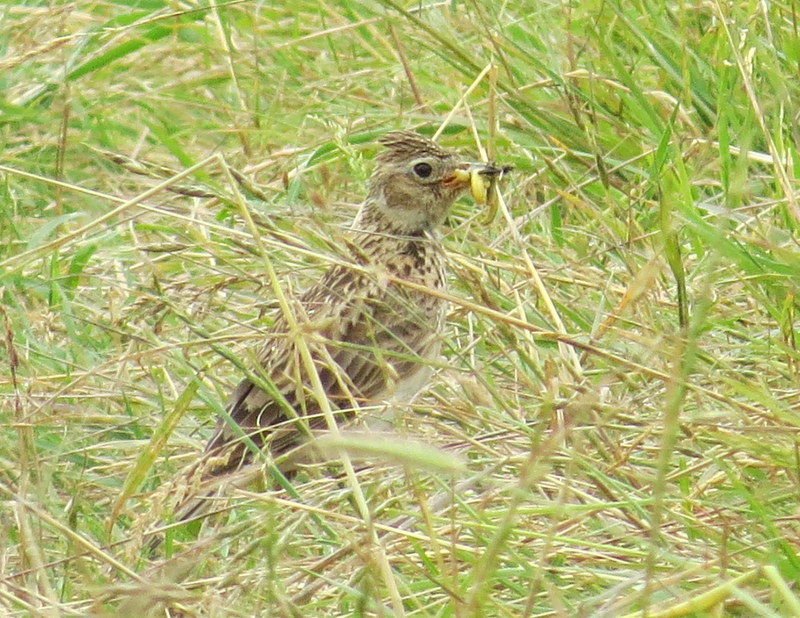
However, we hadn't entirely given up on birds. The sky was full of Swifts, our highest count being 46. We also saw a Hobby, and two Sparrowhawks. A Skylark showed well as it collected grubs for its fledglings.

Skylark
All in all an excellent start to autumn!

Friday, 19 June 2015

Friday June 19

A cloudy morning with some sunny intervals, and rather cool for June.

This morning I carried out my last transect survey of the season looking principally for birds. Despite this, the first interesting creature I saw was an insect, my first Common Emerald Damselfly of the year.

Common Emerald Damselfly
Subsequently the temperature struggled to get warm enough to encourage many insects onto the wing. The birds were a little predictable, the highlights being a rapid fly past by the adult Hobby, a Cuckoo still singing in the distance, a variety of warblers including the reverend Reed Warbler, Sedge Warbler, and two Lesser Whitethroats, and four immature Mute Swans which flew around before trying to land on the pool, where they were quickly seen off by the resident pair.

Mute Swans
The flashes contained two Little Ringed Plovers, a Redshank, and a juvenile Little Owl in the usual tree, while the pair of Little Grebes remain on the pool.

With little else to divert me I took the opportunity to photograph a few plants for my long neglected Flowers of Morton Bagot page.

Tuesday, 16 June 2015

Tuesday June 14

An ideal evening for a visit to the patch, light, but not too sunny, and warm with very little wind.

I was greeted by the sound of a Reed Warbler singing away. This bird seems to have an aversion to singing on a Sunday, I may have to dub him the Reverend Reed Warbler. Moving on to the pool, a single Sedge Warbler sang briefly there.

At this time of year you start to learn the outcomes of the breeding attempts of the local birds. I was particularly pleased to confirm that the anxious calls of the female Lapwing at the pool did indeed mean that she had a chick to care for.

Lapwing chick
This particular chick was quite well grown, but it has a very uncertain future. It never ceases to amaze me that any ground nesting waders manage to raise young to the fledging stage.

At the flashes the presence of two adult Shelducks and four adult Little Ringed Plovers may point to an unsuccessful outcome, but there is still a single Redshank present. A Little Owl started calling and suddenly two appeared in the oak tree. One was pursuing the other very vocally, and I am pretty sure that they were an adult and a juvenile.

juvenile?
adult?
They looked quite different from one another, the juvenile being more chocolate brown and hardly spotted on its crown. I have always assumed they were breeding, but it was good to see some evidence for it.

Sunday, 14 June 2015

Sunday June 14

A sunny start, but soon clouding over. Dave opted for another look at the Melodious Warbler, so I was on my own.

I decided on a bit more surveying, noting that the Reed Warblers have disappeared again. On my way to the flashes I spotted a distant Hobby hawking over trees just over the ridge of the field behind the pool. The recent rain has half filled the nearest flash, which contained a Redshank, while the vegetation obscuring the further flash has grown another half inch.

Walking back along the streamline I was keeping my eye open for the Hobby in case it was perched in one of the ashes, and I got lucky.

The adult Hobby
It had been sitting with its back to me, and I got a shot when it turned its head before it flew off in a panic. A few more butterflies were out, and I recorded Speckled Wood, Small Heaths, Peacock, and my first Red Admiral, Meadow Brown, and Large Skipper of the year.

Large Skipper
But the best was yet to come. I could see a few Swifts wheeling around, high in the sky, and decided to count them. I got to 14, when a Morton Bagot tick flew through them, a Common Tern. This was the first tern of any species I have seen here, although it's actually the second for the patch, Jon Yardley having seen one a couple of years ago. I decided to try for a record shot, so took three shots of sky. The problem being that the bird was too high up to be visible through my lens. Through the binoculars I could see that it had briefly circled with the swifts, and then continued languidly north.

I zoomed in on the images at the back of the camera, but could see only a few blurred Swifts, and was about to delete the shots when I discovered I had actually captured it in the second image, (either that or a passing gnat). So here it is, patch gold.

Common Tern (it's in there somewhere)


Friday, 12 June 2015

Friday June 12

So, back to the patch. Yesterday's excitement gave me a renewed enthusiasm for looking. If a rarity can turn up in the middle of nowhere at Cornets End, why not here?

A rather cloudy start, the temperature gradually warmed up leaving the day distinctly sultry by late morning. An early boost to the morale was the discovery that the Reed Warbler was not only present, but also showing quite well.


I later found that there were at least two present.

I decided to resume my censusing, walking along the road to Church Farm. Highlights were a calling Cuckoo, and a couple of Coal Tits.

Down at the flashes I discovered that the nearest was nearly dry, and the furthest was largely screened by long grass. It did contain two drake Teal though. Waders were represented by a Redshank and a Snipe. A Little Owl called, and showed quite well.


At the pool the water level is also lower, perhaps bringing the promise of waders when the return passage gets under way next month. For now it contained three adult Little Grebes.

Walking back to the car, I disturbed my first Painted Lady of the year.


At the dragonfly pools the water is continuing to evaporate away, and no dragonflies were visible. Perhaps they have failed to survive the drought. The damp mud was good for the House Martins industriously collecting it for their nests, and also exposed a number of mammalian footprints.

Badger tracks?
Brown Rat tracks?
I think I'll stick to birds.