Thursday, 12 January 2023

Thursday January 12 (again) - Twitching a Kittiwake

 You know how it is. You've been out birding in the morning and have written everything up. Time for a nice relax on the sofa. The phone bleeps, but you don't really notice. An hour later it's getting gloomy, you look at your phone. It says Kittiwake at Earlswood a.t.m. The message is timed at 14.23, its now 15.35. Stick or twist?

I twisted. At the end of the road I considered turning round, there had been no news for an hour. I pressed on and arrived at 15.55. The lakes are full of water. My first visit this year, so I tick Great Crested Grebe.

I scan Engine Pool. Nothing. Two Black-headed Gulls are heading away. I must have missed it. I walk across the causeway and half way down Engine Pool. Further scans fail to produce the bird or any birders. I give up, it's obviously gone. Back at the causeway there's a Whatsapp message from the finder Matt. It says "it's the only gull still present, it's by the eastern floating island".

I turn around and gather pace. Half way down I scan the vicinity of the nearest floating island. Nothing. He must mean the other island. I hurry on and scan the area round the second island. Nothing. I spot Matt and walk towards him. "It's gone hasn't it" I say. Matt looks over my right shoulder. "No, it's still here". Good grief.
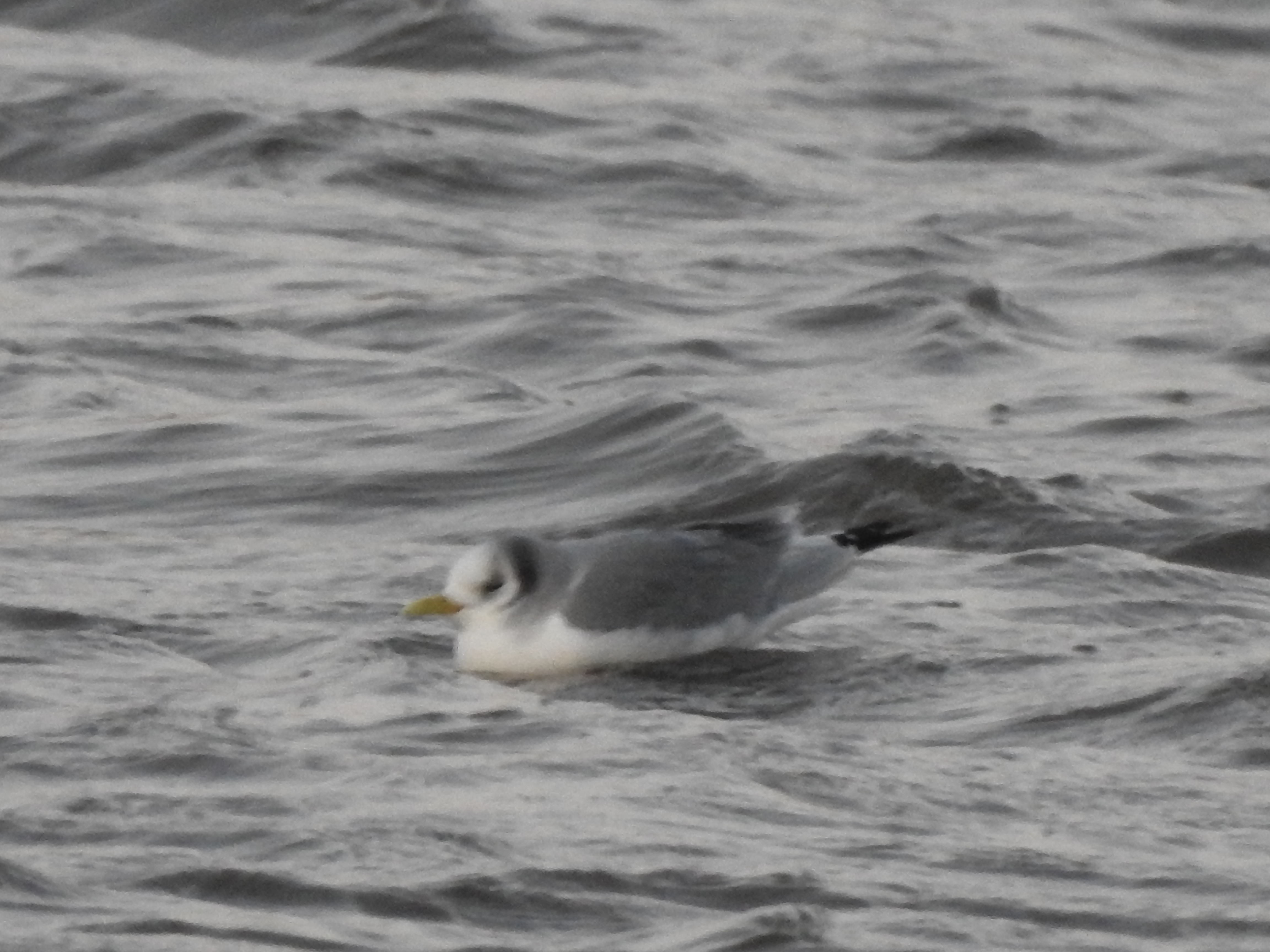
Kittiwake

I saw it at last, but I don't think I deserved it.

Thursday January 12 - Jurassic birding

 The big news this week concerns a Hen Harrier or two filmed near Morton Bagot, but not recently. 

The exciting discovery dates back to the winter of 1992/93 when film-maker Jeremy was active locally. The footage is fantastic and can be viewed here. It covers the period October 19 1992 to March 15 1993. The sightings began at Badbury Hill, a kilometre east of Morton Bagot, and resume at Lower Spernall and Middle Spernall, ending with the last sightings at Spernall Park. 

Exactly how many birds were involved is uncertain. All the footage is of female Hen Harrier(s), but Jeremy did also see (but not film) a male over nearby Stoopers Wood. What all this land has in common is that back then, in the Jurassic, it was farmland managed for shooting. No doubt Finches and Buntings abounded in the Quinoa planted with Pheasants in mind, and the profusion of small birds would have tempted the Hen Harriers to stick around. Nowadays it is all owned by Heart of England Forest, so its fantastic in the spring and summer for biodiversity, but maybe not quite as good in the winter. 

Many thanks to Jeremy for sending me the footage.

I wish we could have the best of both worlds, plenty of forest and also land for the Quinoa and other Pheasant-cover, but without releasing any Pheasants. Perhaps there would be more finches etc in the winter to interest birders (and Hen Harriers, Great Grey Shrikes etc) and fewer Foxes and Crows, so more Curlews and Lapwings could have successful breeding seasons. 

Anyway, jumping off my soap box, I resumed my exploration of the Arrow today. I manage to scramble my way to Alvechurch STW, approaching from the north. I needn't have bothered. It was hopeless. But half way back to the car was something which made it all worthwhile. I was counting Black-headed Gulls flying south and had just got past 150 when I noticed a goose in their wake. Assuming a Greylag for the day-list I dutifully raised my bins and discovered it was actually an Egyptian Goose. I didn't see one at all last year, so a scramble for the camera ensued. By the time I got a shot the bird was heading into the distance, so I got just one barely identifiable image. 

Egyptian Goose

I would contend that if you look very carefully you can just about make out the snow white upperwing coverts. Not my best effort I will admit.

Before the rain resumed, I had time to walk a footpath south-west from Lye Bridge which skirted a hitherto unknown fishery with just enough phragmites to support a couple of wintering Reed Buntings.

Reed Bunting

I also added a couple of Grey Wagtails to the local year list.

Sunday, 8 January 2023

Sunday January 8 - Morton Bagot

 Another day of mild south-westerly breezes. Time for another patch visit. Dave joined me as usual, and we got off to a bright start when we located the Barn Owl just visible in its roosting spot. 

Between 30 and 40 Redwings were flying around, but year-ticks were awaiting us at the flash pool. A Little Egret was standing with 15 Teal on the furthest flash, and eventually a flock of 25 to 30 Lapwings joined them. The Egret later flew towards the Morton Brook where it showed extremely well.


Little Egret

A little further on we found another creature which was worth a shot or two. A Red Fox was patiently awaiting a movement in the grass from a small mammal it had evidently heard. I took some video hoping it would pounce, but after five minutes of non-activity I gave up. I won't subject you to that, but will show the moment it finally looked round. We were downwind so it was unaware that we were there.

Red Fox

We did quite well for mammals, seeing Brown Hare, Muntjacs, a Roe Deer, and more unusually four Fallow Deer, but that was about it for another weekend.

Friday, 6 January 2023

Friday January 6

Since my last post I've added just one new bird for the year, a female Blackcap in our garden. 

Tony has been doing a bit of ringing at Netherstead, targeting the top pool where all the Pied Wagtails had roosted. The morning he did it produced instead an excellent tally of eight Reed Buntings caught. He also saw a Grey Wagtail which remains stubbornly off my list for the year.

Female Reed Bunting - per T Kelly

Today I decided to stick to my guns and potter around in the next section of the River Arrow, just east of Alvechurch. Things started well when I had an excellent view of a Kingfisher, and was then invited by a friendly chap, Joe, to explore his garden and woodland where I'd just seen it. In a perfect world this would have led to the discovery of something unusual, but I'm afraid it did not. 

It's always nice to talk wildlife to people when you are out birding, and today was most notable for the number of friendly folk who stopped to chat.

The River Arrow at Alvechurch

Just south of where I took this photo lies the Alvechurch Sewage Treatment Works. Numerous Black-headed Gulls were commuting between it and Bittell Reservoirs five miles to the north. I've checked the map, and I can't see any way of getting close to it on public roads or footpaths.

I'm going to need a friendly sewerage worker!

Wednesday, 4 January 2023

Wednesday January 4 - The streaming begins

 Towards the end of last year I decided that this year would have a theme, and that would be river valleys...within the Circle of course.

This morning I made a start, at the beginning (nearly) of the River Arrow. It had never really occurred to me, before, that the tiny stream which trickles into the Mill Shrub just north of my Circle is actually the start of the River Arrow.

I decided to pick it up along the Old Birmingham Road just north of Alvechurch. I wasn't able to follow it north towards Lower Bittell as it flows across private land, but a short detour saw me rejoin it on the Canal Dam by the reservoir.

The Arrow as it flows under the Old Birmingham Road

My most unexpected find came in the field which last year hosted the Old Birmingham Road Flash. Today it was dry, but to my surprise it harboured 15 Common Snipe.

Common Snipe(s)

The reservoir proved a bit of a disappointment. A drake Mandarin was presumably the bird present last autumn, but I couldn't see any Teal, Wigeon, or Great Crested Grebes. Just a Gadwall and a few Little Grebes, Tufted Ducks, Coots, Grey Herons, and Mute Swans to move the year-list on. There was a lot of fishing activity.

A Kingfisher was calling from the canal moat which surrounds the reservoir. I then walked along the canal to Alvechurch and looped back to rejoin the Arrow just south of where I'd started.

About 20 years ago I twitched a juvenile Dipper which had been found by Mike Inskip along the road from Cofton Hackett to Bittell Reservoirs. It wasn't well and was picked up and released on the Arrow just north of the Mill Shrub. 

Maybe there is still a pair of Dippers lurking on the streams running into the Arrow north of Redditch. I aim the find out.

Monday, 2 January 2023

Monday January 2 - Unfinished business

 A sunny calm day passed without me setting foot outdoors....until just before 16.00 when I decided to return to Morton Bagot to try to see the Barn Owl.

Walking down from the road, along the Millennium Way, you reach a small metal gate. Step through that and you are faced with the Pool Field. There is no need to go any further.

The top pool, bordered by reed-mace

A pleasant 45 minutes was spent counting Pied Wagtails as groups of them flew in, and eventually dropped into the reed-mace bordering the top pool and a smaller one nearby. I counted 52 individuals which comfortably beats my previous record count for the site.

Eventually the Barn Owl appeared, although it spent most of its time out of sight, quartering the Chat Field. The hedgerows were also occupied by numerous thrushes; Redwings, Song Thrushes, and Blackbirds which were also trying to roost.

The evening was to have one final twist. Driving home I spotted a Woodcock as it banked prior to landing (probably) in fields at Haye Pasture near the Dog Island.


Sunday, 1 January 2023

Sunday January 1 - Morton Bagot

 So here we are, another year dawns. As is traditional I spent the day at Morton Bagot, and as it was a Sunday, Dave was able to join me.

Unusually for an alldayer, I missed the darkness before dawn. However I still had an hour of birding before Dave rolled up, putting it to good use by ticking off Siskin, Redpoll, and Yellowhammer all as fly-overs.

The morning was mild and sunny with an increasingly irritating south-westerly breeze. We strolled to the pool field, where all the little scrapes are now full of water. A Stonechat popped up before we waded into the damper bits. We were soon rewarded with two Common Snipe, and eventually a small area containing five Jack Snipe, the most for several years. Needless to say, despite proceeding with great caution, we failed to see any of them before they took off silently at close range.

The Flash field initially looked birdless, but eventually we found 42 Mallard which looked suspiciously like cage-reared cannon fodder, and a flock of 27 very nervous Teal. A single Cormorant was sitting in a tree, and during the afternoon I saw two more.

As we walked back along the brook Dave glimpsed a Red Kite, so we detoured to the top of the ridge where we were pleased to see it still present.

Red Kite

The last day-tick before we got back to the cars was a single Linnet, species number 51.

After a couple of hours break, I was back in the field. The afternoon was cloudy, but at least the wind had dropped. I concentrated my efforts along the edge of Bannams Wood before heading down to the flash and then completing a huge circuit via Netherstead and Bannams again before returning to my car, which I'd parked at the church.

This considerable effort was rewarded with just six more species: Green Woodpecker, Jay, Coal Tit, Treecreeper, Kestrel, and finally a couple of hooting Tawny Owls in the half-light at about 16.30.

There was time for one unexpected discovery. At least 32 Pied Wagtails heading to roost over Netherstead. A previously unrecorded phenomenon here.

Last year I saw 60 species on day one, this time 57. So I'm a bit down, total-wise, but its a marathon not a sprint.

PS: While I was watching the Pied Wagtails heading to roost over Netherstead, John Chidwick was watching a Barn Owl hunting over the pool field and witnessed dozens of Pied Wagtails flying in to roost in the bulrushes...so that's where they were going.