Friday, 6 November 2020

Friday November 6 - that morning after feeling

 Another bright sunny morning, this time with a hint of south-easterly in the breeze. I was up with the lark, despite having established last night that the ringers would be trapping somewhere else this morning.

In the absence of their nets, and particularly their feeders, relocating the Mealy Redpoll soon started to feel like a fool's errand. In fact it was hard to find any Redpolls at all, and in the end I had to settle for a handful of fly-overs.

Never mind, it was still glorious. 

Looking east towards Bannams Wood

For once, some of the local winter visitors were willing to pose for me.

Meadow Pipit

Redwing

One or two less usual visitors turned up. Two female-type Wigeon joined the six Teal on the nearest flash, three Mute Swans did a brief fly round, and a Lapwing by the furthest flash was the first for weeks. I also noticed three Buzzards tucking into something, probably the ailing Canada Goose seen on Wednesday.

While I was lurking under the trees by the nearest flash several birds landed conveniently close, having clearly not noticed me.

Mistle Thrush

Chaffinch

Three Siskins feeding in an alder managed to defy by best efforts to add them to this morning's gallery.

It may not be the best patch in the world for rarities, but I feel very lucky to have Morton Bagot on my doorstep.

Thursday, 5 November 2020

Thursday November 5 - The ringers trap the big one

OK, its not a Red-flanked Bluetail, but its pretty decent.

Tony and Leigh managed to catch a Mealy Redpoll this morning, and have sent me some gripping photos. They also netted a Blackcap.

Mealy Redpoll - per Tony Kelly

 
Mealy Redpoll - per Tony Kelly

My decision to go there on Wednesday instead of Thursday is now looking pretty poor. Mind you, I probably walked past it oblivious of its presence.

In case anybody is wondering what a Mealy Redpoll is, you're not alone. For about half of my birding life, Lesser Redpoll was treated as the western European (mainly British) race of the Scandinavian Mealy Redpoll, so not a species. This meant we didn't have to care about them.

Then the taxonomists split them, and they became a species, confusingly calling the Scandinavian one the Common Redpoll. This created all kinds of problems. Quite apart from their similarity to Lesser Redpoll (they are bigger and paler), calling them Common Redpoll caused some  birders to confuse the names with the British Lesser Redpoll, which is the common one in the UK.

Are you keeping up? It gets worse. I thought that in the last couple of years they had been considered for re-lumping. That could have meant we would be back to square one, and that they were just a race again. Frankly I'm not sure whether that happened though, and it may have survived as a species.

Dave and I did see a definite Mealy Redpoll here one November a few years ago, and it looked just like the bird pictured. However a few years later, with record numbers of Lesser Redpolls, I saw a bird or two which looked Mealy-like. Unfortunately Dave was never really convinced, and it is possible that feather wear which tends to affect all Redpolls later in the winter, may have been leading me astray.

Blackcap - per Tony Kelly

Blackcaps on the other hand, are easy. A nice late record.

The full list was as follows:

Coal Tit 1
Blue Tit 27 (10)
Great Tit 7 (2)
Long-tailed Tit 6 (2)
Blackcap 1
Goldcrest 3 (1)
Wren 3 (1)
Redwing 1
Dunnock 1
Greenfinch 17
Lesser Redpoll 12 (1)
Mealy Redpoll 1
Goldfinch 5

They also noted substantial numbers of Woodpigeons flying overhead.

Wednesday, 4 November 2020

Wednesday November 4

 I picked today for a visit because the wind had abated, and the fog is not due until tomorrow. As far as that went I got it right. Wall to wall sunshine after a frosty start and a very light westerly breeze.

November can be good. November can be good. If I keep repeating this mantra, I tell myself, it will come true. However, as I hope the orange skinned halfwit across the pond will find out, repeatedly saying something will happen doesn't necessarily mean that it will.

So, just in case, I photographed the first bird which stood still long enough.

A shame about the traffic cones

It was probably just as well, because this was another pretty steady visit.

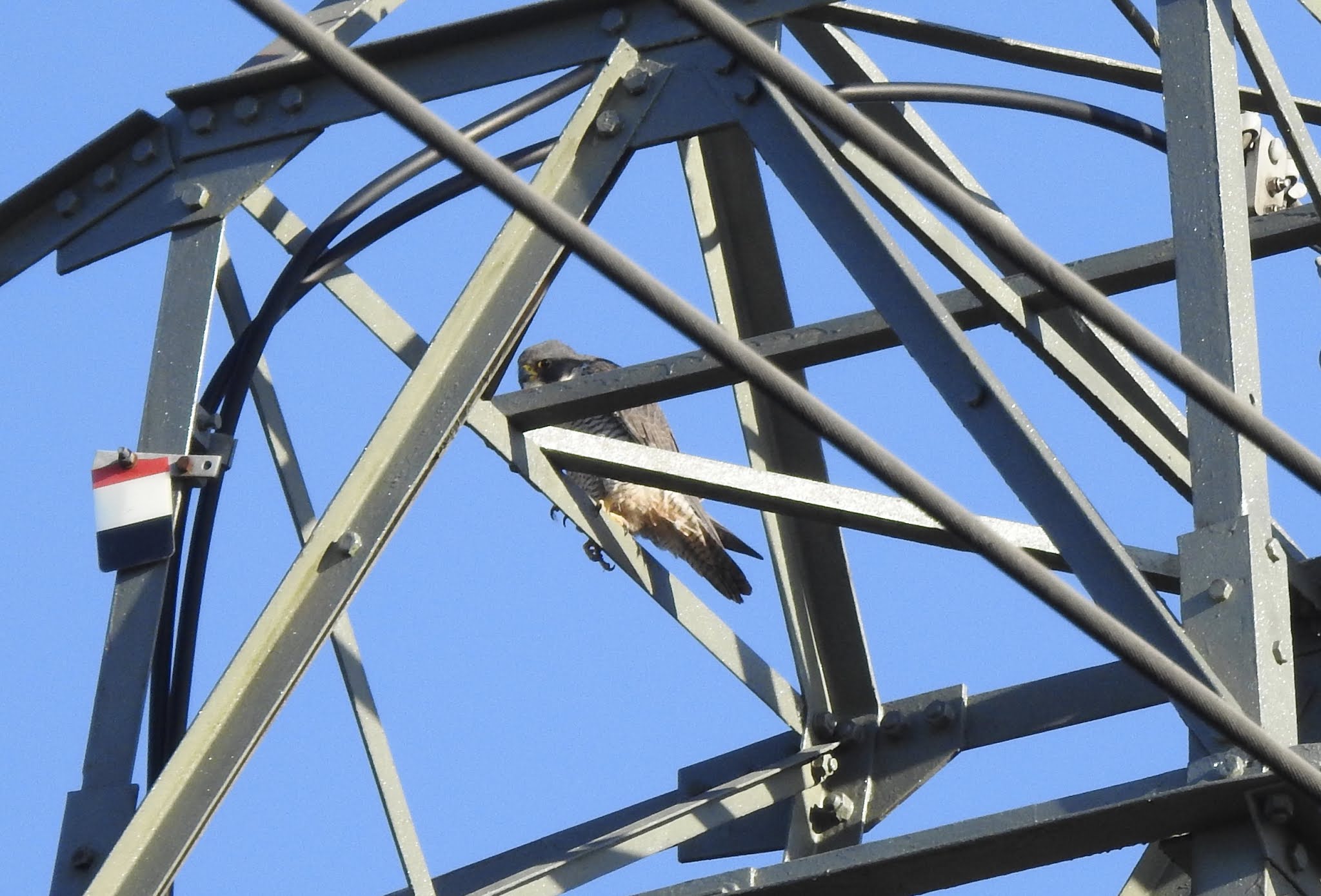
A Peregrine was perched on the pylons for the first time for a while, although it didn't make for a particularly attractive subject. At least it can be seen to be an adult.

Peregrine

There was a certain amount of overhead movement, but this chiefly related to Woodpigeons (550 south-west) and Starlings (100 south-west). All the usual winter species were present in moderate numbers, and as with my last visit, the highlight was supplied by Brambling. The first one was an unseen flyover by the main road, but later on I heard more calls along the Morton Brook, and saw two more flying by with Chaffinches. Finally, a fourth bird perched up on a distant Ash, and I managed a record shot.

A male Brambling

As for the rest of the visit, a kick through the marsh revealed no Snipe of any species although the ground under my feet was quite soggy. The flash field was again dreadful, just five Teal and a possibly injured Canada Goose. Whether the latter had been shot, it might just have been having a sit down, I don't know. I haven't seen any evidence of shooting this year, except circumstantially from the paucity of wildfowl.

There's always next time, November can be good.

Monday, 2 November 2020

Belated ringing update - re 23/10/20

 What with rare birds to see and some email issues, I have overlooked the results of a trapping session which took place here on Fri 23rd October. This brief post will put that right.

Tony and Leigh caught 70 birds as follows:

Blue Tit 2 (1), Great Tit 5(1), Goldcrest 1, Wren 1, Blackbird 1, Fieldfare 2, Redwing 1, Dunnock 2 (2), Greenfinch 12, Lesser Redpoll 37, Goldfinch 5 (2), Reed Bunting 1

They also mentioned that a Great Tit they had ringed here on 24 June 2020 had been retrapped at Arrow Valley culvert on 30 Sept 2020 by the team who a month later caught the Red-flanked Bluetail.

I have also heard from them that one of their controlled Lesser Redpolls had been ringed on Cannock Chase earlier in October. Unfortunately I seem to have lost that original email and I can't remember the precise details.


Sunday, 1 November 2020

Sunday November 1 - reality check

 The new month dawned fresh and mild. October is in the rear-view mirror and Dave was able to join me for this morning's tramp round. 

Over the last few weeks I have been spoilt locally with rarities like Red-flanked Bluetail and Pallid Harrier, while Dave managed to twitch a Yellow-browed Warbler on the outskirts of Coventry. Even Morton Bagot came to the party, in a small way, with a Quail.

It would be nice to think that all this excitement will continue, but let's face it, it won't. Windy days are particularly unforgiving here, and we had almost nothing to show for three hours of effort.

Obviously there were birds, but they struggled to brighten the day. Four Cormorants flew over, five Stonechats remain, a Grey Wagtail was around the Morton Brook, and the hedgerow beyond provided shelter for 15 Greenfinches, scarcer here of late.

Not a Red-flanked Bluetail

We did detect one noteworthy bird. As we kicked through the weedy field in the faint hope that the Quail might still be here, we independently identified a single call note as belonging to a Brambling. It didn't call again, and we didn't see it, but there had been several small parties of Chaffinches flying west so it seemed not unreasonable to count it.

This gives me the opportunity to mention that I have completed The Project. Ever since the BTO (British Trust for Ornithology) devised an on-line data entry site called Birdtrack, I have been an enthusiastic supporter. All my records of birds have been entered into their database since 2005. But I go back a lot further than that, and although I have also always submitted stuff to County Recorders, the raw data was only in my notebooks.

Not any more. The Project involved submitting all my old records back as far as the day I started writing stuff down into Birdtrack. So they now have all my records since November 1978, and I get a lot back.

I can, for example, tell you that my first Brambling was at Blackpill in Swansea on 24 January 1979, and that today's was my 311th record. I can also tell you that since my first visit to Morton Bagot in 2007, I have recorded 97 here, and that I have seen at least one on the patch every year to date. However, the best years were from 2010 to 2013 when arable farming dominated, and the maximum count of 43 came on 30 November 2011.

I am truly the nerd's nerd.

And having got that out of my system, here are some horses.


All I need now is a new project.

Saturday, 31 October 2020

A few more moths

 It's the penultimate weekend of the Garden Moth Survey and for a change it was pretty mild.

Determined to outfox the next door Wasps I turned the light off and hauled the trap inside an hour before it started to get light. The plan worked well and as dawn approached I noticed a moth on the doorframe of the utility room. It was something new.

Checking it against the books I established it was a Beaded Chestnut. A bit more research revealed that the species is common, and is very similar to Lunar Underwing, which is also common.

Beaded Chestnut

This is only my third year of moth trapping, and so it's still exciting to peer into the trap to see what's there. I also still experience an unsettling feeling that maybe I am making some fundamental error causing me to overlook something. Learning that Beaded Chestnut is a common moth and knowing that I have recorded quite a few of the confusion species, makes me wonder if I have misidentified some Lunar Underwings in the last few years. Hopefully not.

I only caught eight moths of five species, the full list being: Light Brown Apple Moth 2, Red-green Carpet 3, Double-striped Pug 1, Vapourer 1, and Beaded Chestnut 1.

These were the first Red-green Carpets I had seen since April and they included a particularly green one which caused a flurry of research.

A normal coloured Red-green Carpet

A very green Red-green Carpet

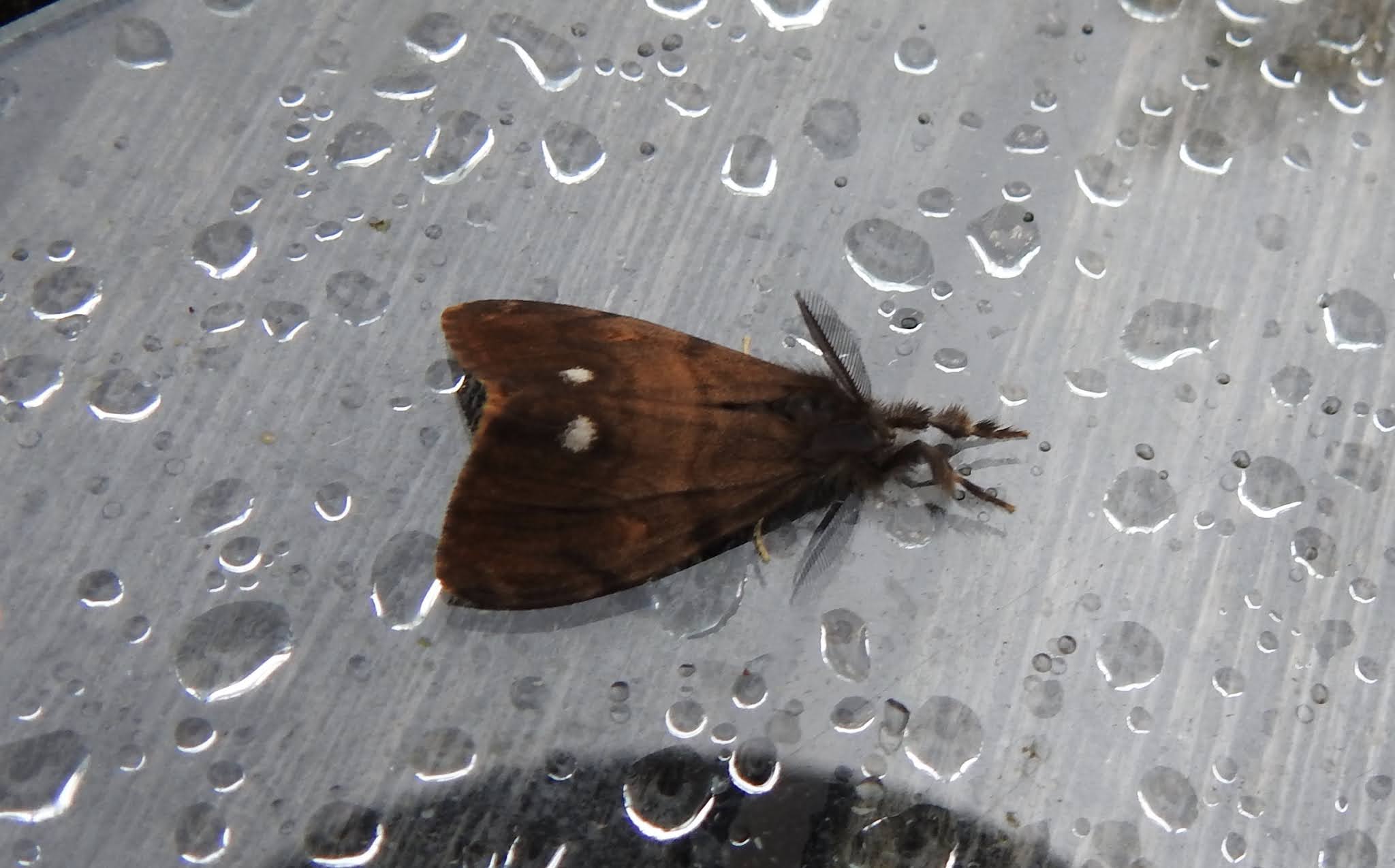
The other notable moth was the Vapourer. It was quite a late one, and also only my second this year.

Vapourer

The light was very poor for photographing the moths this morning, but once the sun came out this afternoon one or two of the above looked ready to leave, so I let them take their chances.

Thursday, 29 October 2020

Thursday October 29 - Lion Wood

 At the risk of sounding like the pessimist I am, I poked my head outside last night and saw clear skies and  the moon. This was not good. It meant that the Red-flanked Bluetail may have also looked up and thought "time to be off".

The fact is that most passerines migrate at night, and they prefer to see stars. It is assumed that the night sky plays some part in navigation, although there are plenty of other cues thought to be used. Whatever it was using, the Bluetail had got it all wrong and had turned up thousands of miles from its intended destination in the Indian subcontinent or even further east.

However, hope springs eternal, and I joined thirty or so of the usual suspects in the wood this morning just after first light for another go.

Someone had brought a secret weapon, and after an hour of standing around near the spot where it was twice seen yesterday, it was deployed. The playing of tapes to attract birds can be frowned upon, and it is not fair on the birds during the breeding season. The chap with the tape was very good, and asked everyone if they had any objection. Of course we didn't.

So the call was played for about 30 seconds. I thought "so that's what they sound like". Further down the track a couple of birders, the Peplows I think, got a bit excited having been unaware of the plan. I was impressed that they knew the call.

The upshot was that nothing happened. Optimism plummeted. The bird must have gone. The next hour was spent chatting, scanning, and eventually wandering about. 

When we started photographing each other (in case we never see each other again, someone said) I knew that pessimism had won the day.

From the left: Graham Mant, John Sirrett, and Mike Inskip

Actually meeting up with old friends is a large part of the attraction of twitching. 

But then a text message arrived at 11.00. It had been found. Three hours later, after chasing false alarm Robins, Nuthatches, and probably leaves, I followed directions (behind the birch) and saw the bird for about two seconds.

A slender pale chat with orange flanks ... er that's it. Good enough for a tick, but I'd like longer views.

So I was tempted to go back again. Finally, at 16.40 it landed in front of the remaining crowd and I could see its blue tail. I took a photo, but in a gloomy wood under grey skies late in the afternoon I had left the setting on "birdwatching". This was a mistake. The resulting shot is so terrible I cannot bring myself to exhibit it here. I realised my mistake, switched to "auto" and took another shot about a second after the bird flew out of frame.

I'm all Blue-tailed out. It'll be back to moths and Morton Bagot for the foreseeable future.